
Tweezer Tops & Bottoms; Spotting Forex Reversal Signals
Learn how to identify potential trend reversals using tweezer top and bottom candlestick patterns in forex trading. Understand the formation, implications, and how to use them effectively.
Imagine you're hiking in the mountains. You reach a peak, and the path suddenly turns sharply downwards. That peak, in trading terms, could be a 'tweezer top,' signaling a potential reversal. Similarly, reaching the bottom of a valley and seeing the path turn upwards could be a 'tweezer bottom.' These candlestick patterns can provide early clues about potential shifts in market direction.
- Tweezer tops and bottoms are reversal candlestick patterns that can indicate potential trend changes.
- Tweezer tops occur after an uptrend, while tweezer bottoms appear after a downtrend.
- These patterns are most reliable when confirmed by other technical indicators and occur at significant support or resistance levels.
- Understanding these patterns can enhance your ability to identify potential entry and exit points in the forex market.
What Are Tweezer Tops and Bottoms?
Tweezer tops and bottoms are candlestick patterns used in technical analysis to identify potential trend reversals. They are characterized by two candlesticks with nearly equal highs (for tweezer tops) or lows (for tweezer bottoms). These patterns suggest that the previous trend is losing momentum and a reversal might be imminent.
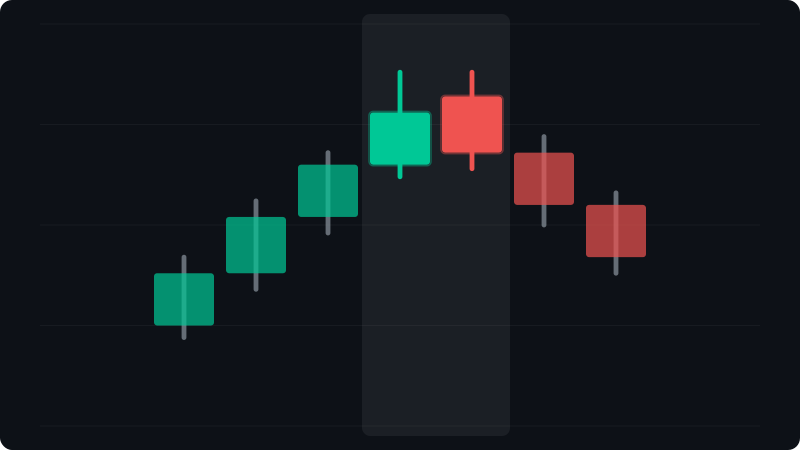
Tweezer Tops: A bearish reversal pattern consisting of two candlesticks with nearly the same high, indicating the end of an uptrend.
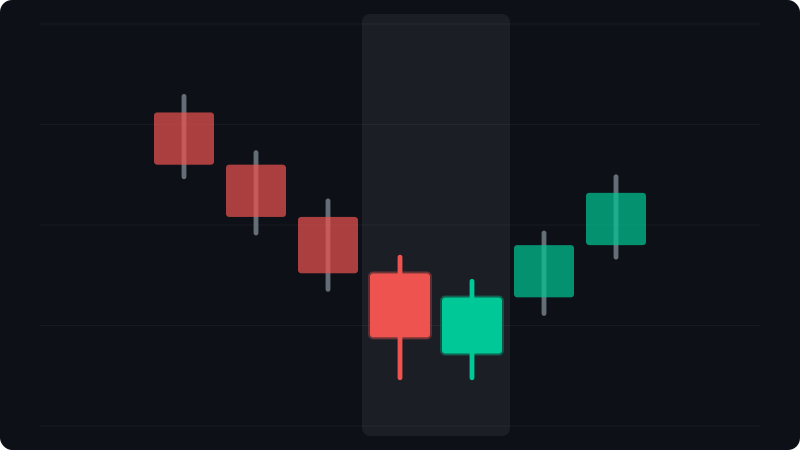
Tweezer Bottoms: A bullish reversal pattern consisting of two candlesticks with nearly the same low, indicating the end of a downtrend.
Think of it like this: imagine two attempts to push a heavy box further up a ramp. If the first attempt reaches a certain height, and the second attempt only reaches the same height, it suggests the pushing force is weakening. In trading, this weakening force can signal a potential reversal.
How Tweezer Patterns Work; Spotting the Signal
Tweezer patterns are relatively simple to identify, but understanding their context is crucial. They are most effective when they appear at key support or resistance levels, or when confirmed by other technical indicators. Here’s a step-by-step breakdown of how they work:
- Identify the Existing Trend: Determine whether the market is in an uptrend (for tweezer tops) or a downtrend (for tweezer bottoms).
- Look for Equal Highs/Lows: Find two consecutive candlesticks with nearly identical highs (tops) or lows (bottoms). The bodies of the candles can be different colors (one bullish, one bearish), but the equal highs/lows are essential.
- Confirm with Other Indicators: Use indicators like the RSI (Relative Strength Index) or MACD (Moving Average Convergence Divergence) to confirm the potential reversal. For example, a tweezer top forming near an overbought RSI level strengthens the signal.
- Consider Volume: High volume during the formation of the tweezer pattern can add more weight to the signal. Increased selling volume during a tweezer top, or increased buying volume during a tweezer bottom, suggests stronger conviction behind the reversal.
Why does this matter? Because identifying potential reversals early can allow you to enter trades at more favorable prices, maximizing your potential profit and minimizing your risk. Imagine catching the start of a new trend instead of jumping in late after the trend has already matured.
Real-World Examples: Tweezer Patterns in Action
Let's look at a couple of hypothetical scenarios to illustrate how tweezer tops and bottoms might play out in the forex market.
Example 1: Tweezer Top on EUR/USD
Imagine EUR/USD has been in a steady uptrend for several days. The price reaches 1.1000. Two consecutive candlesticks form with nearly identical highs at 1.1000. The first candle is bullish, and the second is bearish. The RSI is also showing overbought conditions (above 70). This suggests a potential tweezer top formation. A trader might consider opening a short position (selling EUR/USD) near 1.0990, placing a stop-loss order slightly above the high of the tweezer top (e.g., at 1.1010) to limit potential losses if the price continues to rise. The trader could then target a profit level at a previous support level, such as 1.0950.
Example 2: Tweezer Bottom on GBP/USD
Now, consider GBP/USD in a downtrend. The price falls to 1.2500. Two consecutive candlesticks form with nearly identical lows at 1.2500. The first candle is bearish, and the second is bullish. The RSI is showing oversold conditions (below 30). This suggests a potential tweezer bottom formation. A trader might consider opening a long position (buying GBP/USD) near 1.2510, placing a stop-loss order slightly below the low of the tweezer bottom (e.g., at 1.2490) to protect against further declines. The trader could then target a profit level at a previous resistance level, such as 1.2550.
These examples are hypothetical, of course, but they illustrate how tweezer patterns can be used to identify potential entry points in the forex market. Remember always to use proper risk management techniques, including stop-loss orders, to protect your capital.
Common Mistakes and Misconceptions
Beginners often make several common mistakes when using tweezer patterns. Understanding these pitfalls can help you avoid them and improve your trading accuracy:
- Ignoring the Trend: Tweezer patterns are reversal signals, so they are most effective when they appear after a well-defined trend. Using them in a choppy, sideways market can lead to false signals.
- Not Confirming with Other Indicators: Relying solely on the tweezer pattern without considering other technical indicators can be risky. Always confirm the signal with indicators like RSI, MACD, or volume analysis.
- Setting Inappropriate Stop-Loss Levels: Placing your stop-loss order too close to the entry point can result in being stopped out prematurely due to normal market fluctuations. Ensure your stop-loss is placed at a level that allows the trade some room to breathe but still protects your capital.
- Overtrading: Seeing a tweezer pattern doesn't automatically mean you should enter a trade. Wait for confirmation and ensure the trade aligns with your overall trading plan and risk tolerance.
A common misconception is that all tweezer patterns are created equal. Some are stronger signals than others, depending on the size of the candlesticks, the volume during their formation, and their location relative to key support and resistance levels. The larger the candlesticks and the higher the volume, the stronger the signal tends to be.
Practical Tips for Using Tweezer Patterns
Here are some practical tips to help you effectively incorporate tweezer patterns into your trading strategy:
- Focus on Key Levels: Look for tweezer patterns forming at significant support or resistance levels. These levels often act as turning points in the market, making the tweezer pattern more reliable.
- Use Multiple Timeframes: Analyze the pattern across different timeframes. A tweezer pattern that appears on both the hourly and daily charts is a stronger signal than one that only appears on the hourly chart.
- Practice Patience: Don't rush into a trade as soon as you see a potential tweezer pattern. Wait for confirmation from other indicators and ensure the setup aligns with your trading plan.
- Keep a Trading Journal: Track your trades and analyze the performance of your tweezer pattern setups. This will help you identify what works best for you and refine your strategy over time.
Why is this so important? Because mastering even a few key patterns and strategies is more effective than trying to learn everything at once. By focusing on key levels, using multiple timeframes, and practicing patience, you can significantly improve your trading results.
Frequently Asked Questions
How reliable are tweezer patterns as reversal signals?
Tweezer patterns can be reliable, but they are not foolproof. Their reliability increases when they appear at key support or resistance levels and are confirmed by other technical indicators. It's essential to use them as part of a broader trading strategy rather than relying solely on the pattern itself.
What timeframe is best for identifying tweezer patterns?
Tweezer patterns can be identified on various timeframes, from short-term (e.g., 15-minute) to long-term (e.g., daily or weekly) charts. Longer timeframes tend to produce more reliable signals, but shorter timeframes can still be useful for scalping or day trading strategies. It's a good practice to analyze the pattern across multiple timeframes for confirmation.
Can tweezer patterns be used in combination with other candlestick patterns?
Yes, tweezer patterns can be used in conjunction with other candlestick patterns to strengthen your trading signals. For example, a tweezer top forming near a bearish engulfing pattern can provide a stronger indication of a potential reversal. Combining different patterns can increase the probability of a successful trade.
What are the best indicators to use for confirming tweezer patterns?
Several indicators can be used to confirm tweezer patterns, including the Relative Strength Index (RSI), Moving Average Convergence Divergence (MACD), and volume analysis. The RSI can help identify overbought or oversold conditions, while the MACD can indicate potential trend changes. Volume analysis can confirm the strength of the reversal signal.
Tweezer tops and bottoms are valuable tools for identifying potential trend reversals in the forex market. By understanding how these patterns work, avoiding common mistakes, and incorporating them into a well-rounded trading strategy, you can enhance your ability to make informed trading decisions and improve your overall trading performance. Remember, practice and patience are key to mastering any trading technique.