
Can AI Agents Drive Ethereum's Base to New Heights?
Ethereum's layer-2 scaling solution, Base, is charting a course towards a future integrated with artificial intelligence, announcing significant upgrades aimed at supporting an emerging AI agent economy. This strategic move, detailed in its 2026 roadmap, positions Base to become a foundational platform for AI agents to interact with decentralized markets, potentially reshaping how digital assets are managed and traded.
Market Context
Base's ambition to accommodate AI agents-entities capable of building, owning, and trading assets autonomously-marks a significant evolution in the blockchain space. The network plans to upgrade its infrastructure to support what it terms a "purpose-built market infrastructure," including enhanced smart accounts, novel token standards, and advanced scaling solutions. This initiative places Base alongside other major players like Ethereum itself, Tron, and even traditional financial giants such as Visa and Stripe, all exploring ways to integrate AI into their operations and payment systems. Industry reports indicate a surge in real-world asset (RWA) tokenization, up 240% over the past year, and a 32% increase in stablecoin market capitalization, highlighting the growing demand for robust digital asset markets that AI agents could potentially leverage. Despite these ambitious plans, Ether (ETH) has experienced a recent pullback, trading around $2,040, down 6% over the past seven days. Market data also shows a sharp decline in Ether's realized volatility to its lowest level since mid-January, a metric that has historically preceded significant price movements.
Analysis & Drivers
The primary driver behind Base's strategic pivot is the anticipated growth of agentic AI. By creating specialized infrastructure, including "agent-native smart accounts" and protocols like Coinbase's x402, Base aims to facilitate seamless financial transactions for AI agents. This includes enabling them to access and trade various asset classes such as equities, commodities, prediction markets, and perpetuals directly on-chain. The focus on stablecoins and RWA tokenization further aligns with the needs of sophisticated AI trading systems that require efficient and secure methods for value transfer and asset management. Meanwhile, the cryptocurrency market, particularly for Ether, is currently exhibiting reduced volatility. The 30-day realized volatility on Binance has fallen to 0.62, and its volatility Z-Score is negative at -0.43, suggesting a period of market calm that often precedes substantial price action. Analysts note that while this calm might indicate reduced short-term risk, it also signals that a significant move could be imminent, making key support levels critical.
Trader Implications
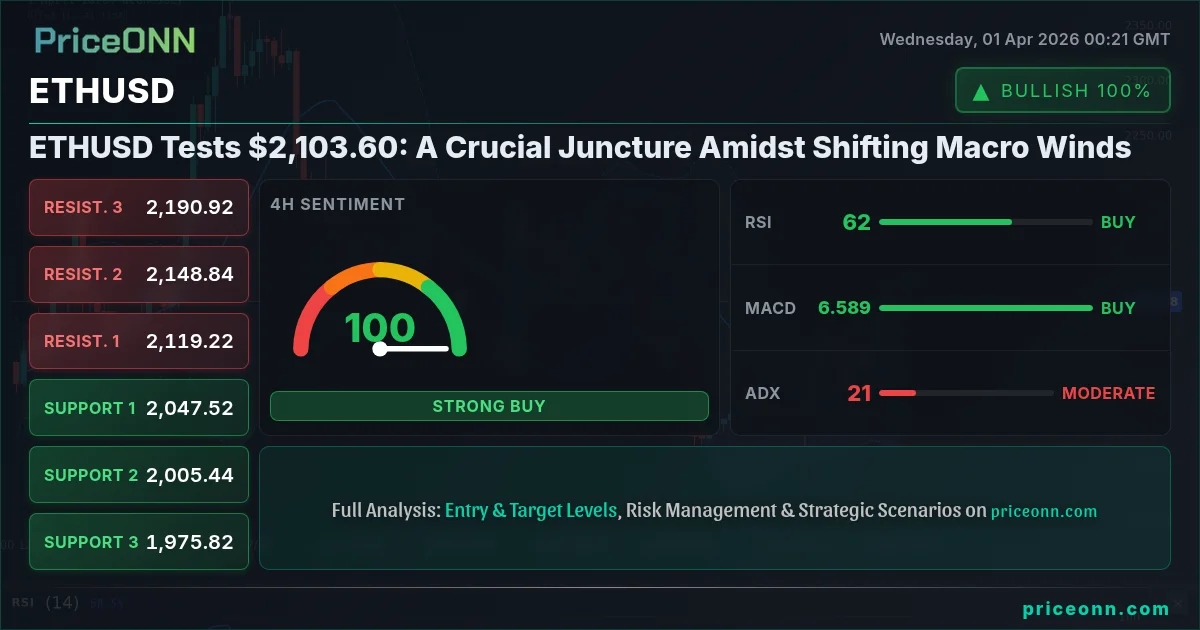
For traders, Base's AI-centric roadmap presents both opportunities and potential risks. The development of advanced market infrastructure could lead to increased liquidity and new trading paradigms, potentially benefiting early adopters. However, the introduction of autonomous AI agents into markets could also introduce new forms of volatility and complexity. On the Ether front, the $2,000 level is emerging as a critical psychological and technical support zone. A decisive break below this level, especially amidst declining volatility, could trigger a cascade of sell orders, potentially pushing ETH towards the $1,800 mark. Conversely, if Ether can hold above $2,000 and the broader market sentiment shifts positively, the reduced volatility could amplify any upward price movement. Traders should closely monitor Base's development progress and any announcements regarding its AI agent integration, while keeping a keen eye on Ether's price action around the $2,000 support level.
Outlook
Base's commitment to building for an AI agent economy signifies a forward-thinking approach within the Ethereum ecosystem, aiming to capture a significant share of future decentralized finance (DeFi) activity. If successful, this could provide a substantial catalyst for the network's adoption and, by extension, Ether's utility. However, the success hinges on the actual deployment and adoption of these AI agents and the robustness of the new infrastructure. In the near term, Ether's price action remains sensitive to macroeconomic factors and broader market sentiment, with the $2,000 support level playing a pivotal role. A failure to hold this level could lead to further downside, while a strong defense might set the stage for a potential recovery, especially if the anticipated volatility surge materializes.
Frequently Asked Questions
What is the main goal of Base's upgrade?
Base aims to build a foundational infrastructure for an AI agent economy by upgrading its systems to support AI agents in building, owning, and trading assets. This includes enhancing smart accounts, tokens, and scaling solutions for seamless AI interaction with markets.
What are the key support levels for Ether (ETH) currently?
Market data indicates that Ether bulls must defend the $1,800-$2,000 support zone. A break below $2,000 could signal further downside risk for ETH price.
How does declining volatility affect Ether's price?
A sharp drop in realized volatility, as seen recently with Ether's 30-day metric falling to 0.62, often precedes significant price movements. While it indicates a period of calm, analysts suggest it could signal a strong subsequent move, either up or down.
Track markets in real-time
Empower your investment decisions with AI-powered analysis, technical indicators and real-time price data.
Join Our Telegram Channel
Get breaking market news, AI analysis and trading signals delivered instantly to your Telegram.
Join Channel

