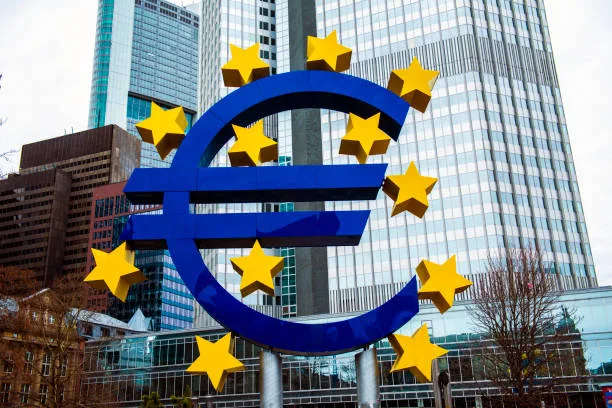
EUR/USD slips below 1.1550 as US Dollar gains on heightened inflationary risks

Euro's Global Footprint
The Euro, the official currency for 20 member states within the European Union's Eurozone, holds significant sway in global finance. Second only to the US Dollar, the Euro plays a pivotal role in international trade and investment flows. Consider this: in 2022, the Euro was involved in 31% of all foreign exchange transactions, highlighting its deep integration into the global financial system. This translates to an average daily turnover exceeding $2.2 trillion, underscoring its liquidity and importance.
Within the vast landscape of currency trading, the EUR/USD pairing reigns supreme. Roughly 30% of all currency transactions involve this pair, dwarfing other Euro-crosses. EUR/JPY accounts for approximately 4%, while EUR/GBP and EUR/AUD represent 3% and 2% respectively. This concentration underscores the EUR/USD's sensitivity to macroeconomic developments in both the Eurozone and the United States.
The European Central Bank, headquartered in Frankfurt, Germany, acts as the Eurozone's central bank. Its primary mission is to maintain price stability, which it achieves through careful management of monetary policy, primarily by adjusting interest rates. Higher interest rates, or even the anticipation of such increases, tend to bolster the Euro's value, as they attract foreign capital seeking higher returns. Conversely, lower rates can weaken the currency.
Decoding the ECB's Decisions
The ECB's Governing Council, composed of national bank heads from Eurozone countries and six permanent members, convenes eight times annually to formulate monetary policy. A key metric guiding these decisions is the Harmonized Index of Consumer Prices, which measures Eurozone inflation. Should inflation exceed expectations, particularly surpassing the ECB's 2% target, the central bank may be compelled to raise interest rates to curb price increases. This dynamic highlights the close relationship between inflation, interest rates, and the Euro's value.
A robust economy generally supports the Euro. It attracts foreign investment and potentially prompts the ECB to raise interest rates, directly strengthening the currency. Conversely, disappointing economic data typically leads to a decline in the Euro's value. Economic figures from Germany, France, Italy, and Spain carry particular weight, representing approximately 75% of the Eurozone's total economic output.
Another crucial indicator for the Euro is the Trade Balance, reflecting the difference between a country's exports and imports. A positive trade balance, indicating strong demand for a country's exports, tends to strengthen its currency, while a negative balance can weaken it.
Reading Between the Lines for Traders
The current weakness in the EUR/USD reflects a broader market narrative: the US Dollar is gaining strength as investors grow increasingly concerned about inflationary pressures in the United States. This situation puts the ECB in a difficult position. While the US Federal Reserve may be inclined to tighten monetary policy to combat inflation, the ECB faces a more complex economic landscape within the Eurozone.
For traders, this divergence in monetary policy outlook presents both risks and opportunities. Keep a close watch on upcoming inflation data from both the Eurozone and the United States. Any surprises could trigger significant movements in the EUR/USD pair. Other assets to monitor include:
- US Dollar Index (DXY): A rising DXY generally indicates further downside pressure on the EUR/USD.
- Eurozone Government Bonds: Monitor bond yields for signs of changing investor sentiment towards the Eurozone economy.
- Gold: As a safe-haven asset, gold may benefit from increased market uncertainty surrounding inflation and monetary policy.
The near-term outlook for the EUR/USD remains uncertain, with the pair vulnerable to further declines if the US Dollar continues to strengthen. Key support levels to watch include recent lows. A break below these levels could signal a deeper correction.
Track markets in real-time
Empower your investment decisions with AI-powered analysis, technical indicators and real-time price data.
Join Our Telegram Channel
Get breaking market news, AI analysis and trading signals delivered instantly to your Telegram.
Join Channel