
Elliott Wave Theory: A Complete Forex and Gold Trading Strategy Guide
A comprehensive guide to Elliott Wave Theory for Forex and Gold trading, covering wave structures, Fibonacci integration, and trade setups. Learn how to read market psychology and build a robust trading strategy based on Elliott Wave principles, with specific examples for XAUUSD and XAGUSD.
Elliott Wave Theory: A Complete Trading Strategy Guide for Forex and Gold
By Kaan Yıldırım, CMT, CFTe
Most traders encounter Elliott Wave theory the same way. They see a chart covered in numbered circles and colored arrows, think "I need to learn this," spend two weeks reading about it, then quietly abandon the whole thing because they counted the same move six different ways and none of them matched by Friday. If that sounds familiar, this guide is written specifically for you.
I have been working with Elliott Wave analysis for over fifteen years, first as an institutional portfolio manager at Borsa Istanbul, later as a technical analyst covering major forex pairs and commodities. In that time, I have seen this methodology misused more often than it has been applied correctly. The problem is almost never the theory itself. The problem is that people treat Elliott Wave as a mechanical system when it is, at its core, a framework for understanding market psychology. Once you make that shift, everything changes.
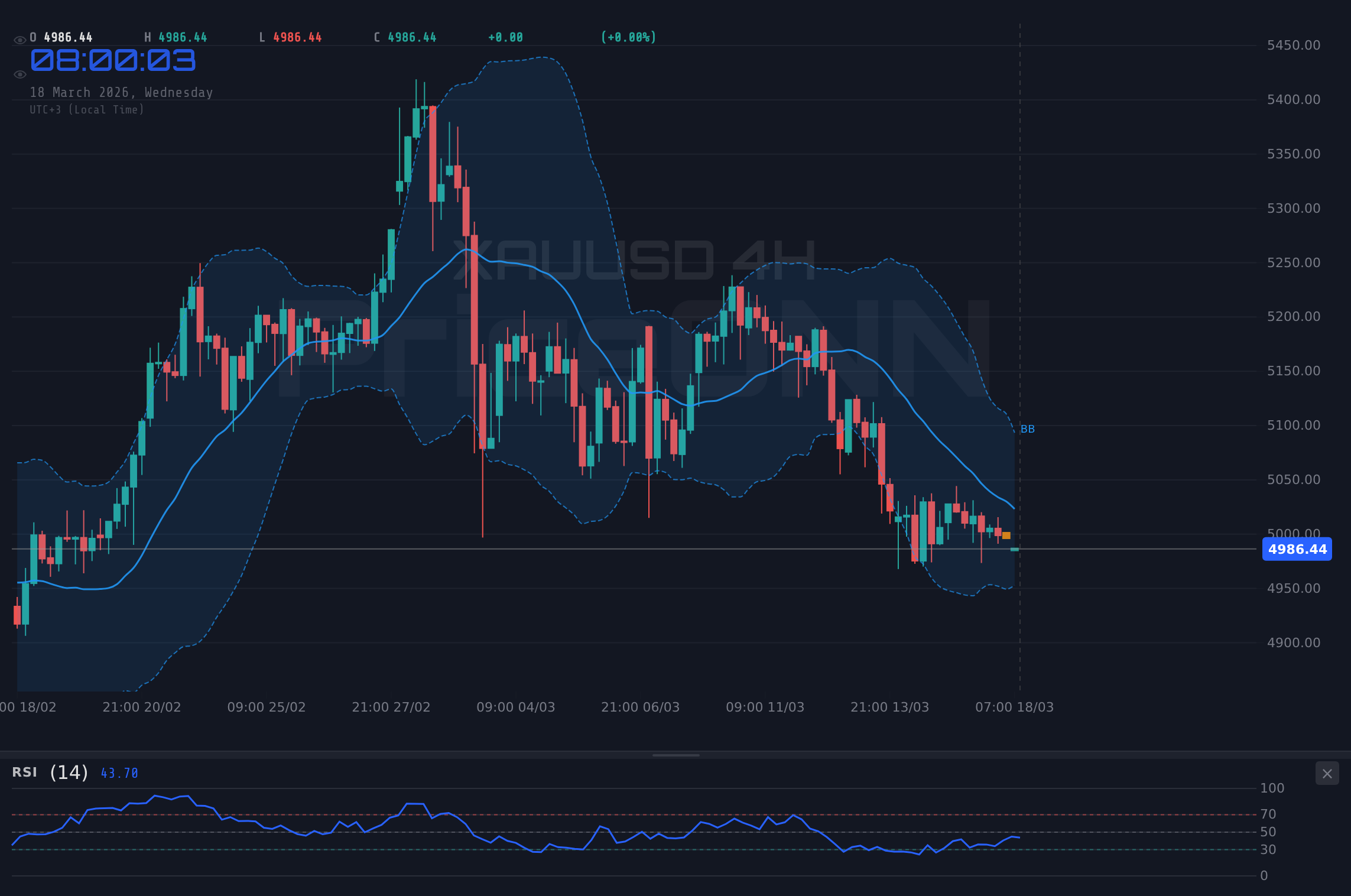
This guide will walk you through the complete Elliott Wave trading strategy from the ground up: the underlying logic, the wave structures, how Fibonacci retracement integrates with wave analysis, and how to build actual trade setups around it. We will spend meaningful time on gold (XAUUSD) and silver (XAGUSD) because these markets display particularly clean wave structures, and they are where I focus most of my own analysis today.
What Elliott Wave Theory Actually Tells Us
Ralph Nelson Elliott published his findings in 1938, but the idea he was working with predates him considerably. Elliott observed that financial markets, rather than moving randomly, trace repeating patterns that reflect the collective psychology of participants. Optimism builds, prices rise in a structured sequence, then pessimism corrects a portion of that advance. This cycle repeats at every scale, from a five-minute chart to a monthly chart spanning decades.
The core structure consists of eight waves: five in the direction of the larger trend, followed by three in the opposite direction. Elliott labeled the trend waves 1 through 5, and the corrective sequence A, B, and C. Within each of those waves, smaller versions of the same pattern are unfolding simultaneously. This self-similar quality, which mathematicians would later describe as fractal behavior, is what gives the theory both its power and its complexity.
What this means practically is that when you look at a chart through an Elliott Wave lens, you are not just identifying support and resistance levels. You are reading where the market is within its psychological cycle. That context shapes not only where price might go next but how it will likely get there, which is what a serious trading strategy actually needs. Understanding elliott wave theory explained provides traders with a powerful tool for market analysis.
The Five-Wave Impulse: Reading the Market's Engine
The impulse sequence, waves 1 through 5, is the market's primary engine. Understanding the personality of each wave is more valuable than memorizing the rules, though the rules matter too. Let's delve into each wave:
- Wave 1: This wave is typically quiet and often emerges from a period of low confidence. Most participants still believe the prior trend will continue. Volume might be low. It’s frequently misidentified in real time. Trying to catch the very beginning of a new trend is the least efficient use of Elliott Wave analysis.
- Wave 2: This wave corrects Wave 1, often deeply. It’s common to see Wave 2 retrace 61.8% or even 78.6% of Wave 1, regularly convincing traders that the prior downtrend has resumed. This is a psychologically challenging moment: you correctly identified Wave 1, then watched the market erase most of it. The key rule is absolute: Wave 2 cannot fully retrace Wave 1. If it does, your count is wrong.
- Wave 3: This is where the market declares its intentions. This wave produces the largest price movement in the least amount of time. Momentum indicators accelerate, and volume expands. The broader market has recognized the new trend, and participation grows rapidly. Wave 3 also has a non-negotiable rule: it cannot be the shortest of Waves 1, 3, and 5 measured in price terms. In practice, it is almost always the longest, and when it extends, it can reach 161.8% or 261.8% of Wave 1's length.
- Wave 4: This is a consolidation phase. Wave 2 was often sharp and swift, but Wave 4 tends to be flat, sideways, or choppy. This difference in character between the two corrective waves within an impulse is known as alternation, a reliable guideline. Wave 4 generally finds support near the peak of Wave 1, another non-negotiable boundary: Wave 4 cannot overlap with Wave 1's price territory in a standard impulse.
- Wave 5: This completes the sequence, often lacking the conviction of Wave 3. Momentum divergences appear on RSI and MACD even as price makes new highs or lows. The crowd is now fully committed to the trend, which is precisely why the trend is about to end. Wave 5 frequently terminates near the 161.8% extension of the Wave 1 through Wave 3 distance projected from the Wave 4 low.
Understanding the elliott wave 5 waves explained is crucial for identifying potential trading opportunities.
Corrective Waves: Where Most of the Money Is Lost
Corrections are where traders who understand impulses get destroyed. The three-wave corrective sequence that follows a five-wave impulse takes three primary forms: zigzags, flats, and triangles. Each behaves differently, and misidentifying one for another is the source of most failed trades in Elliott Wave analysis. Let's explore these elliott wave corrective patterns:
- Zigzag: This is the most straightforward. Wave A moves sharply against the prior trend, Wave B retraces modestly (typically 38.2% to 61.8% of Wave A), and Wave C extends to new corrective lows or highs, usually matching Wave A in length or reaching 161.8% of it. The key characteristic is that both A and C are impulse waves. The sharp, directional nature of a zigzag often looks like a new trend beginning, which is why inexperienced traders keep shorting into the start of a new bull market.
- Flat: This correction has a different character. Wave B retraces close to or beyond the origin of Wave A, which immediately distinguishes it from a zigzag. Wave C then moves to roughly the same level as the end of Wave A or slightly beyond. Flats indicate a strong underlying trend. When the market cannot even correct properly, it is telling you something about where it wants to go next.
- Triangle: These are contracting or expanding structures that typically appear in Wave 4 of an impulse or as Wave B of a larger correction. They consist of five overlapping waves labeled A through E, each respecting the boundaries of a converging channel. The breakout from a triangle, in the direction of the prior trend, is frequently explosive. This is one of the cleaner setups Elliott Wave analysis generates, precisely because the pattern has such defined boundaries.
- Complex Correction: The most dangerous structure for traders is the complex correction, sometimes called a W-X-Y or double three. These are combinations of the simpler patterns connected by linking waves labeled X. Complex corrections can extend far longer in both time and price than any single corrective pattern, and they tend to appear at major turning points where the market needs more time to digest a preceding move. When a correction starts behaving in ways that do not fit a simple zigzag or flat, the honest response is to widen your perspective rather than force a count.
Elliott Wave and Fibonacci: The Analysis That Actually Works
Elliott Wave theory and Fibonacci analysis were made for each other, and attempting to use one without the other is like navigating with half a map. The Fibonacci ratios 0.382, 0.500, 0.618, and 0.786 are not decorative additions to the framework. They describe the proportional relationships between waves. Understanding elliott wave fibonacci retracement is key to successful application.
- Wave 2 corrections most frequently halt at the 61.8% or 78.6% retracement of Wave 1.
- Wave 4 corrections tend to respect the 38.2% retracement, consistent with the alternation guideline.
- When a Wave 2 retracement level and a 38.2% Fibonacci level from a larger degree wave converge at the same price zone, that is a confluence point, and confluence is where the highest-probability entries exist.
- For extensions, the 161.8% Fibonacci extension is the most common Wave 3 target when measured from the origin of Wave 1.
- Wave 5 targets are frequently found at the 100% or 161.8% extension of the net distance from the start of Wave 1 to the end of Wave 3, projected from the Wave 4 low.
What I look for in practice is not a single Fibonacci level but a cluster. When the 61.8% retracement of Wave 1, the 100% measured move from a prior structure, and the 78.6% retracement of a larger degree wave all land within ten to fifteen pips of each other in forex or within a dollar range in gold, that cluster carries significant weight. The market does not always honor it, but it honors it enough to build a strategy around it.
Building an Elliott Wave Trading Strategy
The most profitable application of Elliott Wave analysis is not trying to identify where you are in a sequence after the fact. It is anticipating where you will be and preparing in advance. This is the essence of an elliott wave trading strategy.
The trade setup I return to most consistently is the Wave 3 entry following a Wave 2 correction. After identifying a convincing Wave 1 advance, I wait for the corrective Wave 2 to develop and watch for it to stall at a Fibonacci confluence zone, ideally between 50% and 78.6% of Wave 1. I want to see momentum indicators show a bullish divergence on the lower time frame, typically the four-hour chart, as price approaches that zone. When a reversal candle forms at or near the confluence, that is the entry signal.
The stop loss is placed below the origin of Wave 1 with a modest buffer. If Wave 2 trades below that point, the wave count is invalidated. The first target is the 100% extension of Wave 1 from the Wave 2 low, and the second target is the 161.8% extension. The risk/reward geometry on this setup, when entry is precise, is typically better than 1 to 3 and often reaches 1 to 5 on strong trending instruments. This is how to how to use elliott wave in trading for concrete results.
The Wave 5 reversal setup works in the opposite direction. When price approaches the Fibonacci extension zone where Wave 5 is expected to terminate, I begin monitoring for momentum divergence on both the daily and four-hour charts. RSI making lower highs while price makes higher highs in what appears to be a terminal wave is a meaningful warning signal. The entry is taken against the prevailing trend only after a clear reversal structure forms, not in anticipation of one. This is a lower-probability setup than the Wave 3 entry and requires proportionally tighter management.
One discipline that separates functional Elliott Wave trading from academic Elliott Wave analysis is always maintaining an alternative count. If the market invalidates your primary count, you should already know what comes next. Surprises in Elliott Wave analysis almost always reflect a failure to consider alternatives, not a failure of the theory itself.
Gold and Silver: Elliott Wave in Practice
Gold and silver have a long history of tracing clean, well-defined Elliott Wave structures, which is part of why these markets attract technically oriented traders. The long-term gold chart going back to the 2001 lows is a textbook example of a multi-year impulse sequence, and the corrective phases within it have repeatedly respected Fibonacci levels with unusual precision. Let's consider elliott wave gold analysis and elliott wave silver trading XAGUSD.
For XAUUSD analysis using Elliott Wave, the weekly chart is the starting point. Establishing where gold sits within its larger degree structure tells you which type of moves to expect on the daily and four-hour charts. A market in a Wave 3 advance at the weekly degree will produce shallow, fast corrections at the daily level. A market completing a Wave 5 at the weekly level will display the kind of struggling, divergence-laden advance that invites a short trade once reversal signals appear. The elliott wave XAUUSD analysis can provide valuable insights.
The relationship between XAUUSD and XAGUSD is also worth monitoring from a wave perspective. Silver frequently leads gold at major turning points, particularly at tops. When silver's wave count suggests a terminal structure while gold is still advancing, that divergence in the two metals often resolves with gold confirming a top within days or weeks. It is not a trading signal in isolation, but as one input among several, it has value.
For scalping and shorter-term approaches on gold, the one-hour chart displays readable wave structures during active sessions, particularly the London open and the overlap between London and New York. The same principles apply: Fibonacci confluence zones, momentum confirmation, and a clear invalidation level for the stop. The difference is that lower time frame counts are noisier and require more frequent revision. Keeping your primary analysis anchored to the daily chart and using the one-hour only for entry timing reduces the noise considerably. For traders seeking a best elliott wave strategy for scalping, focus on these active sessions and shorter timeframes.
The Mistakes That Cost Traders Real Money
Forcing a count is the most common and most expensive mistake in Elliott Wave trading. When a structure does not fit cleanly into one of the standard patterns, the temptation is to label it anyway and proceed with the trade. This is how traders end up long at the beginning of a Wave C decline in a flat correction, convinced they are entering a Wave 3 advance.
The corrective wave label does not change the quality of the structure. If the waves do not have the right internal composition, if the Fibonacci relationships do not line up, and if momentum does not confirm, the count is probably wrong. Walking away from an unclear structure is not a failure of analysis. It is the analysis working correctly.
Using only one time frame is another consistent source of problems. A structure that looks like a complete five-wave impulse on a fifteen-minute chart may be a single Wave 1 on a four-hour chart. The wave degree you are trading in determines both the opportunity size and the risk parameters, and you cannot assess degree without stepping back to larger charts.
Finally, there is the problem of emotional commitment to a count. Once a trader has spent significant time building a wave count and sharing it publicly, they develop an attachment to being right about it. The market does not care about your count. The moment price action tells you the structure has changed, update the count. The analysts who make money with Elliott Wave over long periods are those who revise their counts quickly and without ego, not those who defend the original call until the account is empty.
The Real Edge in Elliott Wave Trading
Elliott Wave theory does not tell you exactly where price will go. No methodology does. What it provides is a structured way to assess where you are in the market cycle, what the likely next movement looks like, and where a specific hypothesis about price movement gets invalidated. That combination of directional expectation, target definition, and clear invalidation is precisely what a trading strategy needs. Understanding elliott wave entry exit points is critical for risk management.
The traders who use this framework successfully tend to share a few characteristics. They are patient enough to wait for the setup to develop rather than entering the moment they label a wave. They are honest enough to revise their counts when the market demands it. And they understand that the edge in Elliott Wave analysis is not in predicting the future with precision. It is in consistently entering trades where the Fibonacci structure and wave context create a favorable risk/reward environment, and exiting cleanly when that environment changes. This is what sets it apart in the elliott wave vs technical analysis landscape.
Fibonacci seviyeleri bize şunu söylüyor: the structure of price movement is not random, but it is not perfectly predictable either. What the chart gives us is probability. Trade the probability with proper risk management, accept when it does not work out, and stay in the game long enough for the edge to express itself. That is the complete Elliott Wave trading strategy, and it fits in fewer words than most courses that charge thousands of dollars to teach it.
Disclaimer: *The information provided in this article is for educational purposes only and should not be considered as financial advice. Trading involves risk, and it is possible to lose money. Always conduct your own research and consult with a qualified financial advisor before making any investment decisions.*
Kaan Yıldırım holds CMT and CFTe certifications and has been active in financial markets for over 20 years. He focuses on multi-timeframe technical analysis with an emphasis on Elliott Wave structures and Fibonacci confluence zones across forex majors, gold, and silver.
Track markets in real-time
AI-powered analysis, technical indicators and real-time price data.
Join Our Telegram Channel
Breaking market news, AI analysis and trading signals instantly.
Join Channel