
Is AUD/USD Headed Below 0.7000 as Bears Take Control Amidst Global Economic Jitters?

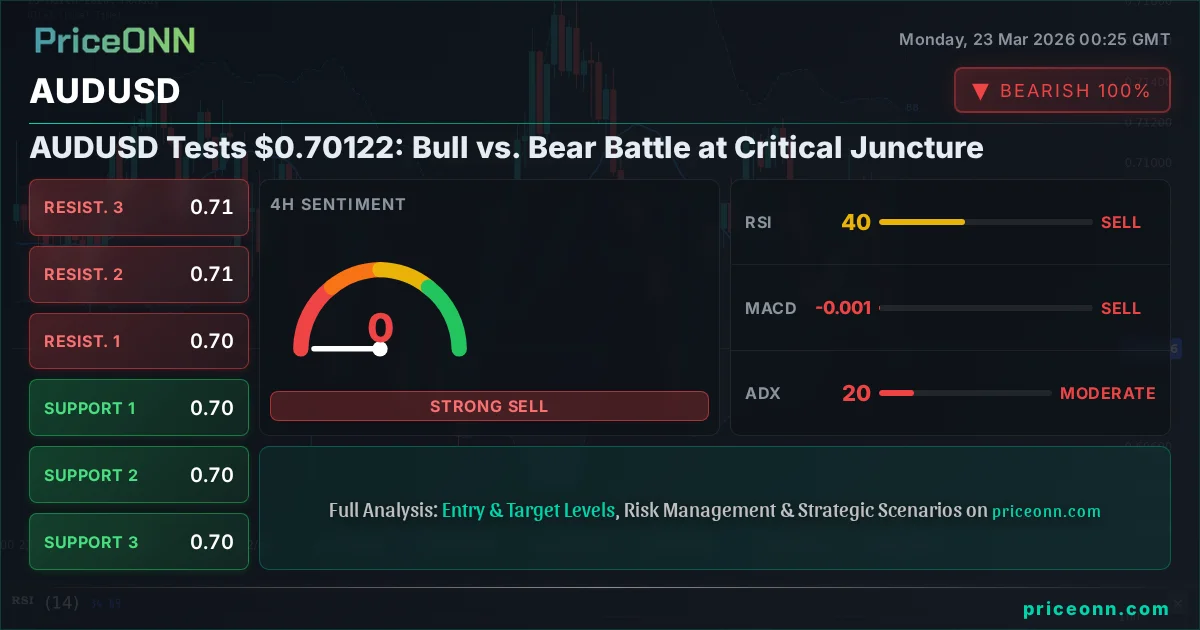
AUD/USD commenced Monday's trading session with a notable bearish opening gap, quickly testing a one-week low during early Asian hours. While the anticipated aggressive follow-through selling has not yet materialized, the pair is hovering precariously around the 0.7000 psychological mark, currently down 0.25% for the day. This level represents a critical juncture, with market data indicating that the 200-day Exponential Moving Average (EMA) is also under pressure, suggesting a potential shift in short-term sentiment favoring the downside.
Market Context: Aussie's Descent Below Key Technicals
The Australian Dollar has found itself under increasing pressure, with the AUD/USD exchange rate carving out a one-week low in the early part of the week. The inability to hold above the 0.7000 level, a significant psychological support, is a cause for concern for bulls. The proximity to this round number, coupled with the vulnerability of the 200-day EMA, paints a picture of a market leaning towards bearish sentiment. Traders are closely monitoring this area, as a decisive break below 0.7000 could trigger further downside momentum, potentially retesting lower support levels not seen in recent weeks.
Analysis & Drivers: Global Headwinds and Domestic Concerns
Several fundamental factors are contributing to the current weakness in the Australian Dollar. On the domestic front, the monetary policy stance of the Reserve Bank of Australia (RBA) remains a key determinant of the AUD's value. While the RBA has maintained a steady hand, global interest rate differentials and the market's anticipation of future policy moves play a crucial role. Historically, a hawkish RBA typically supports the AUD, but current global economic uncertainties may temper this effect.
Beyond domestic policy, Australia's economic health is deeply intertwined with global commodity markets and its largest trading partner, China. As a major exporter of raw materials, particularly iron ore, fluctuations in commodity prices significantly impact the AUD. Industry reports indicate that iron ore exports alone generated approximately $118 billion in 2021, highlighting the commodity's economic weight. Signs of slowing growth or instability in China can directly dampen demand for Australian exports, putting downward pressure on the currency.
The broader fundamental backdrop, which includes mixed economic signals from major global economies and ongoing geopolitical tensions, is contributing to a general risk-off sentiment. This environment often leads investors to seek safe-haven assets, thereby weakening currencies like the Australian Dollar, which are more sensitive to global growth prospects.
Trader Implications: Watching the 0.7000 Level and Beyond
For traders, the immediate focus remains squarely on the 0.7000 psychological level. A sustained break and close below this mark would likely confirm the bearish bias and could signal a move towards the next significant support zone, potentially around 0.6950 or even lower. Technical indicators, such as the RSI and MACD, are being closely watched for signs of increasing downward momentum. Traders should be prepared for potential volatility as the market digests incoming economic data from both Australia and its key trading partners.
Key risk factors include any unexpected positive economic data from China that could bolster commodity prices and revive demand for the AUD, or conversely, any hawkish signals from the RBA that deviate from current expectations. On the downside, a weaker-than-expected Australian inflation report or a sharp decline in iron ore prices would further solidify the bearish outlook.
The current technical setup, with the pair trading below its 200-day EMA, suggests that rallies might be capped and could offer opportunities for short-selling. A trader might consider looking for confirmation signals around the 0.7000-0.7020 resistance zone to initiate short positions, with a stop-loss placed above recent highs. Conversely, a strong rebound from 0.7000 with a decisive break above 0.7050 could signal a short-term reversal, but this appears less likely given the current market sentiment.
Outlook: Downside Risks Persist for the Aussie
The outlook for AUD/USD remains cautious, with downside risks appearing more pronounced in the near term. The confluence of technical weakness and prevailing global economic uncertainties suggests that the bears may continue to hold the upper hand. Traders will be keenly observing the upcoming economic calendar for any data that could sway sentiment, with particular attention paid to Chinese manufacturing PMI and Australian employment figures. A failure to hold above 0.7000 could pave the way for a deeper correction.
Frequently Asked Questions
What is the current trading range for AUD/USD?
As of Monday's opening, AUD/USD is trading around the 0.7000 mark, having touched a one-week low. It is down 0.25% for the day, with a potential breakdown below 0.7000 being closely watched.
What are the key drivers impacting the Australian Dollar?
Key drivers include the RBA's monetary policy, global commodity prices (especially iron ore), and the economic performance of China, Australia's largest trading partner. Recent mixed economic signals from China have contributed to headwinds.
What is the short-term outlook for AUD/USD?
The short-term outlook appears cautious with downside risks. A sustained break below 0.7000 could lead to further declines, with the 200-day EMA also showing vulnerability. Traders are watching for confirmation signals for potential short positions.
Track markets in real-time
Empower your investment decisions with AI-powered analysis, technical indicators and real-time price data.
Join Our Telegram Channel
Get breaking market news, AI analysis and trading signals delivered instantly to your Telegram.
Join Channel



PriceONN