AUD/USD Price Forecast: Bears have the upper hand near 0.7000; 200-EMA breakdown in play
Market Pressure Mounts on the Aussie
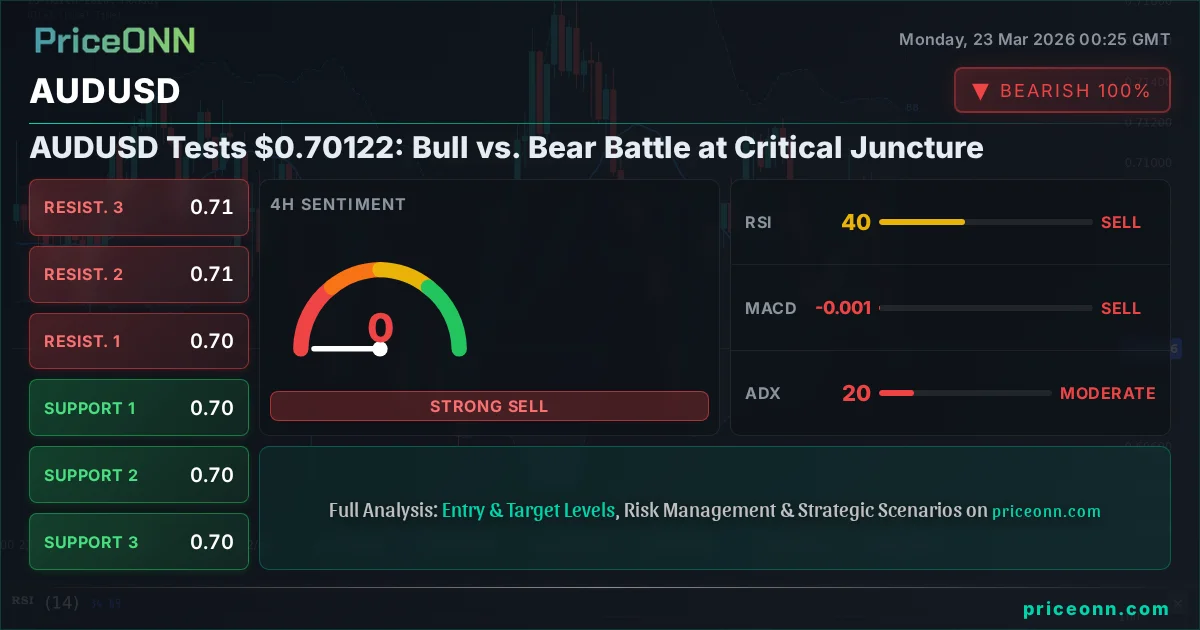
The currency pair, AUD/USD, commenced Monday's session with a slight bearish opening gap. This initial dip saw the exchange rate plumb a one-week low during the early Asian trading hours. Despite the downward pressure, a decisive follow-through selling momentum has yet to materialize, leaving the pair to consolidate near a significant psychological threshold.
Currently trading around the 0.7000 figure, the Australian Dollar has shed 0.25% against its US counterpart. This level represents a critical juncture, with traders closely watching for any signs of a breakdown below this long-held support. The pair's proximity to this mark comes as the 200-day moving average (EMA) also appears vulnerable, suggesting a potential shift in short-term sentiment.
Unpacking the Drivers of Australian Dollar Fluctuations
Several fundamental pillars underpin the Australian Dollar's valuation, with the monetary policy stance of the Reserve Bank of Australia (RBA) taking center stage. The RBA's benchmark interest rate decisions directly influence lending costs across the economy, thereby shaping inflation expectations and economic activity. Historically, a relatively hawkish RBA, characterized by higher interest rates compared to global peers, tends to bolster the AUD. Conversely, accommodative policy or rate cuts can exert downward pressure.
Beyond domestic monetary policy, Australia's economic fortunes are intrinsically linked to global commodity markets and its primary trading partner, China. As a major exporter of raw materials, the price dynamics of key commodities, particularly iron ore, wield significant influence. A surge in iron ore prices typically correlates with increased demand for the AUD, as it signals robust global industrial activity and enhances Australia's export revenue. Data from 2021 indicated iron ore exports alone generated approximately $118 billion, underscoring its economic weight.
The economic vitality of mainland China plays a pivotal role. When China's economy expands robustly, its demand for Australian goods and services, especially raw materials, escalates. This heightened demand naturally lifts the Australian Dollar. Conversely, any signs of deceleration in the Chinese economy can dampen demand for Australian exports, consequently weakening the AUD. Surprises in Chinese economic data releases, whether positive or negative, frequently trigger immediate reactions in AUD currency pairs.
Furthermore, Australia's overall Trade Balance, the differential between export earnings and import expenditures, serves as another crucial barometer. A healthy surplus, achieved when export revenues exceed import costs, generally fortifies the AUD. This occurs as foreign entities require more AUD to purchase Australian products. A persistent deficit, however, can signal underlying economic weaknesses and apply pressure to the currency.
Finally, global risk sentiment, a measure of investor appetite for riskier assets versus a preference for safe havens, impacts the AUD. Periods of 'risk-on' sentiment, where investors feel optimistic about global growth, often see capital flow into currencies like the AUD, which are perceived as higher-yielding or growth-sensitive. In contrast, 'risk-off' environments, marked by uncertainty and fear, typically lead investors to seek the perceived safety of assets like the US Dollar or Japanese Yen, thus depreciating the AUD.
Market Ripple Effects
The current pressure on the AUD/USD pair and its proximity to the 0.7000 handle warrants attention from a broader market perspective. The Australian Dollar often acts as a barometer for global growth expectations and commodity demand. A sustained decline below key technical levels could signal increasing global economic headwinds or a significant shift in risk appetite.
Traders monitoring this pair should also keep a close eye on the performance of the US Dollar Index (DXY). A strengthening dollar, often driven by global risk aversion or hawkish Federal Reserve signals, typically correlates with a weaker AUD/USD. Additionally, the trajectory of commodity prices, especially crude oil and copper, can offer clues. Given Australia's export reliance, significant moves in these commodities can directly influence the AUD's strength.
Furthermore, the economic outlook for China remains paramount. Any emerging data suggesting a slowdown in Chinese manufacturing or consumer demand could exacerbate pressure on the AUD. Conversely, signs of stimulus or a resilient Chinese economy might offer a reprieve for the Australian Dollar. Investors should consider how these interconnected factors might influence other commodity-linked currencies such as the Canadian Dollar (CAD) and emerging market assets sensitive to global growth narratives.
Track markets in real-time
Empower your investment decisions with AI-powered analysis, technical indicators and real-time price data.
Join Our Telegram Channel
Get breaking market news, AI analysis and trading signals delivered instantly to your Telegram.
Join Channel