
AUD/USD Slides to Two-Month Lows: What's Next for the Aussie?

AUD/USD has tumbled to its lowest point in over two months, struggling to find support around the 0.6850 level. This slide marks the fifth consecutive session of losses for the Australian Dollar, erasing significant gains made earlier in March and pushing the pair down by over 300 pips from its recent high near 0.7190.
Market Context
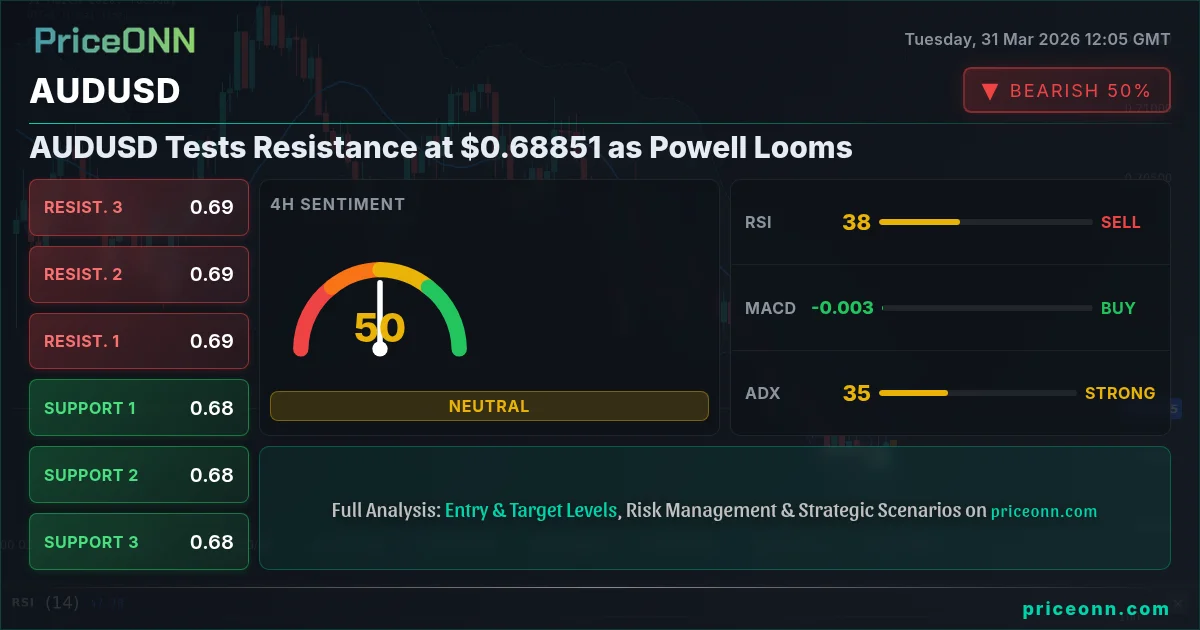
The prevailing bearish sentiment has intensified in late March, with AUD/USD experiencing a sharp acceleration in its decline. The pair closed Monday near 0.6850, a level that now represents a critical juncture. This consolidation below the 100-day Simple Moving Average (SMA) indicates that short-term momentum is firmly in the hands of sellers. The recent price action suggests a shift in market sentiment, moving away from risk-on appetite towards a more cautious, risk-off stance, which typically weighs on commodity-linked currencies like the Australian Dollar.
Analysis & Drivers
Several fundamental factors are contributing to the AUD/USD's downturn. The Reserve Bank of Australia's (RBA) interest rate policy remains a pivotal influence. While specific RBA actions are not detailed in recent data, market expectations regarding future rate decisions, especially in comparison to other major central banks, play a crucial role. Higher relative interest rates tend to bolster the AUD, whereas lower rates can pressure it. Furthermore, as Australia is a major exporter of commodities, particularly iron ore to China, the economic health of its largest trading partner is paramount. Signs of slowing growth or instability in China often translate into reduced demand for Australian goods, thereby weakening the AUD. The price of iron ore itself, Australia's largest export, also directly impacts the currency's valuation. A decline in iron ore prices typically correlates with a weaker Australian Dollar.
Trader Implications
Traders are closely watching the 0.6850 level, which is currently acting as a consolidation zone. A decisive break below this support could open the door for further declines, potentially targeting psychological levels such as 0.6800 and below. Key indicators to monitor include the 100-day SMA, which has now become a resistance level, and broader market sentiment. A sustained risk-off environment would likely continue to pressure AUD/USD. Conversely, any positive news regarding the Chinese economy or a rebound in iron ore prices could provide temporary relief. Investors should also pay close attention to upcoming economic data releases from both Australia and China, as these could significantly alter the short-term trajectory of the pair. The current technical setup suggests that any upward movements may be met with selling pressure, making it challenging for bulls to regain control without a significant shift in fundamental drivers.
Outlook
The immediate outlook for AUD/USD remains challenging, with the pair consolidating at a two-month low. Without a clear catalyst for a reversal, such as more hawkish signals from the RBA or a significant improvement in China's economic outlook, the path of least resistance appears to be to the downside. Traders should remain vigilant for potential breakdowns below key support levels. The ongoing consolidation around 0.6850 suggests that the market is digesting recent losses, but the absence of strong buying interest points towards potential further weakness in the coming sessions.
Frequently Asked Questions
What is the current support level for AUD/USD?
The AUD/USD pair is currently consolidating around the 0.6850 level, which is acting as a short-term support. A break below this could see further declines towards 0.6800.
What are the main drivers affecting the Australian Dollar?
Key drivers include the Reserve Bank of Australia's (RBA) interest rate policy, the health of the Chinese economy (Australia's largest trading partner), and the price of iron ore, Australia's primary export. Market sentiment also plays a significant role.
What is the short-term outlook for AUD/USD?
The short-term outlook remains cautious, with the pair trading at a two-month low. Without a significant positive catalyst, such as improved Chinese economic data or hawkish RBA signals, further downside pressure is possible.
Track markets in real-time
Empower your investment decisions with AI-powered analysis, technical indicators and real-time price data.
Join Our Telegram Channel
Get breaking market news, AI analysis and trading signals delivered instantly to your Telegram.
Join Channel