AUDUSD Tests Resistance at $0.68851 as Powell Looms
AUDUSD is testing resistance near $0.68851 amid rising DXY and hawkish Fed expectations. Key levels and scenarios analyzed ahead of Powell's speech.
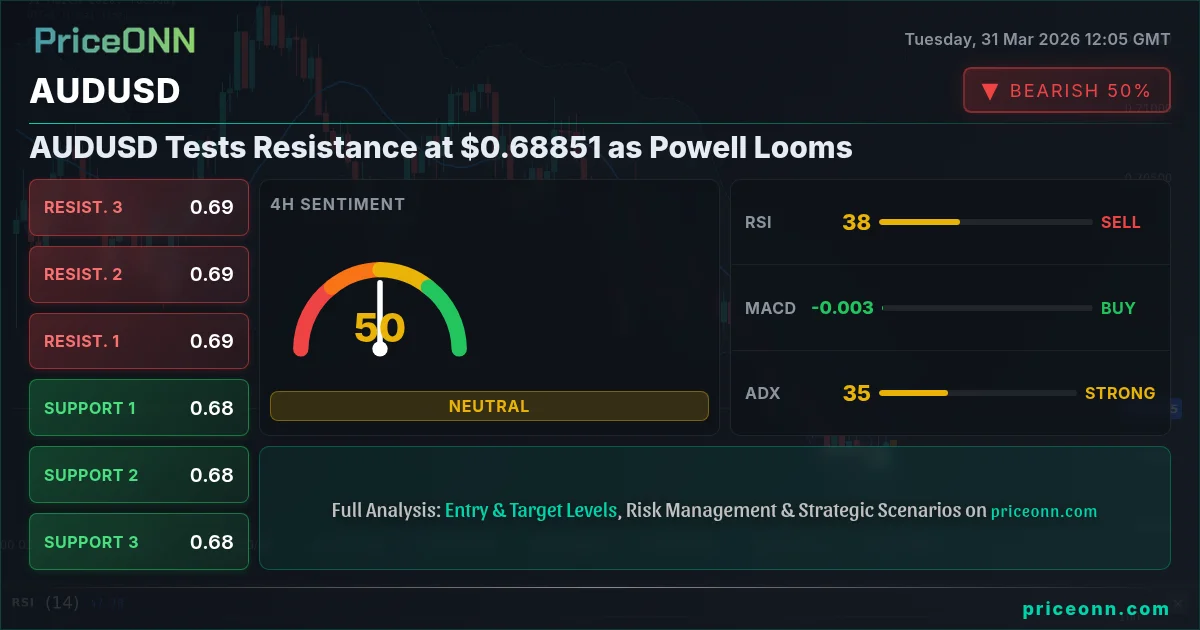
The Australian Dollar is hitting a critical juncture against the US Dollar, with AUDUSD currently hovering around $0.68851. This level is proving to be a tough nut to crack, especially as broader market forces, including a strengthening US Dollar and the ever-present shadow of Federal Reserve policy, weigh on sentiment. With all eyes on Fed Chair Powell's upcoming remarks, traders are bracing for potential volatility. The question on everyone's mind: will the Aussie break higher, or is a pullback imminent?
The AUDUSD pair has been in a significant downtrend, marked by a five-session losing streak and a substantial drop from its March high, as highlighted by recent market news. Yet, the current price action around $0.68851 suggests a potential pause in this decline, or perhaps even a short-term reprieve for the bulls. The Australian Dollar's fate is intrinsically linked to global risk sentiment and commodity prices, both of which have been volatile. Gold prices, for instance, are eyeing further gains, which typically supports commodity-linked currencies like the AUD. However, the surging US Dollar, currently trading around 100.04 on the DXY index, presents a formidable headwind.
- AUDUSD is testing critical resistance at $0.68851, a level that has capped recent upside attempts.
- The RSI(14) is at 61.67 on the 1H chart and 38.09 on the 4H, indicating mixed signals but a general downward bias on the daily.
- Key support for AUDUSD lies at $0.68327 (4H) and $0.6831 (1D), while resistance is firmly at $0.68636 (4H) and $0.6872 (1D).
- Broader market correlations show a strengthening DXY (100.04) and rising oil prices ($110.72 Brent), creating a complex environment for the Aussie.
The Tug-of-War: Macro Drivers and AUDUSD's Predicament
The global economic landscape is a complex tapestry woven with threads of geopolitical tension, inflationary pressures, and shifting monetary policy expectations. The ongoing Middle East conflict continues to inject uncertainty, pushing Brent crude oil prices firmly above $110. This surge in energy costs, while potentially beneficial for commodity exporters like Australia, also fuels inflation concerns globally. Higher inflation typically prompts central banks, including the US Federal Reserve, to maintain a hawkish stance or delay rate cuts, which in turn strengthens the US Dollar.
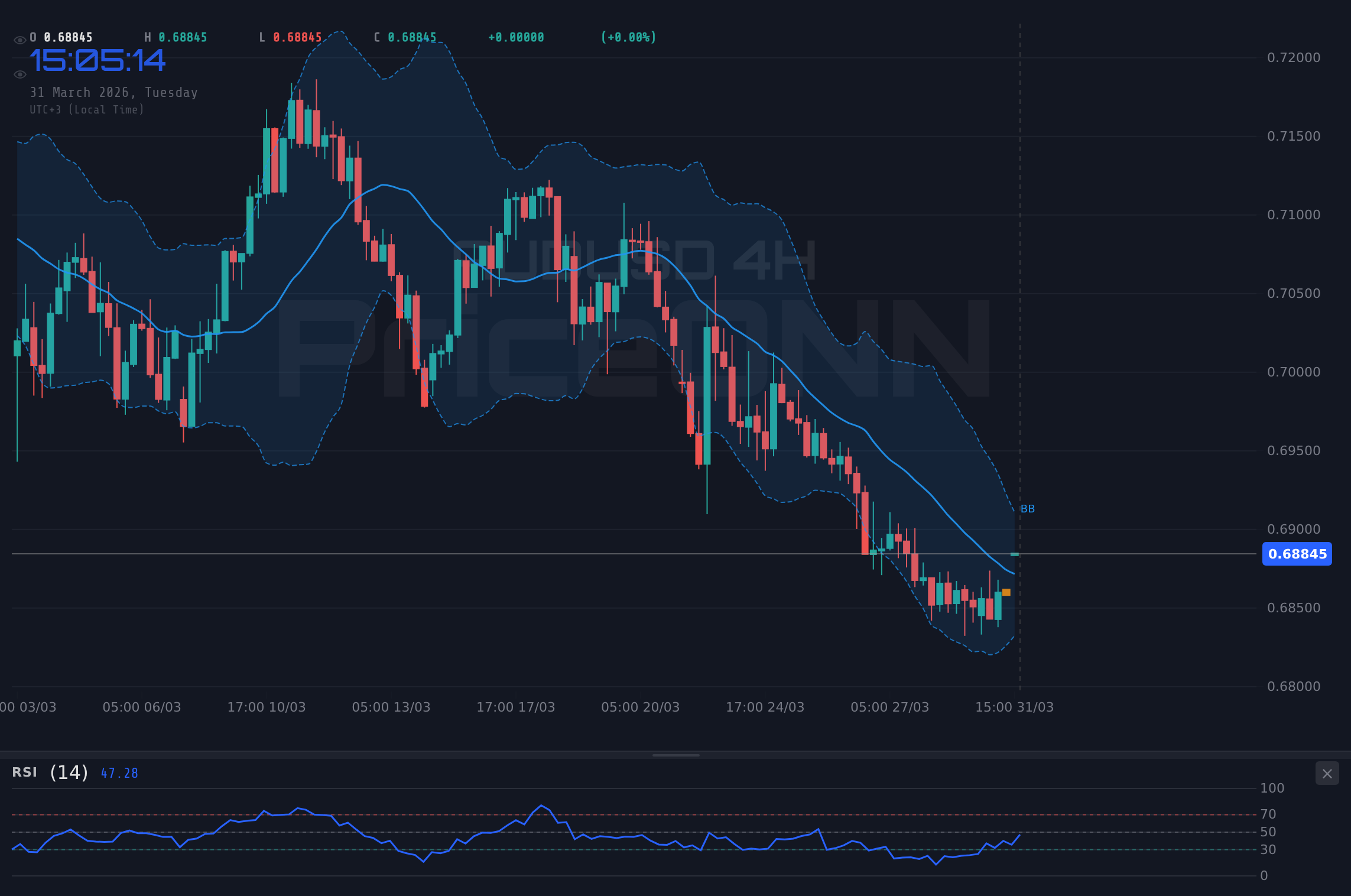
The US Dollar Index (DXY) is currently demonstrating this correlation, trading around 100.04. A stronger dollar generally makes it more expensive for holders of other currencies to buy dollar-denominated assets, and it puts downward pressure on currency pairs like AUDUSD. The market is keenly watching the US indices; the S&P 500 and Nasdaq are showing resilience in the short term, but their longer-term outlook remains cautious given the current macro backdrop. If risk appetite were to falter, we could see a flight to safety, further bolstering the dollar and weighing on the Aussie.
The minutes from the Bank of Japan's recent meeting hinted at a potential policy shift, causing USD/JPY to retreat from its highs. While this doesn't directly impact AUDUSD, it signals a broader trend of central banks reassessing their ultra-loose policies in response to persistent inflation. For AUDUSD, the Reserve Bank of Australia's (RBA) own policy path is crucial. Market participants are looking for any clues that might suggest a pivot from the RBA, but for now, the Fed's stance remains the dominant driver.
The Aussie's Internal Battle: RBA vs. Global Headwinds
Domestically, the Australian economy presents a mixed picture. While commodity prices remain elevated, providing a natural tailwind for the AUD, other economic indicators suggest underlying weakness. The AUDUSD pair has extended its losing streak, indicating that global factors are currently outweighing domestic strengths. Recent news highlighted that AUD/USD slid to two-month lows, extending its losing streak, which underscores the prevailing bearish sentiment.
The RBA's monetary policy decisions are paramount. If the RBA were to signal a more hawkish stance, perhaps due to persistent inflation or a stronger-than-expected domestic economy, it could provide a much-needed boost to the Australian Dollar. However, the market seems to be pricing in a different narrative for now, with the focus firmly on the Fed. The 'aud usd fundamentals' search query suggests traders are actively seeking clarity on the economic underpinnings of this pair, and the current data paints a complex, often contradictory, picture.
The Australian Dollar's relationship with China's economic health also cannot be understated. As a major trading partner, any signs of slowdown or stimulus in China can directly impact demand for Australian exports and, consequently, the AUD. While specific recent news on this front is limited in the provided data, it remains a background factor that analysts monitor closely. The 'aud usd 0.7200 target' query, while currently distant, hints at a longer-term bullish aspiration that would require a significant shift in both global and domestic conditions.
Scenario Breakdown: Navigating the AUDUSD Price Maze
Given the conflicting signals and the high degree of uncertainty surrounding Fed policy and geopolitical events, a multi-scenario approach is essential for trading AUDUSD. The current technical indicators present a fragmented picture. On the 1-hour chart, the RSI is at 61.67, suggesting some upward momentum, but the MACD shows negative momentum. The 4-hour chart paints a similar story with an RSI of 38.09, leaning towards a bearish outlook, while the daily RSI at 39.97 reinforces this downward bias. The ADX, however, shows a strong downtrend on the 4-hour (34.87) and daily (27.35) charts, indicating that the prevailing direction, though potentially weakening, is still downward.
The price action itself is the most immediate clue. AUDUSD is currently battling resistance around the $0.68636 level on the 4-hour chart and $0.6872 on the daily. A decisive break above these levels, particularly on increased volume, would be required to invalidate the current bearish setup. Conversely, failure to overcome these resistance points, coupled with a slip below the immediate support at $0.68327, would likely confirm the continuation of the downtrend.
The Bears' Grip Tightens
65% ProbabilityThe Waiting Game Around $0.68500
25% ProbabilityA Glimmer of Hope for the Aussie
10% ProbabilityWhat's Driving the Market This Week? Powell and the Fed's Next Move
The most significant event on the horizon is undoubtedly Fed Chair Powell's speech. Market participants will be dissecting every word for clues about the Fed's future interest rate path. Persistent inflation, as evidenced by recent economic data, suggests the Fed may need to remain hawkish for longer than anticipated. If Powell signals a reluctance to cut rates or even hints at further tightening, it would likely strengthen the US Dollar across the board, putting AUDUSD under renewed pressure.
Conversely, any dovish undertones or acknowledgment of cooling inflation could trigger a dollar sell-off and provide a much-needed lift to riskier assets like the Australian Dollar. The current market sentiment appears cautious, with major indices like the S&P 500 and Nasdaq showing some short-term resilience but facing potential headwinds. The price of oil, hovering above $110 for Brent crude, remains a key inflation indicator. Geopolitical developments in the Middle East continue to be a wildcard, capable of causing sharp swings in both energy prices and risk sentiment.
The technical indicators offer a mixed outlook, but the prevailing trend on the daily chart is still down. The ADX at 27.35 on the daily suggests a strong downtrend is in place. While the 1-hour chart shows some short-term bullish signals, they are not yet confirmed by the longer timeframes. The Stochastic oscillator on the 4-hour chart is showing a potential bearish crossover, and the RSI is below 40, leaning towards further downside potential. The key will be how AUDUSD reacts to the immediate support and resistance levels.
The Path Forward: Key Levels to Watch
For the bears, the immediate focus is on holding the ground below the $0.68636 resistance. A failure to break higher here and a subsequent move below the 4-hour support at $0.68327 would be a strong signal for a continuation of the downtrend, potentially targeting $0.68018. This scenario is bolstered by the strong ADX reading and the prevailing dollar strength.
For the bulls, a decisive close above $0.6872 on the daily chart is crucial. This would require a significant shift in market sentiment, perhaps driven by dovish comments from Powell or unexpected positive news for the Australian economy. If this resistance breaks, the next targets would be $0.68945 and potentially higher, though the long-term target of $0.7200 remains a distant aspiration under current conditions.
The neutral scenario anticipates consolidation, particularly if Powell's remarks are ambiguous or if market participants adopt a wait-and-see approach. In this case, AUDUSD might trade within a defined range, likely between the 1-hour support at $0.68405 and resistance at $0.68612, until a clearer directional catalyst emerges. The high probability remains with the bearish scenario given the current technical and fundamental backdrop.
| Indicator | Value | Signal | Interpretation |
|---|---|---|---|
| RSI (14) | 39.97 | Bearish | Daily RSI below 40 suggests bearish momentum. |
| MACD Histogram | -0.0015 | Bearish | Negative histogram indicates weakening upside momentum. |
| Stochastic | 9.14 / 16.13 | Bearish | Daily Stochastic in oversold territory, but showing bearish crossover. |
| ADX | 27.35 | Bullish Trend | Strong downtrend indicated by ADX value. |
| Bollinger Bands | Middle Band | Watch | Price trading below the middle band suggests downward pressure. |
Frequently Asked Questions: AUDUSD Analysis
What happens if AUDUSD breaks below the $0.68327 support level?
A break below the key 4-hour support at $0.68327 would likely confirm the bearish trend, potentially triggering a move towards $0.68223 and then $0.68018. This would be amplified if the DXY holds firm above 100.
Should I buy AUDUSD at current levels of $0.68851 given the mixed signals?
Buying at current levels carries significant risk. While the 1-hour chart shows some bullish signs, the daily trend and key resistance at $0.6872 suggest caution. A more prudent approach would be to wait for a confirmed break above resistance or a clear bounce from support, with a probability estimate of 10% for a sustained bullish move currently.
Is the RSI at 39.97 a sell signal for AUDUSD on the daily chart?
An RSI reading of 39.97 on the daily chart indicates bearish momentum, but it's not yet in oversold territory (typically below 30). While it supports a bearish outlook, confirmation from price action and other indicators like MACD and ADX is needed for a strong sell signal.
How will Fed Chair Powell's speech affect AUDUSD this week?
Powell's speech is the most significant catalyst. Hawkish commentary reinforcing a higher-for-longer interest rate narrative would likely strengthen the USD, pushing AUDUSD lower. Dovish remarks could trigger a dollar sell-off and support the Aussie, but the market's current setup leans towards caution.
Track markets in real-time
AI-powered analysis, technical indicators and real-time price data.
Join Our Telegram Channel
Breaking market news, AI analysis and trading signals instantly.
Join Channel