USDJPY Tests $159.54 Amid Powell Speech Looming; What's Next?
USDJPY hovers near $159.54 as traders brace for Powell's speech. Technicals show mixed signals, demanding caution. Here's the breakdown.
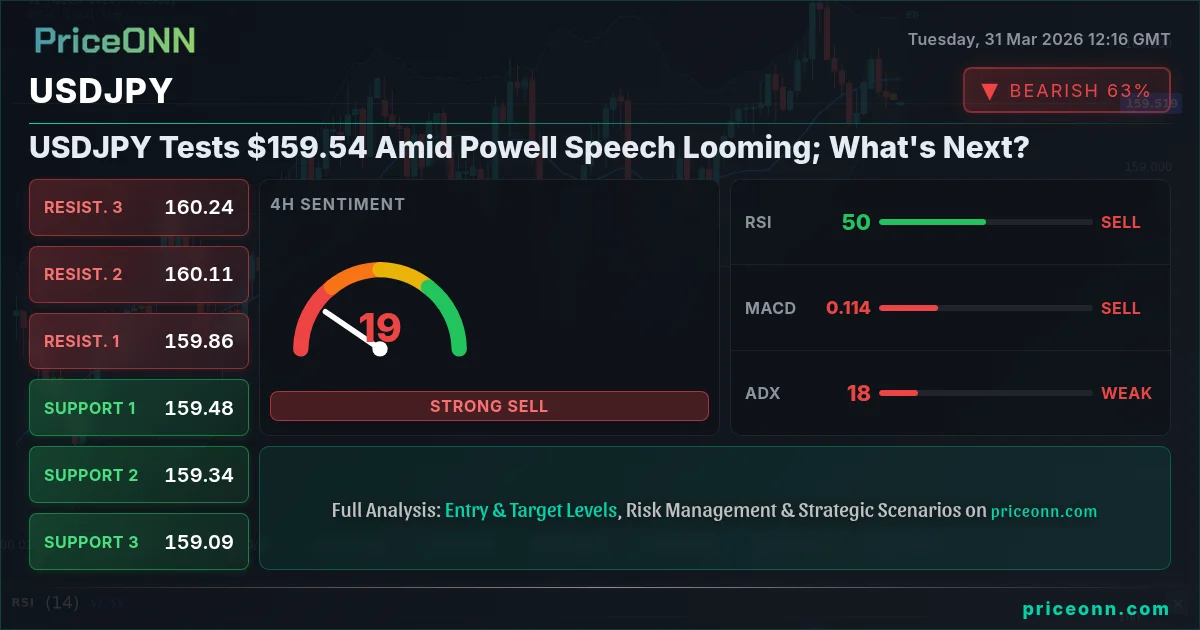
The currency markets are holding their breath as USDJPY hovers precariously around the $159.54 mark. With Federal Reserve Chair Jerome Powell's upcoming speech on the horizon, the air is thick with anticipation. This isn't just another Tuesday; it's a critical juncture where subtle shifts in central bank rhetoric could trigger significant volatility. Having observed USDJPY navigate these choppy waters, it's clear that while the daily chart hints at a potential reversal, the short-term picture remains muddled, demanding a nuanced approach rather than a blind directional bet. The interplay between the Bank of Japan's dovish stance and the Federal Reserve's hawkish undertones continues to set the stage for a fascinating technical and fundamental battleground.
- USDJPY is currently trading at $159.54, a level that has seen significant attention.
- The 1-Day RSI at 57.91 suggests underlying bullish momentum, but the MACD histogram is negative, indicating caution.
- Key resistance looms at $160.32, while support is found around $159.19.
- Traders are closely watching the DXY index, currently at 100.08, for clues on dollar strength.
The technical landscape for USDJPY presents a complex mosaic of signals, making a definitive short-term call challenging. On the 1-hour chart, the trend is decidedly bearish with a strength of 78%, supported by a negative MACD momentum and an RSI hovering at 43.83. This suggests immediate downward pressure. However, pivot to the 4-hour chart, and the trend shifts to neutral with 50% strength. Here, the MACD is also negative, but the RSI at 49.95 sits right on the fence, indicating indecision. The Stochastic K line at 31.22 is crossing above the D line at 24.30, offering a potential bullish divergence – a classic signal that sellers might be losing steam, even if the trend indicators haven't caught up yet. This divergence is particularly interesting given the ADX reading of 17.78, which points to a weak, consolidating trend, ripe for a breakout but lacking conviction.
When we zoom out to the daily timeframe, the picture becomes even more intriguing, and frankly, more concerning for immediate directional traders. The daily trend is classified as bullish with a significant strength of 87%. The RSI at 57.91 is in the neutral zone but trending upwards, aligning with the bullish trend. The MACD is still printing negative momentum, sitting below its signal line, which is a lingering bearish sign, but the Stochastic indicator is flashing a strong buy signal with %K at 79.58 and %D at 71.85 – firmly in overbought territory but still pointing higher. The ADX at 23.89 indicates a medium-strength uptrend. This multi-timeframe conflict – bearish short-term signals battling against a bullish longer-term trend and a neutral mid-term outlook – is precisely why many are adopting a 'watch and wait' strategy.
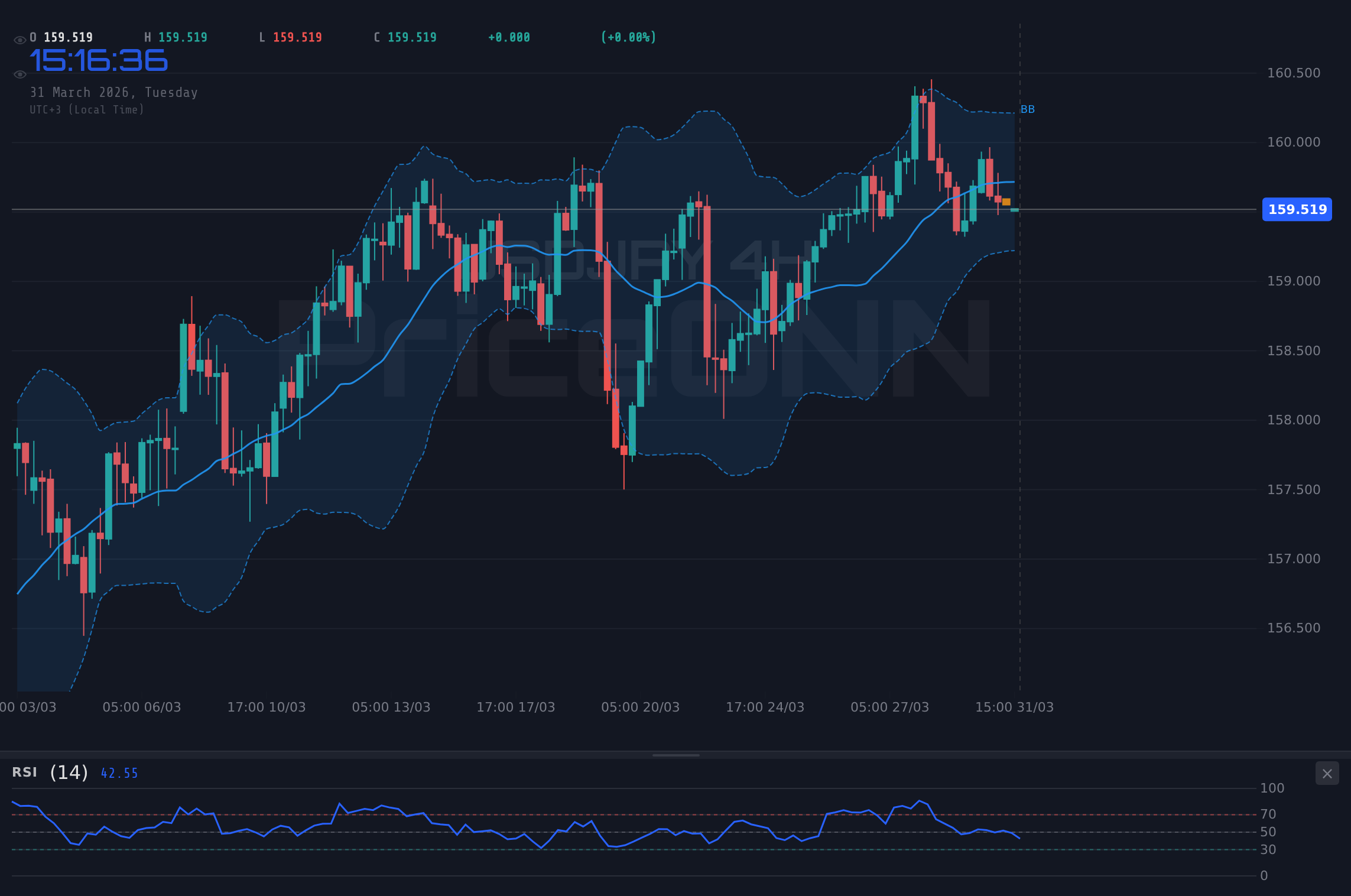
The conflicting signals across different timeframes are a clear warning. A strong directional bias is not yet supported by confluence. Therefore, patience is paramount. Jumping into positions based on a single timeframe's signal could lead to whipsaws. The market is telling us to wait for confirmation, ideally a daily close decisively above resistance or a clear breakdown below support.
The Dollar Index (DXY) currently stands at 100.08, showing a slight daily decline of 0.12%. On the 1-hour chart, it exhibits a bullish trend (99% strength) with RSI at 50.96 and a strong ADX of 38.56. However, the 4-hour chart reveals a bullish trend (95% strength) but with RSI at 65.11, bordering on overbought, and a Stochastic %K below %D signaling a potential pullback. The daily chart confirms a strong bullish trend (100% strength) with RSI at 62.31. This strength in the dollar, despite minor intraday fluctuations, provides a foundational support for USDJPY. When the DXY strengthens, it typically exerts upward pressure on USDJPY, making the pair's current consolidation near $159.54 even more noteworthy. The market is pricing in a scenario where the Fed remains hawkish, supporting the dollar, even as the Bank of Japan (BoJ) hints at policy normalization.
The recent news flow adds another layer of complexity. Reports indicate that USD/JPY retreated below 160.00 after hitting a year-to-date high, influenced by the Bank of Japan's hawkish meeting minutes. This suggests that while the carry trade advantage (borrowing in low-yield JPY to invest in higher-yield USD assets) remains, the BoJ is subtly signaling a potential shift away from negative interest rates. This is a long-term factor that could cap USDJPY's upside, even if immediate pressures from the Fed's stance and interest rate differentials remain. Conversely, ongoing Middle East tensions and oil prices surging towards $120 are creating inflationary pressures globally. This environment often benefits safe-haven assets, but in the context of USDJPY, it can also lead to a 'risk-off' sentiment that might temporarily strengthen the JPY as a safe haven, although the dominant driver has been the interest rate differential.
The current ADX readings across multiple timeframes (1H: 15.52, 4H: 17.78, 1D: 23.89) consistently point towards weak to moderate trending conditions. This implies that the market is not in a strong directional phase, making breakout strategies particularly risky without prior confirmation. We are likely in a consolidation period before a significant move, driven by upcoming fundamental catalysts like Powell's speech.
Looking at broader market correlations, the S&P 500 is currently at 6400.1, showing a strong daily gain of 0.96%. However, the 4-hour and daily charts reveal a bearish trend with ADX readings of 28.33 and 50.27 respectively. This suggests that while equities are showing some resilience, the underlying trend on longer timeframes is down. A significant risk-off event, potentially triggered by Powell's speech or escalating geopolitical tensions, could lead to a sharp sell-off in equities. In such a scenario, we might see a flight to safety, which could, paradoxically, benefit the JPY as a safe-haven currency, putting downward pressure on USDJPY, despite the dollar's own safe-haven status.
Gold prices, currently at $4574.44, are showing a strong upward trend on the 1-hour and 4-hour charts, though the daily chart presents a more neutral picture with RSI at 40.61. The surge in gold, driven by geopolitical risks and falling US yields (as noted by the March 31 news), typically occurs when the dollar weakens or inflation concerns rise. However, the dollar is showing underlying strength. This divergence highlights the complex market dynamics. If Powell's speech signals a more hawkish stance, it could lead to higher yields, potentially pressuring gold and supporting the dollar, which would be a double-edged sword for USDJPY – dollar strength being bullish, but higher yields potentially signaling economic resilience that could eventually lead to BoJ policy normalization, capping gains.
The immediate price action around $159.54 is crucial. The 1-hour resistance is identified at $159.78, followed by $159.84 and $159.91. A sustained break above $159.91 on the 1-hour chart, ideally accompanied by increasing volume and positive MACD crossover, could signal the start of a move towards the daily resistance levels. On the flip side, immediate support is found at $159.53, $159.26, and $159.09. A decisive close below $159.19 on the daily chart would invalidate the bullish longer-term outlook and open the door for a more significant correction, potentially targeting the $158.69 support level. The ADX value of 17.78 on the 4-hour suggests that any breakout needs strong confirmation; otherwise, it could be a false move.
For a bullish setup to materialize, we need to see a clear daily close above the $159.91 resistance level. This should be accompanied by a positive MACD crossover on the 4-hour chart and an RSI moving above 50. Conversely, a bearish setup would be confirmed by a daily candle closing below the $159.19 support, with the MACD histogram turning decisively negative and the RSI falling below 40.
The narrative surrounding USDJPY is heavily influenced by the interest rate differential and central bank policy expectations. The Fed, under Powell, has been navigating a complex inflation landscape. While recent data might suggest some easing, the Fed's rhetoric has often maintained a hawkish bias, aiming to ensure inflation is firmly under control. CME FedWatch data, if available, would provide precise probabilities for rate cuts, but generally, the market anticipates a cautious approach from the Fed. Any hint of a delay in rate cuts or a more aggressive stance on inflation from Powell's speech would likely strengthen the dollar, pushing USDJPY higher. Conversely, signals of an imminent pivot or concerns about economic slowdown could weaken the dollar, leading to a USDJPY pullback.
On the other side of the pair, the Bank of Japan's recent policy meeting minutes have introduced a degree of uncertainty. While they have maintained their ultra-loose monetary policy for now, the discussion around potential future policy shifts - such as ending negative interest rates or yield curve control - is gaining traction. This is a critical factor that could fundamentally alter the USDJPY dynamic in the medium to long term. If the BoJ signals a more concrete path towards policy normalization, it could lead to JPY strengthening across the board, capping USDJPY gains even if the dollar remains robust due to Fed policy. This is the 'unknown unknown' that keeps traders on edge.
Considering the broader economic calendar, upcoming high-impact events will be crucial. While today's calendar is light on major releases for USDJPY's constituents (EUR, GBP, USD, JPY), the anticipation of Powell's speech overshadows much of the immediate data. Looking ahead, any significant US employment or inflation data releases in the coming days will be scrutinized for their impact on Fed policy expectations. Similarly, any hints from the BoJ regarding their policy path will be keenly watched. The market is essentially in a holding pattern, waiting for these catalysts to provide the necessary directional conviction. The current price action around $159.54 is a reflection of this uncertainty – a tight range where neither bulls nor bears have a clear upper hand without further fundamental confirmation.
Frequently Asked Questions: USDJPY Analysis
What happens if USDJPY breaks decisively above $160.32 resistance following Powell's speech?
A sustained daily close above $160.32, especially if accompanied by a hawkish tone from Powell, would likely signal a continuation of the bullish trend. This could open the door for further upside, potentially targeting levels near $161.45, with the MACD confirming a bullish momentum shift.
Should I consider a short position if USDJPY closes below $159.19 support today?
A daily close below $159.19 would invalidate the current bullish bias and suggest a deeper correction. Given the ADX strength on the daily chart at 33.15, this breakdown could lead to a move towards the $158.69 support level, especially if the BoJ's stance remains implicitly dovish.
Is the RSI at 57.91 a buy signal for USDJPY on the daily chart?
An RSI of 57.91 is in the neutral zone, leaning bullish but not indicating an immediate buy signal on its own. It suggests upward momentum is present but not yet overwhelming. Confirmation from other indicators like MACD crossover or a clear price breakout above resistance would be needed for a strong buy signal.
How might Powell's upcoming speech impact USDJPY if inflation concerns are re-emphasized?
If Powell reiterates concerns about persistent inflation, it would likely reinforce a hawkish Fed outlook. This could strengthen the US Dollar, pushing USDJPY higher towards resistance levels like $160.32, assuming the BoJ's policy signals don't provide significant counter-pressure.
The path forward for USDJPY hinges on the delicate balance between Fed policy expectations and BoJ signals, all while navigating geopolitical crosswinds. The current technical picture is one of consolidation rather than conviction. Traders must remain disciplined, waiting for clear confirmation of a trend continuation or reversal. The $159.54 level is not just a price point; it's a psychological battleground where the next significant move will likely be decided. As always, managing risk and focusing on high-probability setups remain the cornerstone of successful trading.
Track markets in real-time
AI-powered analysis, technical indicators and real-time price data.
Join Our Telegram Channel
Breaking market news, AI analysis and trading signals instantly.
Join Channel