

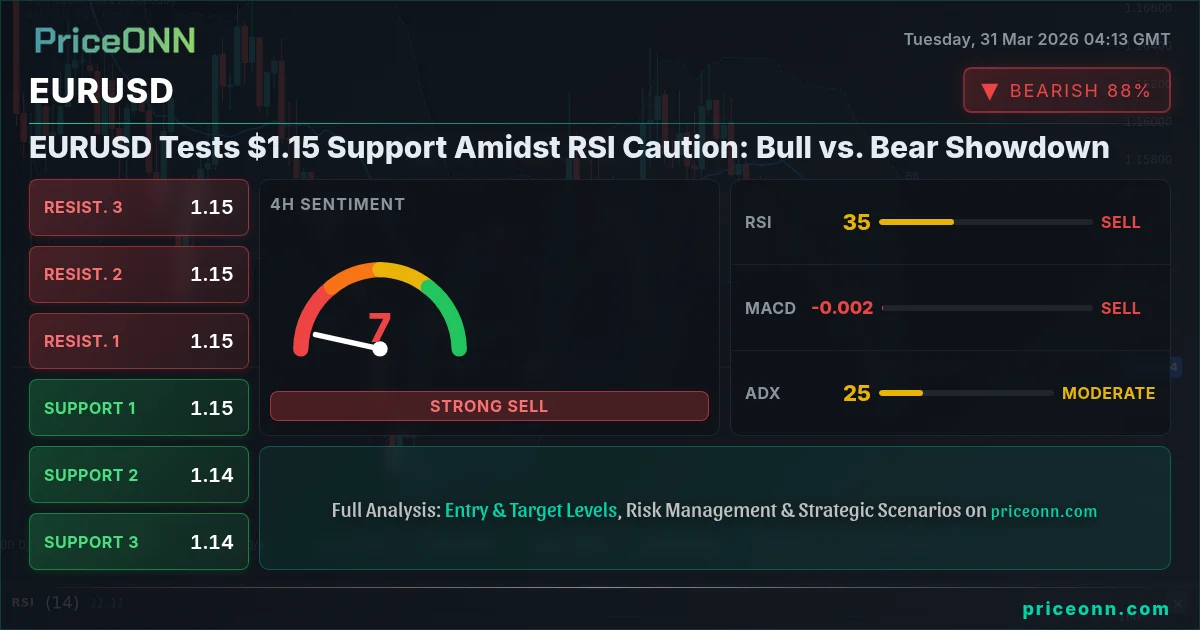
The tug-of-war between bulls and bears is intensifying around the critical $1.15 level for EURUSD. After a period of choppy trading, the pair is now testing key support zones, but mixed signals from technical indicators suggest a significant battle is underway. This isn't just about a single currency pair; it's a microcosm of broader market tensions driven by shifting economic outlooks, geopolitical instability, and the ever-present influence of the US Dollar Index (DXY). Understanding the forces at play here requires a multi-faceted approach, examining not just the euro and dollar but also their global economic counterparts and the underlying risk sentiment driving market participants.
- EURUSD is testing support near $1.1470, with the critical psychological level at $1.15 in focus.
- The 1D RSI at 37.84 indicates a bearish trend, but the 1H Stochastic is showing a potential bounce signal.
- Key resistance is forming around $1.1509, while immediate support lies at $1.1472.
- Geopolitical tensions in the Middle East and a strong DXY at 100.25 are influencing EURUSD's direction.
The current price action for EURUSD, hovering precariously around the $1.1470 mark with the crucial $1.15 psychological level acting as a magnet, presents a classic battleground scenario. The daily chart paints a decidedly bearish picture, with the Relative Strength Index (RSI) at 37.84, firmly in oversold territory and signaling a downtrend. This aligns with the longer-term trend, which appears to be in favor of the bears. However, the shorter timeframes offer a glimmer of hope for the bulls. The 1-hour Stochastic oscillator, with %K at 60.75 and %D at 62.65, is showing a potential divergence and a move towards oversold conditions, suggesting a possible short-term reversal or at least a pause in the selling pressure. This dichotomy between the daily bearish sentiment and the intraday signals creates a complex trading environment, where confirmation is paramount. The market is clearly at a crossroads, and the next move could be significant, dictated by a confluence of technical levels and fundamental drivers.
The Bullish Case: A Counter-Trend Rally in the Making?
For the bulls to regain control, they need to overcome several significant hurdles, primarily centered around the immediate resistance levels and the prevailing bearish momentum. The 1-hour chart offers some solace, with the Stochastic %K (60.75) beginning to curl upwards, potentially indicating a short-term bounce. Coupled with a MACD that shows positive momentum on the 1-hour timeframe, there's a narrative to be built for a tactical short-covering rally. The idea here is that the pair has been oversold on shorter timeframes, and a natural correction is due. This scenario would likely be triggered by a break and hold above the immediate 1-hour resistance at $1.14785. Should this occur, the next target would be the $1.1485 level, followed by a more significant test of the $1.1509 resistance. Furthermore, a weakening of the US Dollar Index (DXY), which is currently trading around 100.25, could provide the necessary tailwind. If the DXY falters from its current elevated levels, particularly if it dips below the 4-hour middle band, it would reduce the headwinds faced by EURUSD and potentially fuel a move higher. Traders looking to play this scenario would be anticipating a reversal, betting that the current downtrend has exhausted itself in the short term and that a retracement is the most probable outcome before any further downside.
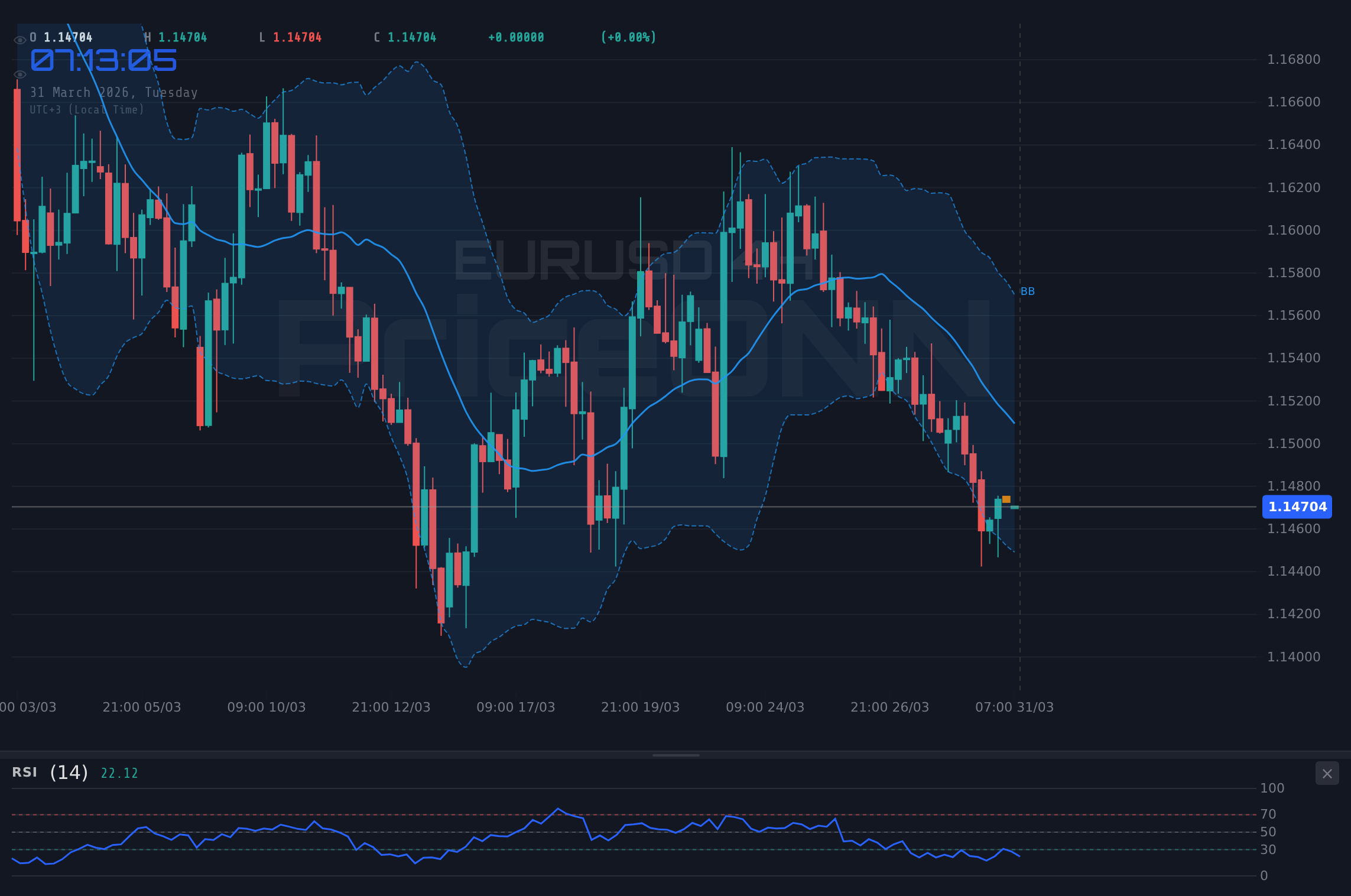
The key to a sustained bullish move, however, lies in breaking the bearish sentiment on the daily charts. This would require more than just a short-term technical bounce. It would necessitate a fundamental catalyst that shifts the market's perception of the Euro's prospects. Currently, the daily RSI at 39.88 on the 1-hour chart and 35.11 on the 4-hour chart, and 37.84 on the daily chart, are all pointing downwards, indicating that sellers are in control over the medium to long term. For a true bullish reversal, we would need to see these indicators turn around, ideally with RSI pushing above 50 and staying there. The ADX on the daily chart at 33.15 also confirms a strong downtrend, making any bullish counter-trend move an uphill battle. The 4-hour Stochastic, currently K=75.02, D=75.34, is also signaling a potential pullback, reinforcing the bearish bias on that timeframe. Even the 1-hour MACD, while showing positive momentum, is still below the signal line on the 4-hour chart, indicating underlying weakness. Therefore, while a short-term bounce is possible, the path to a sustained bullish trend is fraught with significant technical and fundamental resistance.
From a broader market perspective, the bullish case for EURUSD would be bolstered by a significant shift in global risk sentiment. If risk appetite were to surge, leading to a sell-off in safe-haven assets like the US Dollar and potentially even gold, it could create an environment where the Euro finds stronger footing. However, the current market backdrop doesn't strongly support this. Geopolitical tensions, particularly in the Middle East, are keeping a bid under safe-haven currencies and commodities. The Brent crude price at $110.91 and WTI at $103.23, despite recent dips, remain elevated, contributing to inflation concerns that generally favor stronger currencies or at least currencies of commodity-exporting nations. The correlation with the DXY is also crucial; if the dollar index, currently at 100.25, were to show signs of topping out or reversing significantly, it would open the door for EURUSD gains. However, the DXY's own daily trend is bullish with an ADX of 33.32, making a sustained dollar weakness scenario less probable in the immediate term. The strength of US indices like the SP500 (6401.85) and Nasdaq (23140.87) can also influence risk sentiment, but their own daily trends are bearish, further complicating the picture for risk-on assets.
The Bearish Case: Downside Momentum and Fundamental Weakness
The bearish argument for EURUSD is arguably stronger, supported by consistent technical signals across multiple timeframes and a challenging fundamental outlook for the Eurozone. The daily chart is the most compelling evidence: RSI at 37.84, MACD below its signal line with negative momentum, and Bollinger Bands showing the price below the middle band all point towards continued downside. The ADX at 33.15 on the daily timeframe indicates a strong downtrend, suggesting that the current move is not merely a shallow correction but a significant trend. The immediate support at $1.1472 is already being tested, and a break below it would open the door for further declines towards the next support level at $1.14655 on the 1-hour chart, and more significantly, the 4-hour support at $1.14562. A decisive break below $1.1450 could trigger a cascade of stop-loss orders, accelerating the fall towards the $1.14309 support on the daily chart. The overall signal for the daily timeframe is a clear 'SELL', with 8 out of 8 indicators aligning for bearish continuation.
Fundamentally, the Eurozone faces a complex economic landscape. While inflation has shown signs of moderating in some regions, the overall economic growth picture remains sluggish compared to the United States. German inflation data, which is closely watched, is projected to surge, potentially complicating the European Central Bank's (ECB) policy decisions. If inflation proves stickier than expected, it could force the ECB to maintain a hawkish stance or even consider further tightening, which would typically support the Euro. However, the current economic data doesn't necessarily support this scenario. The lack of significant high-impact economic calendar events in the immediate aftermath of the provided data, beyond general trend indicators, means that any directional move will likely be driven by technicals and broader market sentiment. The correlation with the DXY is also a major factor. As the DXY shows a strong bullish trend on the daily chart (ADX 33.32) and is trading above 100, it exerts consistent downward pressure on EURUSD. A stronger dollar generally implies tighter financial conditions globally, which can weigh on riskier assets and emerging market currencies, but also on currency pairs like EURUSD where the dollar is the base currency.
The geopolitical backdrop further reinforces the bearish narrative for EURUSD. Escalating tensions in the Middle East, as highlighted by the Russia-Cuba fuel voyage and the resulting oil price surge (Brent at $110.91, WTI at $103.23), are keeping safe-haven demand elevated. This environment typically favors the US Dollar as a safe-haven currency, further pressuring EURUSD. While Europe has faced recurring energy crises, the current geopolitical shocks are adding another layer of uncertainty to the region's economic outlook. If these tensions were to escalate further, leading to broader supply disruptions or increased military conflict, it could trigger a significant risk-off event, driving capital away from the Euro and towards the perceived safety of the dollar. The weak performance of European indices like the Dow Jones (45636.5) on its daily chart, despite a recent rebound, also suggests underlying caution in the broader market, which is not conducive to a strong Euro.
Technical Confluence and the Path Forward
The technical indicators present a conflicting yet ultimately revealing picture for EURUSD. On the daily timeframe, the signals are overwhelmingly bearish: RSI at 37.84, MACD negative, ADX strong at 33.15, and Stochastic showing a bearish crossover (K=19.07, D=54.37). This suggests that any rallies are likely to be short-lived and sold into. The immediate support at $1.1472 is critical; a break below this level would confirm the bearish bias and open the path towards $1.14655 and potentially $1.14309. The strength of the daily downtrend, as indicated by the ADX, means that significant counter-trend moves are difficult to sustain.
However, the shorter timeframes introduce an element of caution for the bears. The 1-hour chart shows a Stochastic %K (60.75) above %D (62.65) and moving higher, suggesting potential short-term upward momentum. The MACD on the 1-hour is also positive. This could lead to a brief retracement or consolidation before the main downtrend resumes. Traders looking for confirmation of a bullish move on the 1-hour would need to see a clear break above the $1.14785 resistance, with sustained buying pressure. Conversely, failure to hold the $1.1472 support would likely lead to a rapid decline. The 4-hour chart presents a mixed bag: RSI at 35.11 is bearish, but Stochastic shows a potential bounce (K=22.31, D=20.67). The ADX at 24.61 indicates a moderate downtrend, less decisive than the daily.
The overarching narrative is one of a strong daily downtrend facing potential short-term headwinds. The confluence of bearish daily signals, coupled with the strong DXY and persistent geopolitical risks, suggests that the path of least resistance remains to the downside. However, the intraday indicators do offer a possibility of a short-term bounce, which could be exploited by nimble traders. The key will be to watch the $1.1472 support level. A decisive break below it would likely confirm the bearish continuation, targeting lower levels. A hold and bounce from this level, however, could lead to a test of the $1.1509 resistance, but a sustained move higher would require a significant shift in market sentiment or a weakening of the dollar.
Trade Scenarios and Outlook
Bearish Scenario: Downside Acceleration
65% ProbabilityNeutral Scenario: Consolidation Around $1.15
25% ProbabilityBullish Scenario: Short-Term Bounce
10% ProbabilityFrequently Asked Questions: EURUSD Analysis
What happens if EURUSD breaks below the $1.1472 support level?
A break below $1.1472 on the 1-hour chart would confirm the bearish trend, potentially accelerating declines towards the $1.14309 support level identified on the daily chart. This would likely be driven by continued dollar strength and risk-off sentiment.
Should I consider buying EURUSD at current levels of $1.1470 given the daily RSI is 37.84?
Buying at current levels is a high-risk proposition given the strong daily bearish trend indicated by the RSI. While a short-term bounce is possible, a confirmed break above $1.1485 would be needed for higher probability bullish setups, targeting $1.1509 resistance.
Is the bearish RSI at 37.84 a definitive sell signal for EURUSD?
While a daily RSI below 40 suggests bearish momentum, it's not a definitive sell signal on its own. Confirmation from other indicators like MACD and ADX, along with price action breaking key support levels like $1.1472, is crucial for validating a sell-off.
How will the DXY at 100.25 affect EURUSD this week?
The DXY's bullish trend and current price above 100 exert downward pressure on EURUSD. If the DXY continues to strengthen, it will make it harder for EURUSD to sustain any upward moves and could contribute to further declines towards $1.14309.
Track markets in real-time
AI-powered analysis, technical indicators and real-time price data.
Join Our Telegram Channel
Breaking market news, AI analysis and trading signals instantly.
Join Channel