
Australian Dollar edges higher to near 0.6950 on RBA hawkish rhetoric
 PriceONN Editorial Desk
Multi-source verification
PriceONN Editorial Desk
Multi-source verification

Aussie Dollar's Ascent Fueled by Monetary Policy Signals
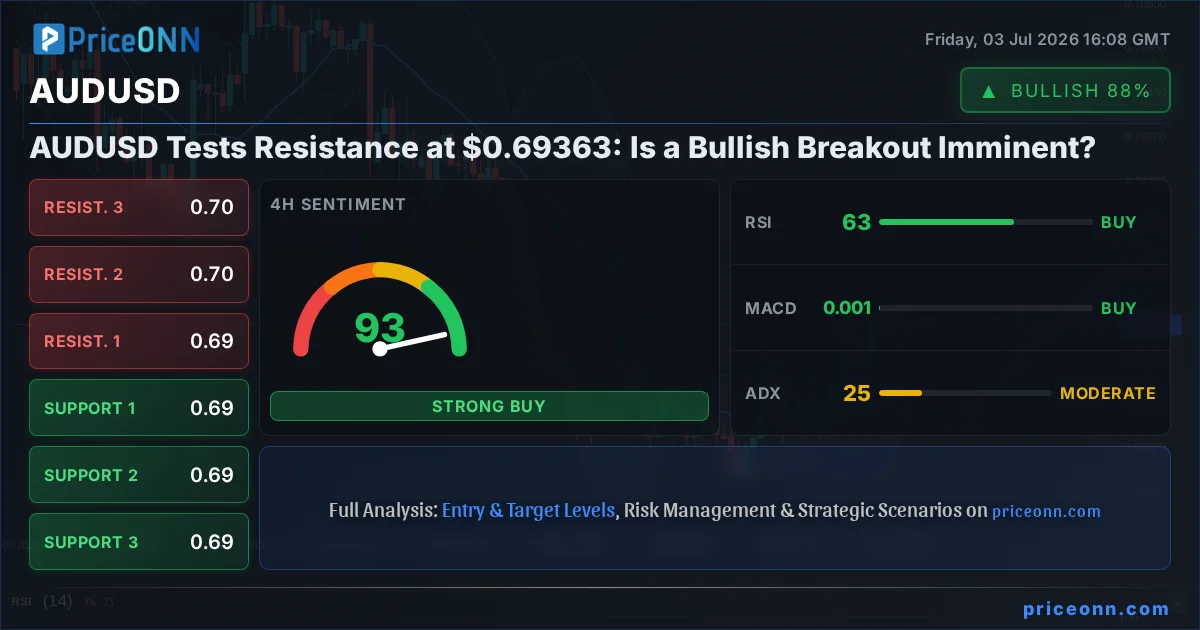
The Australian Dollar is flexing its muscles, nudging closer to the 0.6950 level in early Asian session trading. This upward momentum is largely attributable to a decidedly hawkish tone emanating from the Reserve Bank of Australia (RBA), signaling a potential shift in the nation's monetary policy stance.
At the heart of the AUD's valuation lies the benchmark interest rate policy dictated by the RBA. For a nation whose economic fortunes are intrinsically tied to its vast natural resources, the global price trajectory of key commodities, particularly iron ore, plays a critical role. Concurrently, the economic vitality of China, Australia's paramount trading partner, casts a long shadow. Domestic factors such as inflation figures, the pace of economic expansion, and the nation's trade balance also contribute significantly to the currency's performance. Furthermore, global investor sentiment, specifically the prevailing risk appetite, acts as a barometer; a 'risk-on' environment typically bolsters the AUD, while a 'risk-off' scenario tends to suppress it.
Unpacking the RBA's Influence on the Currency
The RBA wields considerable influence over the Australian Dollar (AUD) by setting the official cash rate, which governs the cost of interbank lending. This foundational rate cascades through the broader economy, impacting borrowing costs for businesses and consumers alike. The central bank's primary mandate is to maintain price stability, targeting an inflation rate between 2% and 3%. To achieve this, the RBA adjusts interest rates, either increasing them to cool inflationary pressures or decreasing them to stimulate economic activity. A policy of relatively higher interest rates compared to those offered by other major central banks generally enhances the appeal of the AUD, attracting foreign capital seeking better returns. Conversely, a policy of significantly lower rates can diminish the currency's attractiveness.
Beyond rate adjustments, the RBA possesses tools like quantitative easing (QE) and quantitative tightening (QT). QE, which involves injecting liquidity into the financial system, typically exerts downward pressure on the AUD. Conversely, QT, which withdraws liquidity, tends to support the currency's value. These unconventional measures can have a pronounced effect on credit conditions and, consequently, on the AUD's exchange rate.
Global Economic Interdependencies Shaping the AUD
The economic health of China, Australia's largest export market, is a critical determinant of the AUD's strength. When the Chinese economy thrives, its demand for Australian raw materials, goods, and services escalates. This heightened demand translates directly into increased demand for the Australian Dollar, pushing its value higher. Conversely, any slowdown in China's growth trajectory often leads to reduced demand for Australian exports, thereby weakening the AUD.
Surprises in Chinese economic data releases, whether positive or negative, frequently trigger immediate reactions in the Australian Dollar and its associated currency pairs. This sensitivity highlights the deep economic linkage between the two nations.
Commodity Prices and Trade Balance Dynamics
Iron ore stands as Australia's single largest export, generating approximately $118 billion annually as of 2021, with China being the principal buyer. Consequently, fluctuations in iron ore prices can serve as a significant catalyst for the AUD. A general trend of rising iron ore prices typically correlates with an appreciation of the Australian Dollar, driven by increased aggregate demand for the currency from the commodity's trade. The reverse is true when iron ore prices decline.
Moreover, elevated iron ore prices often contribute to a more favorable Trade Balance for Australia. The Trade Balance itself, representing the difference between a nation's export earnings and its import expenditures, is another key influencer of currency value. When Australia successfully exports high-demand commodities and goods, its currency tends to strengthen as foreign entities require more AUD to facilitate these purchases. A positive net Trade Balance, therefore, bolsters the AUD, while a negative balance exerts downward pressure.
Reading Between the Lines
The RBA's recent hawkish rhetoric, while providing an immediate lift to the AUD/USD pair, warrants careful consideration. Traders will be scrutinizing upcoming RBA communications for further confirmation of a sustained tightening bias. The interplay between domestic interest rate policy and the fluctuating global demand for Australian commodities, particularly iron ore driven by China's economic pulse, remains the core dynamic. Any divergence between the RBA's stance and that of other major central banks, like the US Federal Reserve, will be critical. A widening interest rate differential favoring Australia could provide further upside, but this is contingent on China's growth trajectory remaining stable and commodity prices holding firm. Investors should monitor the 0.6950 resistance level closely; a sustained break above this could signal further gains, while a retreat below could indicate waning bullish momentum.
The immediate impact of hawkish central bank commentary often creates short-term volatility. For the Australian Dollar, this means potential headwinds from global risk sentiment shifts or unexpected economic data from China could quickly reverse recent gains. Key assets to watch include the AUD/USD cross, commodity indices, and equities sensitive to Chinese demand. Traders should also keep an eye on the US Dollar Index (DXY) for broader market sentiment cues.
Track markets in real-time
Empower your investment decisions with AI-powered analysis, technical indicators and real-time price data.
Join Our Telegram Channel
Get breaking market news, AI analysis and trading signals delivered instantly to your Telegram.
Join Channel PriceONN News
The minutes from the Reserve Bank of Australia’s (RBA) June meeting, released on 30 June, suggested that policymakers are not yet ready to rule out further policy tightening. Board members noted persistent excess demand and broad-based inflationary pressures across the economy, leaving the door open for another interest rate increase if required. Against this backdrop, […] The post Australian Dollar Holds Above the Current Market Profile appeared first on ActionForex.
PriceONN News
Oil is back in the driver’s seat, and both the pound and the aussie are feeling its grip. The Bank of England held rates at 3.75% in June, but with UK inflation at 2.8% and crude oil climbing on renewed Middle East tensions, markets now lean towards a hike before year-end. Down under, the Reserve […] The post GBP/AUD Analysis: the Tug-Of-War Begins appeared first on ActionForex.
PriceONN News
The NZD/USD pair trades in positive territory around 0.5775 during the early European session on Friday. The New Zealand Dollar (NZD) gathers strength to its strongest level in three weeks against the US Dollar (USD) on a hawkish rate hike from the Reserve Bank of New Zealand (RBNZ).
PriceONN News
Silver price (XAG/USD) trades 0.4% higher to near $60.22 during the European trading session on Friday. The white metal gains as the US Dollar (USD) continues to remain under pressure amid hopes that the restart of the war between the United States (US) and Iran won’t long last.
PriceONN News
The Swiss Franc (CHF) pares some of its early gains against the US Dollar (USD) during the early European trading session on Friday. The USD/CHF pair is 0.26% lower at around 0.8048 even after a slight recovery move.
PriceONN News
The Indian Rupee (INR) extends Thursday’s recovery against the US Dollar (USD) in the opening session on Friday. The USD/INR pair falls further to near 95.22 as the US Dollar weakens as the restart of the war in the Middle East between the United States (US) and Iran won’t be prolonged.
PriceONN News
The GBP/USD pair trades in positive territory around 1.3430 during the early European trading hours on Friday. The UK government leadership transition and growing expectations of further Bank of England (BoE) interest rate hikes underpin the British Pound (GBP) against the US Dollar (USD).
PriceONN News
The EUR/USD pair attracts some buyers for the third consecutive day and touches a fresh weekly high, around the 1.1460 area, during the Asian session on Friday.
PriceONN News
The USD/CAD pair loses momentum to near 1.4145 during the early European session on Friday. The US Dollar (USD) weakens against the Canadian Dollar (CAD) on receding expectations of a rate increase from the US Federal Reserve (Fed).
PriceONN News
The US Dollar (USD) extends its losing streak for the third trading day on Friday amid signs of de-escalation in the ongoing clash between the United States (US) and Iran.
PriceONN News
The GBP/USD pair gathers strength to around 1.3430 during the Asian trading hours on Friday. The British Pound (GBP) edges higher against the US Dollar (USD) on the UK government leadership transition and growing expectations of further Bank of England (BoE) interest rate hikes.
PriceONN News
The EUR/USD pair posts modest gains around 1.1430 during the early Asian session on Friday, bolstered by a softer US Dollar (USD).