
Bitcoin and Ethereum Face Renewed Selling Pressure as Global Risk Aversion Mounts
The cryptocurrency market is facing renewed selling pressure, with major assets like Bitcoin (BTC) and Ethereum (ETH) struggling to maintain recent gains. What appeared to be a brief period of isolation from broader market anxieties has quickly dissipated, underscoring the interconnectedness of global financial assets. A pervasive sense of risk aversion, amplified by persistent inflationary concerns and a strengthening US Dollar, is now weighing heavily on digital assets.
Market Context
The year has been characterized by deceptive upward price movements across various asset classes, and cryptocurrencies have not been immune. Last week, there was a perception that digital assets might be diverging from the general market malaise. However, this notion has evaporated as global financial markets experience a significant downturn. This bearish sentiment is impacting assets across the risk spectrum, from traditional safe havens like bonds and precious metals to riskier equities and digital currencies. The prevailing market dynamic shows that a stronger US Dollar is currently a headwind for most other assets, including cryptocurrencies. Rising energy prices are further complicating the economic landscape, making it challenging to find effective hedges against broader market declines.
Bitcoin, in particular, recently attempted to surpass the significant $75,000 psychological level shortly after the 20 million BTC issuance milestone. However, its subsequent failure to sustain this upward momentum has cascaded through the entire digital asset class. Market data shows that this widespread selling has led to sharp declines, with some altcoins plummeting by as much as 2% in recent trading sessions. This environment is particularly punishing for higher-beta assets, which are more volatile and sensitive to shifts in market sentiment.
Analysis & Drivers
The primary driver behind the current downturn appears to be a resurgence of global risk aversion. Investors are increasingly concerned about persistent inflationary pressures, which are prompting central banks to maintain a hawkish stance or even consider further tightening measures. This macroeconomic backdrop favors a stronger US Dollar, which typically acts as a drag on riskier assets like cryptocurrencies. The correlation between a strengthening dollar and declining crypto prices has been a consistent theme in recent market cycles.
Furthermore, rising energy prices are adding another layer of complexity. Higher energy costs can fuel inflation, increase operational costs for crypto miners, and generally dampen economic activity, all of which can negatively impact asset prices. While cryptocurrencies were once seen as a potential hedge against inflation or a diversifier from traditional markets, their sensitivity to risk sentiment and macroeconomic conditions cannot be overstated in the current climate. Analysts note that the failure of Bitcoin to hold its recent highs suggests that the underlying bullish momentum may be waning, at least in the short term.
Trader Implications
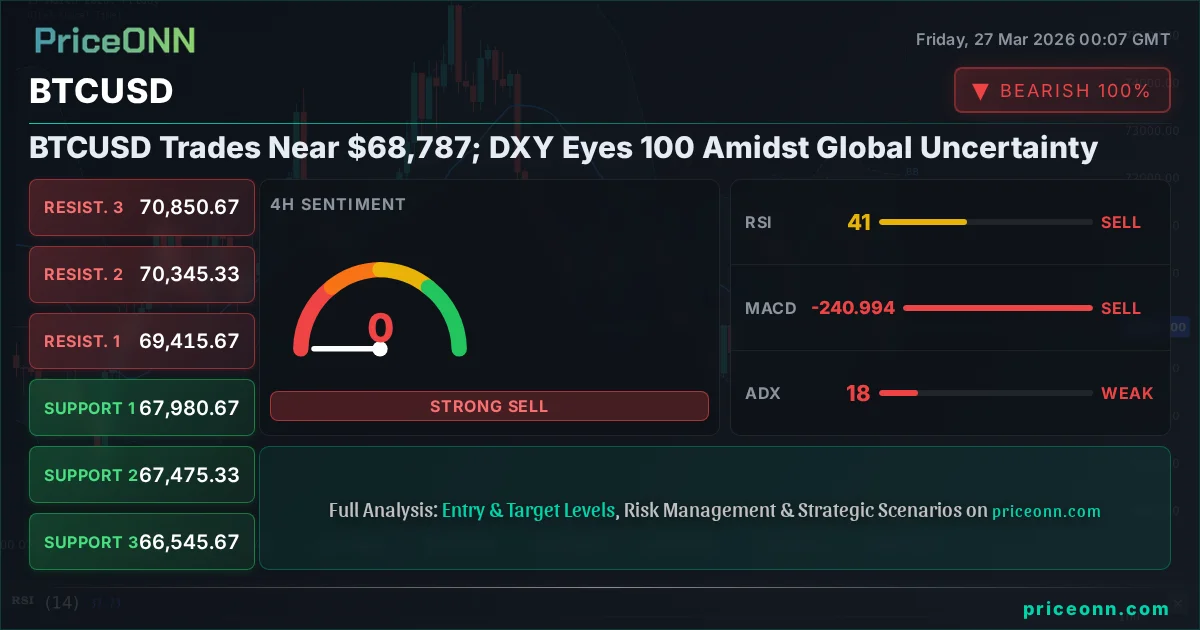
Traders should be cautious of the prevailing bearish sentiment and the potential for continued downside. Key levels to watch for Bitcoin include the $70,000 support level, which, if broken, could trigger further selling pressure. Resistance remains around the recent highs near $75,000. For Ethereum, traders will be monitoring its ability to hold above the $3,500 mark.
The increased volatility indicates that risk management is paramount. Traders might consider scaling into positions cautiously or waiting for clearer signs of a market bottom. The sensitivity to US Dollar strength and broader risk sentiment suggests that macroeconomic data releases, particularly inflation figures and central bank commentary, will be critical catalysts in the coming days and weeks. A sustained move higher in energy prices could also introduce additional headwinds.
Outlook
The immediate outlook for cryptocurrencies remains challenging as global risk aversion persists. Market participants will be closely watching for any indications of a shift in central bank policy or a de-escalation of inflationary pressures. Until then, the trend of a strengthening US Dollar and a risk-off environment is likely to continue to weigh on digital assets. Traders should brace for potential choppiness and focus on established support and resistance levels as they navigate the current market uncertainty.
Frequently Asked Questions
What is causing Bitcoin and Ethereum prices to fall?
The primary drivers are a global increase in risk aversion and persistent inflation concerns, which are strengthening the US Dollar. Bitcoin's inability to sustain its move above $75,000 has also contributed to a broader sell-off in the digital asset market.
What are the key price levels traders should watch?
Traders should monitor Bitcoin's ability to hold the $70,000 support level, with resistance at $75,000. For Ethereum, the $3,500 level is a critical support to watch.
What is the short-term outlook for cryptocurrencies?
The short-term outlook remains challenging due to ongoing global risk aversion and macroeconomic uncertainties. Further price volatility is expected until there are clear signs of easing inflation or a shift in central bank policy.
Track markets in real-time
Empower your investment decisions with AI-powered analysis, technical indicators and real-time price data.
Join Our Telegram Channel
Get breaking market news, AI analysis and trading signals delivered instantly to your Telegram.
Join Channel



PriceONN