
Can USD/JPY Sustain Gains as Yen Faces Policy Divergence?

USD/JPY is showing signs of a rebound, currently trading around 158.33 and up 0.4% during Friday's Asian session, following a significant downturn on Thursday. This recovery occurs even as the Japanese Yen (JPY) exhibits underperformance against major counterparts, a move that contrasts with signals from the Bank of Japan (BoJ) suggesting a continued hawkish stance on monetary policy.
Market Context
In a dramatic reversal on Thursday, the USD/JPY pair experienced a sharp decline of over 1.25%, falling back below the 158.00 level to settle near 157.80. This move was attributed to broad Yen strength, a development that caught many market participants by surprise. The Yen's recent volatility underscores its potential for significant price swings when underlying economic and policy factors align. Historically, the Yen has been subject to persistent depreciation, largely driven by a substantial divergence in monetary policy between the Bank of Japan and other major central banks, particularly the U.S. Federal Reserve. While other central banks were aggressively hiking rates to combat inflation, the BoJ maintained an ultra-accommodative policy for over a decade leading up to 2024. This policy gap significantly widened the interest rate differential, favoring the U.S. Dollar over the Yen.
Analysis & Drivers
The recent shifts in USD/JPY dynamics are closely tied to evolving monetary policy expectations. The Bank of Japan's decision in March 2024 to move away from its prolonged period of ultra-loose policy, including raising interest rates for the first time since 2016, marks a significant turning point. While this policy shift aims to combat persistent low inflation and normalize monetary conditions, its impact on the Yen is still unfolding. The BoJ's stated intention to maintain a hawkish outlook suggests a potential for further policy tightening, which could lend support to the Yen. However, the widening interest rate differential with the U.S. continues to exert downward pressure on the Yen. The Federal Reserve's stance on interest rates, influenced by U.S. inflation data and economic growth, remains a critical factor. Any indication of a more hawkish U.S. monetary policy from the Fed would likely counteract the supportive effects of the BoJ's tightening, potentially leading to further appreciation of the U.S. Dollar against the Yen.
Furthermore, the Yen's appeal as a safe-haven asset cannot be overlooked. During times of global economic uncertainty or geopolitical stress, investors often seek refuge in perceived stable assets. The Japanese Yen, with its deep and liquid markets, has historically benefited from such flows. Any escalation in global tensions could trigger safe-haven demand for the Yen, offering it a measure of support independent of monetary policy differentials.
Trader Implications
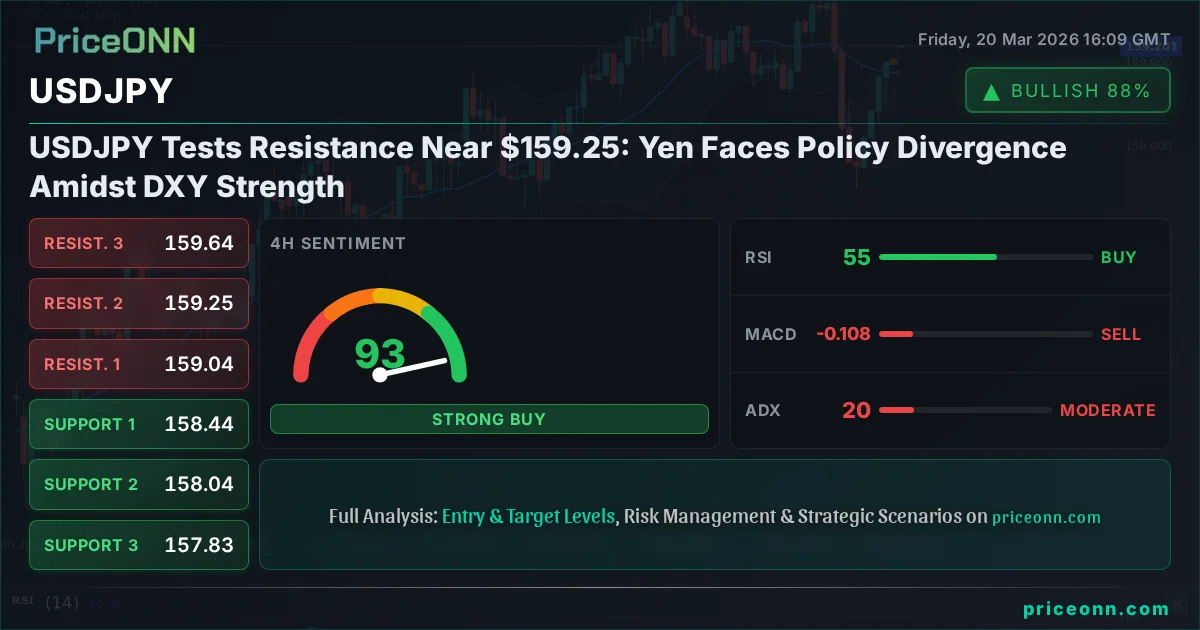
Traders monitoring the USD/JPY pair should pay close attention to the 20-day Exponential Moving Average (EMA), which is currently acting as a key support zone around the 157.50 level. A sustained break below this level could signal further downside momentum. Conversely, resistance may be found near the recent highs around 158.50. Key catalysts to watch include upcoming economic data releases from both the U.S. and Japan, as well as any further commentary from central bank officials regarding their respective monetary policy outlooks. The divergence between the BoJ's hawkish signals and the broader market's expectation for Fed rate cuts remains a primary driver of volatility. Traders should also be aware of the potential for sudden shifts in sentiment driven by safe-haven flows, which could quickly alter the Yen's trajectory.
Outlook
The outlook for USD/JPY remains uncertain, caught between the Bank of Japan's policy normalization and the persistent interest rate advantage held by the U.S. Dollar. While the BoJ's shift away from ultra-loose policy provides some underlying support for the Yen, the Federal Reserve's policy path will likely dictate the near-term direction. A continuation of the BoJ's tightening cycle, coupled with any signs of a less hawkish stance from the Fed, could see USD/JPY test lower levels. However, if U.S. economic data remains robust and the Fed signals a slower pace of rate cuts than anticipated, the pair could regain upward momentum, potentially retesting levels above 158.50.
Frequently Asked Questions
What is the key support level for USD/JPY?
The 20-day Exponential Moving Average (EMA) is currently acting as a critical support zone for USD/JPY, located around the 157.50 level. A break below this point could indicate further downward pressure.
Why did USD/JPY drop sharply on Thursday?
USD/JPY dropped over 1.25% on Thursday, settling near 157.80, primarily due to a broad strengthening of the Japanese Yen. This move occurred despite the general narrative of Yen weakness seen over the past year.
What is the Bank of Japan's current monetary policy stance?
The Bank of Japan (BoJ) has signaled a continued hawkish approach to monetary policy. This was marked by their decision in March 2024 to raise interest rates, departing from over a decade of ultra-loose policy, aiming to combat low inflation.
Track markets in real-time
Empower your investment decisions with AI-powered analysis, technical indicators and real-time price data.
Join Our Telegram Channel
Get breaking market news, AI analysis and trading signals delivered instantly to your Telegram.
Join Channel



PriceONN