
Is EUR/USD Set for a Rebound After Geopolitical Truce Hopes Fade?

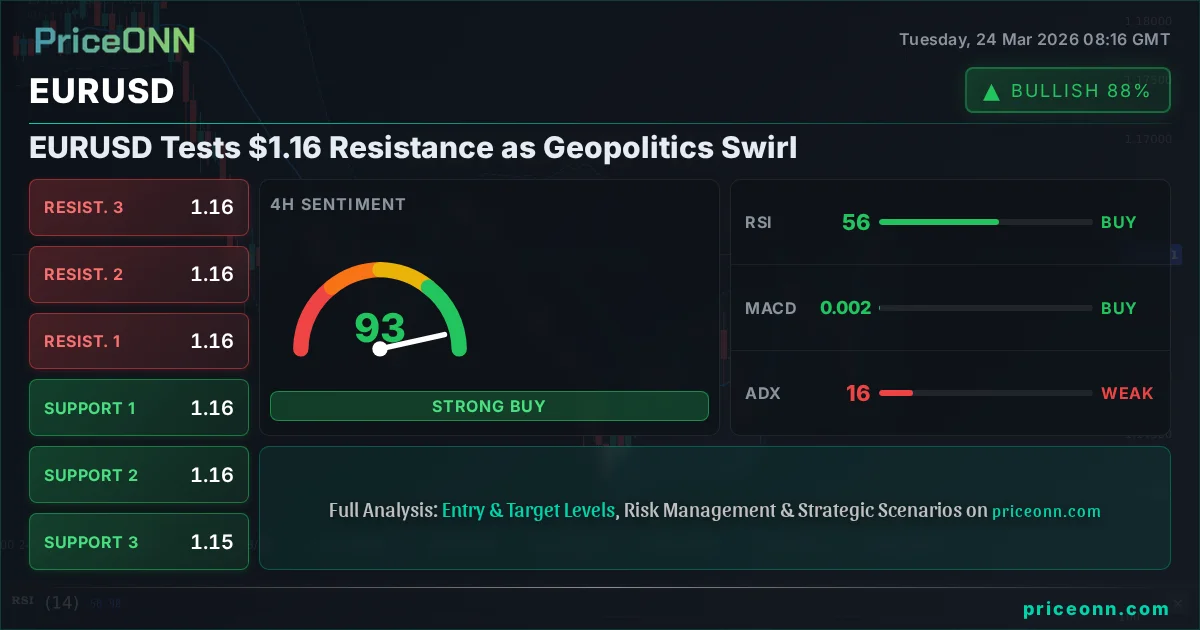
EUR/USD experienced a notable recovery on Monday, pushing higher by 0.37% to reach 1.1613. This rebound followed an initial surge in market sentiment that was later tempered by evolving geopolitical developments. The pair had previously tested lower levels, finding support near 1.1484.
Market Context
The initial catalyst for the Euro's strength appeared to be optimism surrounding potential de-escalation in Middle East tensions. Reports indicated that President Trump had announced a five-day truce following discussions between Washington and Tehran. This news initially weakened the US Dollar across the board, allowing the EUR/USD to gain traction. However, as the day progressed, the narrative shifted, with subsequent information suggesting that Iran might deny direct involvement in such negotiations, leading to a reassessment of the Dollar's weakness and providing a floor for its recovery.
The Euro, as the second most traded currency globally after the US Dollar, plays a crucial role in international finance. It represents 20 European Union countries and accounts for a substantial portion of daily foreign exchange transactions. The European Central Bank (ECB) manages monetary policy for the Eurozone, with its primary mandate being price stability. Decisions on interest rates, heavily influenced by inflation data like the Harmonized Index of Consumer Prices (HICP), directly impact the Euro's attractiveness to global investors. With an inflation target of 2%, any deviation prompts the ECB to adjust rates, affecting the currency's value.
Analysis & Drivers
The volatility in EUR/USD on Monday highlights the significant influence of geopolitical events on currency markets, particularly when they involve major global players like the United States and Iran. The initial Dollar sell-off was a direct response to perceived reduced geopolitical risk, which typically drives investors away from safe-haven assets. However, the subsequent retraction of that narrative underscores the fragility of such sentiment shifts. Market data shows that the US Dollar's strength is often tethered to global uncertainty, and any perceived reduction in that uncertainty can lead to rapid unwinds.
Furthermore, the underlying economic drivers for both currencies remain critical. For the Euro, the ECB's monetary policy stance, coupled with Eurozone economic health indicators such as GDP and PMI data, will continue to shape its trajectory. For the US Dollar, Federal Reserve policy and domestic economic data are paramount. The interplay between these factors, overlaid with geopolitical developments, creates a complex trading environment.
Trader Implications
Traders should closely monitor the evolving geopolitical landscape between the US and Iran. Any further clarification or escalation will likely dictate short-term Dollar movements. Key levels to watch for EUR/USD include the recent high of 1.1613 as immediate resistance, with a break above potentially signalling further upside. Conversely, a sustained move back below the session lows near 1.1484 could indicate a return of bearish sentiment for the pair.
The Indian Rupee (INR), while not directly involved in this specific EUR/USD move, serves as a reminder of how sensitive currencies can be to external factors. Market reports indicate that the INR is highly influenced by crude oil prices, the US Dollar's value, and foreign investment inflows. Reserve Bank of India (RBI) policy on interest rates and market intervention also plays a vital role in its stability. Any significant shifts in global risk sentiment or commodity prices can have ripple effects across various currency pairs, including those not directly linked to the primary event.
Outlook
Looking ahead, the EUR/USD pair's direction will likely depend on the clarity and persistence of geopolitical developments. Should the de-escalation narrative falter, the US Dollar could regain strength, putting downward pressure on EUR/USD. Conversely, a genuine breakthrough in US-Iran relations, however unlikely, could fuel further risk appetite and benefit the Euro. Traders will also be keenly awaiting upcoming economic data releases from both the Eurozone and the United States for further directional cues.
Frequently Asked Questions
What caused EUR/USD to rebound on Monday?
EUR/USD rebounded by 0.37% to 1.1613 as initial optimism over a potential US-Iran truce began to fade, which initially weakened the US Dollar. However, subsequent reports suggesting Iran's denial of direct involvement tempered the move.
What are the key support and resistance levels for EUR/USD?
Key resistance is observed near the recent high of 1.1613. Significant support was tested around 1.1484, and a break below this level could signal further downside for the pair.
What other factors influence the US Dollar and Euro?
The US Dollar is influenced by Federal Reserve policy and US economic data, while the Euro is sensitive to ECB monetary policy and Eurozone economic indicators like GDP and PMI. Geopolitical events and commodity prices also play a significant role.
Track markets in real-time
Empower your investment decisions with AI-powered analysis, technical indicators and real-time price data.
Join Our Telegram Channel
Get breaking market news, AI analysis and trading signals delivered instantly to your Telegram.
Join Channel



PriceONN