

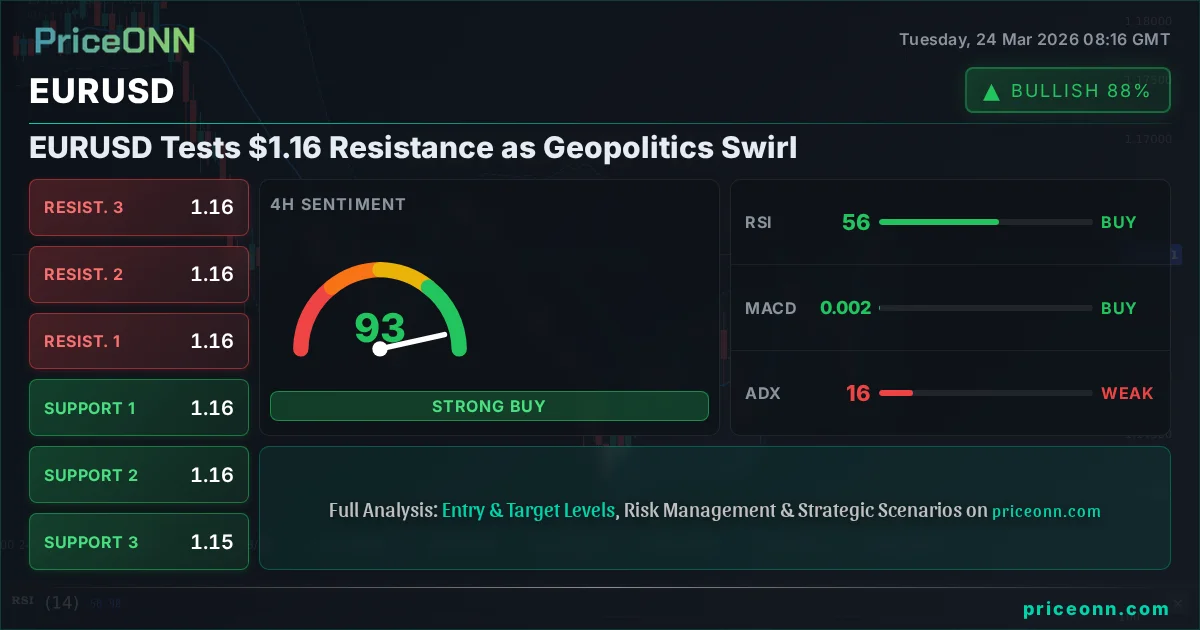
EURUSD is currently locked in a pivotal battle around the $1.16 mark. This isn't just another trading session; it's a moment where the tug-of-war between fundamental economic forces and swirling geopolitical undercurrents is on full display. With the Dollar Index (DXY) showing signs of strength, currently at 99, and major equity indices like the SP500 trading near 6595.75, the broader market sentiment is complex. For EURUSD, this confluence of factors creates a critical juncture, demanding a closer look at what's driving the price and where it might head next. The question on every trader's mind is whether the pair can break through key resistance levels or if the underlying headwinds will force a retreat.
- EURUSD is trading at $1.16, testing resistance levels with the Dollar Index at 99.
- The 1-hour RSI for EURUSD is 61.83, indicating rising bullish momentum, while the 1D RSI is 47.27, suggesting a slight bearish bias in the longer term.
- Key resistance for EURUSD is eyed at $1.16736, with support found at $1.15184 on the daily timeframe.
- Geopolitical events, particularly those impacting oil prices (Brent at $101.37) and safe-haven demand, are influencing the pair's correlation with DXY and risk sentiment.
The Bull's Roadmap: Navigating Towards Higher Ground
Breaking the $1.16 Barrier: What It Takes
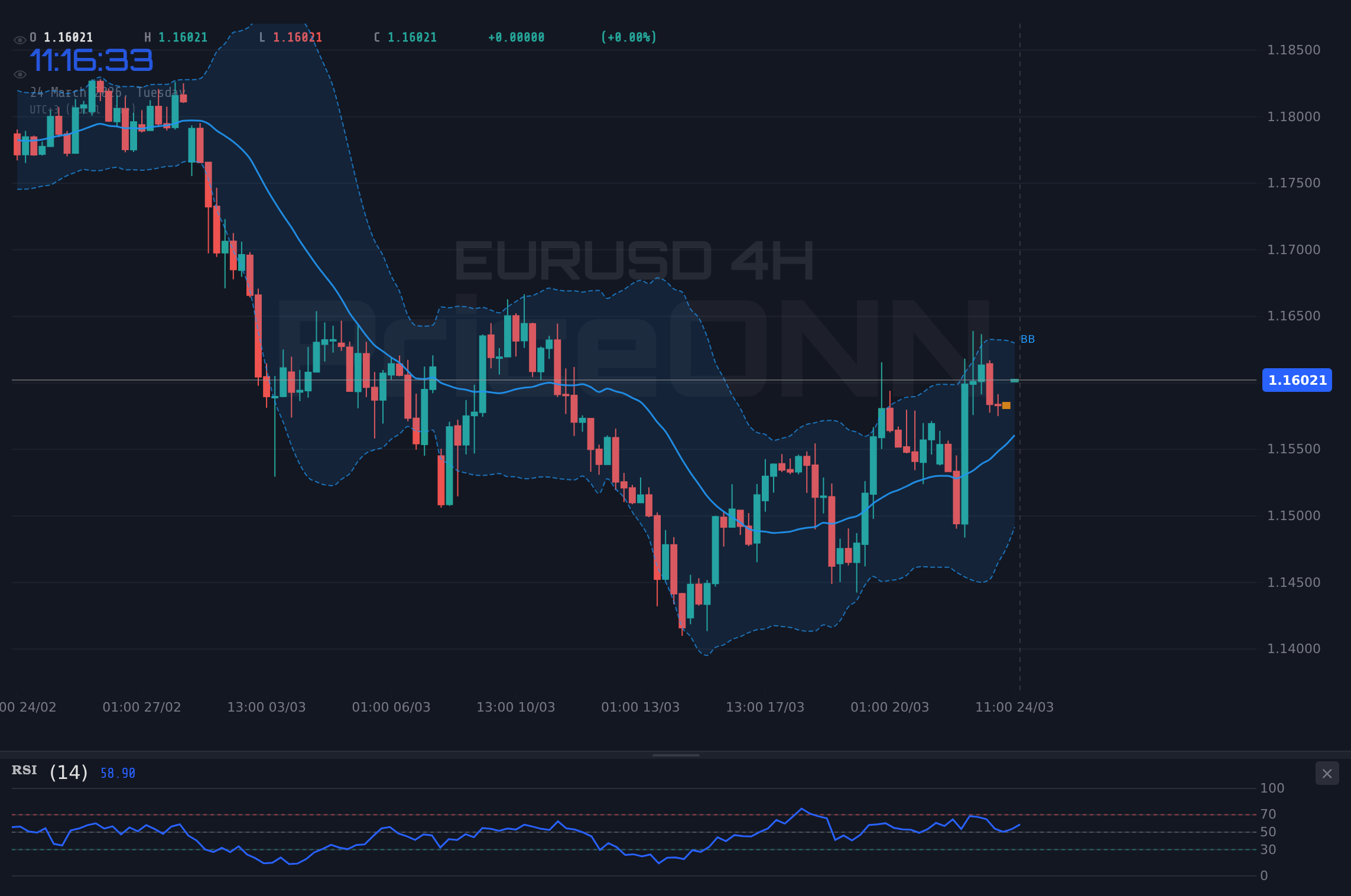
For EURUSD to stage a convincing rally, bulls need to overcome significant hurdles, not least of which is the immediate resistance lurking just above the current $1.16 handle. The 1-hour chart shows a bullish leaning, with an RSI of 61.83 suggesting momentum is building. However, the longer-term daily chart paints a more cautious picture, with an RSI of 47.27 indicating that while short-term sentiment might be positive, the broader trend still holds bearish undertones. A decisive break above the immediate resistance around 1.16088 on the 1-hour chart would be the first step. This would likely need to be supported by a weakening DXY, perhaps falling back below its 1-hour medium band, and a general easing of geopolitical tensions that could reduce safe-haven demand for the dollar. If these conditions align, the next target would be the 4-hour resistance at 1.16322, followed by the daily resistance at 1.16736. This scenario hinges on positive economic data from the Eurozone, perhaps a stronger-than-expected PMI or inflation print, giving the ECB room to maintain a less dovish stance than the market anticipates, or conversely, a surprise dovish signal from the Fed that weakens the dollar broadly.
Rally Confirmation: Indicators Aligning
Confirmation of a bullish trend would be seen if EURUSD manages to hold above the $1.16002 level for an extended period, transforming it into a support base. The 4-hour chart, currently showing a MACD that's positive and above its signal line, would need to maintain this momentum. Stochastic indicators on both the 1-hour (K=57.24, D=34.18) and 4-hour (K=70.6, D=55.89) timeframes are showing bullish signals, with the %K line above the %D line, suggesting upward pressure. However, the ADX on the 1-hour chart at 22.48 indicates only a moderately strong trend, meaning any upward move could be choppy. For a sustained rally, we'd want to see that ADX climb. The daily chart's Stochastic, currently K=77.64 and D=51.47, also supports a move higher, but it's nearing overbought territory, implying potential for a pullback before further gains. The key here is confluence: a break of resistance, supported by positive momentum indicators across multiple timeframes, and a favorable macroeconomic backdrop, ideally with the DXY retreating from its current 99 level.
The Eurozone Economy: A Silent Driver?
While geopolitical headlines often dominate, the underlying economic health of the Eurozone remains a crucial, albeit sometimes silent, driver for EURUSD. Recent data, such as the PMI figures, will be closely scrutinized. If these reports indicate robust economic activity and perhaps a slight uptick in inflation, it could embolden the European Central Bank (ECB) to signal a more cautious approach to monetary easing. This would provide a fundamental tailwind for the Euro. Conversely, weak economic data would likely reinforce expectations of ECB rate cuts, putting downward pressure on EURUSD, even if the dollar faces its own challenges. The current 1-hour Stochastic showing K=45.24 and D=19.17 suggests there's still room for upward movement before becoming overbought, but the daily RSI at 47.27 implies that the broader market sentiment is not yet firmly behind the Euro. Any positive surprise in Eurozone employment or inflation figures could be the catalyst needed to push EURUSD towards the 1.17339 resistance level.
Where Bears Take Control: The Downside Risk Scenario
The $1.15 Level: A Line in the Sand
The bearish case for EURUSD hinges on its inability to sustain momentum above the $1.16002 level and a subsequent fall back below psychological support. The daily chart is particularly concerning for bulls, with its RSI at 47.27 and a MACD that, while showing positive momentum on the 1-hour and 4-hour charts, has a bearish undertone on the daily timeframe. A break below the 1-hour support at 1.15692 would be the first warning sign. This could be triggered by a resurgence in safe-haven demand for the US Dollar, perhaps fueled by escalating geopolitical tensions or negative surprises in Eurozone economic data. If the DXY were to push higher, moving decisively back above its 4-hour medium band and towards the 99.41 resistance, it would likely drag EURUSD lower. The key daily support level to watch is 1.15184. A sustained break below this level would open the door for a more significant sell-off, targeting the next support at 1.14235.
Technical Indicators Flashing Red
While the short-term charts show some bullish signals, the longer-term technical picture presents several red flags. The daily ADX at 35.48 indicates a strong downtrend is in play, even if shorter timeframes show consolidation or minor rallies. The daily Stochastic, with K=77.64 and D=51.47, is approaching overbought territory, which could precede a reversal. However, this is somewhat contradicted by the daily MACD showing positive momentum. This divergence is precisely what makes the current levels so critical. A failure to break higher could lead to a sharp reversal. If EURUSD falls back below 1.15686 on the 4-hour chart, and the DXY continues its ascent towards 99.56, the bearish momentum could accelerate. The 4-hour Stochastic, currently K=73.17 and D=48.78, is also showing a bullish signal, but a reversal in the dollar could quickly flip this. The key is that the daily downtrend, indicated by the strong ADX, remains the dominant force unless decisively broken.
Macroeconomic Headwinds: Fed's Tightrope Walk
The Federal Reserve finds itself in a precarious position. San Francisco Fed President Mary Daly's recent comments highlighted the uncertainty surrounding monetary policy, caught between persistent inflation and geopolitical risks. If inflation proves stickier than expected, or if geopolitical events drive oil prices higher (Brent is currently at $101.37), the Fed might be forced to delay or even reconsider rate cuts. This would be dollar-positive and bearish for EURUSD. The market is currently pricing in a specific path for Fed policy, and any deviation from that expectation could cause significant volatility. For EURUSD, a hawkish tilt from the Fed, or even just a signal that rate cuts are further off than anticipated, would likely see the pair pressured downwards towards the 1.14235 support. The correlation with the DXY is crucial here; if the dollar strengthens due to Fed expectations, EURUSD will likely suffer.
The Waiting Game: Consolidation Around $1.16
Caught Between Two Worlds: The Neutral Scenario
It's entirely plausible that EURUSD remains range-bound in the short to medium term, especially if conflicting signals persist and geopolitical events create choppiness rather than clear direction. In this scenario, price action might oscillate between the immediate support at 1.15692 and resistance at 1.16088 on the 1-hour chart. The daily chart, with its RSI hovering around 47.27 and ADX at 35.48, suggests a market that is neither fully bullish nor bearish, but perhaps consolidating within a broader trend. This 'waiting game' could be influenced by upcoming economic data from both the US and Eurozone. If US data disappoints while Eurozone data surprises positively, it could lead to a range-bound scenario where the pair fails to make significant headway in either direction. Similarly, if geopolitical news remains ambiguous, creating short bursts of volatility that quickly fade, EURUSD could be stuck. The key levels to watch in this scenario would be the daily support at 1.15184 and the daily resistance at 1.16736, with price action likely confined between these broader boundaries.
The Dance of Conflicting Indicators
The current technical landscape for EURUSD is a prime example of conflicting signals. The 1-hour and 4-hour charts exhibit bullish momentum with positive MACD and Stochastic readings. However, the daily chart presents a more bearish picture with its RSI below 50 and a strong ADX indicating a prevailing downtrend. This duality suggests that short-term traders might be buying on dips, expecting a bounce, while longer-term investors remain cautious, waiting for clearer signals of a trend reversal. The Stochastic on the daily chart, K=77.64 and D=51.47, is in overbought territory, which could signal a pause or reversal, but the positive momentum on shorter timeframes might override this for now. In a consolidation phase, expect price to respect intraday support and resistance levels, with volume possibly drying up as traders await clearer direction from major economic events or geopolitical developments. The SP500's neutral signal on the 4-hour chart (4 Al, 4 Sat) further adds to the indecisive market sentiment.
Economic Data Dependency: The Ultimate Decider
In a market environment characterized by ambiguity, economic data releases become paramount. Traders will be keenly watching upcoming inflation reports, employment figures, and manufacturing indices from both the US and the Eurozone. For instance, if US Non-Farm Payrolls (NFP) data comes in significantly below expectations, it could weaken the dollar and support EURUSD, potentially pushing it towards the upper end of its range. Conversely, strong US data could reinforce the dollar's strength and cap any upside for the pair. The market's reaction to these releases will be crucial in determining whether EURUSD breaks out of its current range or continues to consolidate. The current price action, hovering around $1.16, suggests that the market is waiting for definitive catalysts. The current ADX readings across different timeframes (1H: 22.48, 4H: 16.29, 1D: 35.48) indicate a lack of strong directional conviction, typical of consolidation phases.
The Verdict: What's Most Likely?
Weighing the bullish short-term momentum against the bearish longer-term technicals and the persistent geopolitical uncertainty, the most likely scenario for EURUSD in the immediate future appears to be a continuation of consolidation with a slight bearish bias, given the daily trend strength indicated by the ADX at 35.48 and the overall bearish signals on the daily timeframe (Al: 3, Sat: 5). The probability leans towards a scenario where the pair struggles to decisively break higher, and any rallies are met with selling pressure, especially as it approaches the 1.16736 daily resistance. The DXY's current strength at 99 and the general risk-off sentiment suggested by the SP500's neutral 4H signal (4 Al, 4 Sat) also favor a more cautious outlook. While short-term traders might find opportunities on intraday bounces, the larger trend suggests that upside may be limited unless significant catalysts emerge. Therefore, a scenario where EURUSD tests lower support levels, perhaps aiming for the 1.15184 mark on the daily chart, seems more probable than a strong sustained rally. The probability estimate for this scenario is approximately 60%.
The Bullish Scenario (25% Probability)
This scenario plays out if EURUSD decisively breaks above the $1.16088 resistance on the 1-hour chart and holds. Key to this would be a clear drop in the DXY below 98.84, coupled with positive Eurozone economic data that boosts the Euro. The 4-hour chart's bullish MACD and Stochastic signals would need to be confirmed by a rising ADX, ideally above 25. If this bullish momentum builds, the pair could target the 4-hour resistance at 1.16322, and potentially push towards the daily resistance at 1.16736. This would require a significant shift in market sentiment, perhaps driven by unexpected dovish commentary from the Fed or a de-escalation of geopolitical tensions.
The Bearish Scenario (60% Probability)
This scenario unfolds if EURUSD fails to hold above $1.16 and breaks below the 1-hour support at 1.15692. A rising DXY, pushing towards 99.56, would be a key confirmation. Escalating geopolitical risks or weak Eurozone economic data could trigger this move. The daily chart's underlying bearish trend, supported by the ADX at 35.48, would reassert itself. The initial target would be the daily support at 1.15184, followed by 1.14235. This is the most probable outcome given the current technical divergence and macro uncertainties.
The Neutral Scenario (15% Probability)
In this scenario, EURUSD remains range-bound, trading between the daily support of 1.15184 and resistance of 1.16736. Price action would be choppy, with intraday rallies failing to hold and dips finding temporary buyers. This outcome is likely if economic data remains mixed and geopolitical news is inconclusive, leading to indecision in the market. Traders would likely focus on short-term opportunities within the range, waiting for a clearer catalyst to break the stalemate.
What I'm Watching This Week: Key Triggers for EURUSD
The coming days will be crucial for EURUSD as traders look for direction amid a complex backdrop. Several key factors will be closely monitored to determine whether the pair breaks out of its current range or continues its choppy trajectory. The interplay between geopolitical developments and economic data releases will be paramount in shaping market sentiment and influencing central bank policy expectations.
1. DXY Movement and Fed Speak
The Dollar Index (DXY) is currently at 99, showing strength that pressures EURUSD. Any significant move by the DXY, either breaking key resistance at 99.56 or falling back below 98.84, will be a major signal. Equally important will be any further commentary from Federal Reserve officials. Given San Francisco Fed President Mary Daly's recent remarks about policy uncertainty, any hints about the timing or pace of potential rate cuts will be closely watched. A hawkish tone would likely strengthen the dollar and weigh on EURUSD, while dovish signals could offer relief.
2. Eurozone Economic Data Releases
Upcoming economic data from the Eurozone, particularly inflation figures and Purchasing Managers' Index (PMI) reports, will be critical. Stronger-than-expected data could bolster the Euro by suggesting the ECB might adopt a less dovish stance, potentially pushing EURUSD towards higher resistance levels. Conversely, weak data would likely reinforce expectations of ECB easing and put downward pressure on the pair, aligning with the bearish scenario. The current daily RSI of 47.27 suggests there's room for improvement, but confirmation through strong data is needed.
3. Geopolitical Developments and Oil Prices
The ongoing geopolitical landscape, particularly concerning the Middle East and its impact on oil prices (Brent at $101.37, WTI at $89.85), remains a significant wildcard. Any escalation of tensions could drive safe-haven demand for the dollar, strengthening the DXY and pressuring EURUSD lower. Conversely, signs of de-escalation could reduce safe-haven flows and allow EURUSD to find support. The market's reaction to oil price volatility will be a key indicator of broader risk sentiment.
Frequently Asked Questions: EURUSD Analysis
What happens if EURUSD breaks decisively above the $1.16736 resistance level?
A break above the daily resistance at $1.16736 would signal a significant bullish shift, potentially targeting the next key level at $1.17339. This would likely require a combination of strong Eurozone economic data and a weakening DXY, possibly falling below 98.84, confirming a shift in market sentiment.
Should I consider selling EURUSD if it falls below $1.15184 support, given the current RSI at 47.27?
A break below the daily support at $1.15184 would invalidate short-term bullish hopes and align with the prevailing bearish daily trend, confirmed by an ADX of 35.48. This would be a strong signal to consider selling, targeting $1.14235, especially if the DXY shows further strength towards 99.56.
Is the Stochastic indicator at K=77.64, D=51.47 on the daily chart a sell signal for EURUSD?
The daily Stochastic nearing overbought territory (K=77.64) suggests potential for a pullback or consolidation. However, this signal is somewhat contradicted by bullish momentum on shorter timeframes (1H RSI 61.83). A confirmed sell signal would require this daily indicator to cross bearishly and for price action to break below immediate intraday support.
How will upcoming US NFP data impact EURUSD around the $1.16 level?
Stronger-than-expected US Non-Farm Payrolls data could boost the DXY (currently at 99) and put downward pressure on EURUSD, potentially pushing it towards $1.15184. Conversely, weaker data might weaken the dollar and support EURUSD, possibly aiding a move towards the $1.16736 resistance.
The market rarely gives clear signals. Patience, disciplined risk management, and a deep understanding of both technicals and fundamentals are your greatest allies in navigating these complex waters. Wait for your setup, manage your risk, and the opportunities will present themselves.
Track markets in real-time
AI-powered analysis, technical indicators and real-time price data.
Join Our Telegram Channel
Breaking market news, AI analysis and trading signals instantly.
Join Channel