
Is the Kiwi Poised for a Shift as RBNZ Eyes Economic Slack Amid Oil Price Volatility?


The New Zealand Dollar (NZD) faces a pivotal moment as the Reserve Bank of New Zealand (RBNZ) signals a nuanced approach to managing inflation. RBNZ Chief Economist Paul Conway stated that the central bank perceives significant economic slack within the nation's economy. This underlying weakness is expected to shape the RBNZ's response to the inflationary pressures arising from elevated global oil prices, suggesting a potentially less aggressive monetary tightening path than previously anticipated.
Market Context
The RBNZ operates with a mandate to keep inflation within the 1% to 3% target band, with a focus on the 2% midpoint. Typically, rising inflation prompts interest rate hikes to cool economic activity. However, the acknowledgment of economic slack implies that the RBNZ might prioritize supporting growth or avoid overly dampening demand, even in the face of imported inflation from oil price shocks. This cautious stance could influence the attractiveness of New Zealand assets and, consequently, the value of the NZD. The currency's performance is a key barometer of economic health, heavily influenced by domestic policy decisions and international trade dynamics, particularly with China, its largest trading partner. Fluctuations in global commodity prices, especially dairy, also play a crucial role in the NZD's valuation.
Analysis & Drivers
The primary driver influencing the RBNZ's strategy appears to be the assessment of the economy's productive capacity. Persistent economic slack means that the economy is not operating at its full potential, with underutilized labor and capital. In such an environment, a surge in oil prices, while inflationary, might not immediately translate into broad-based wage-price spirals. Instead, it could primarily act as a drag on consumption and investment. This scenario gives the RBNZ room to maneuver, potentially avoiding aggressive rate hikes that could exacerbate an economic downturn. The RBNZ's decision-making process will likely involve a delicate balancing act between curbing inflation and safeguarding economic growth. Factors such as global economic growth, commodity price trends, and geopolitical stability impacting oil markets will be closely monitored.
Trader Implications
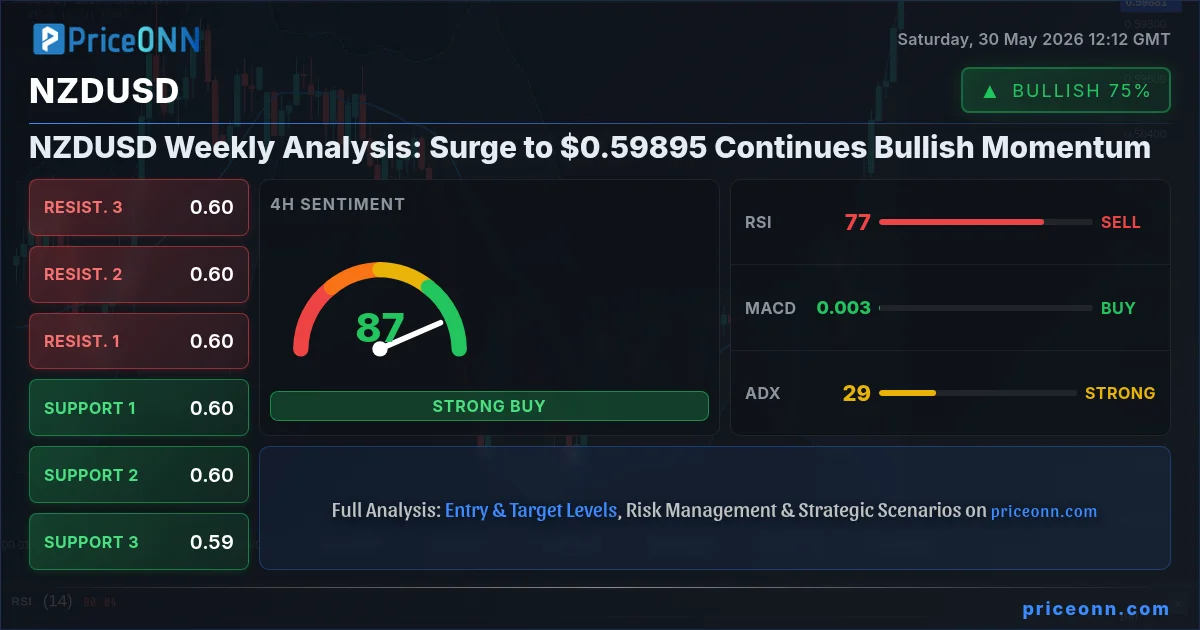
For traders, the RBNZ's measured approach to inflation suggests that the interest rate differential between New Zealand and other major economies may not widen as dramatically as some had expected. This could limit upside potential for the NZD against currencies where central banks are pursuing more aggressive tightening cycles. Key levels to watch for NZD/USD would include the support at 0.6000 and resistance around the 0.6150 mark. Traders should remain vigilant for any shifts in RBNZ rhetoric or incoming economic data that might suggest a change in their assessment of economic slack or inflation risks. Furthermore, monitoring the price of crude oil and the economic health of China will be crucial for understanding the external pressures on the New Zealand economy and its currency.
Outlook
The RBNZ's cautious stance, driven by the presence of economic slack, suggests a period of potentially stable, albeit range-bound, trading for the New Zealand Dollar. While oil price volatility remains a significant risk factor for inflation, the central bank's willingness to tolerate some overshoot in the inflation target to avoid stifling growth provides a degree of support. Investors and traders should anticipate continued focus on domestic economic indicators and global commodity markets as key determinants of the NZD's trajectory in the coming months.
Frequently Asked Questions
What is the RBNZ's inflation target?
The Reserve Bank of New Zealand aims to maintain inflation within a medium-term target band of 1% to 3%, with a preferred midpoint of 2%.
How might economic slack affect the RBNZ's response to oil price shocks?
Economic slack suggests the economy has spare capacity, allowing the RBNZ to potentially tolerate higher inflation from oil prices for longer without triggering aggressive interest rate hikes, thus avoiding further dampening of economic activity.
What are the key price levels to watch for NZD/USD?
Traders should monitor the support level at 0.6000 and the resistance at 0.6150 for NZD/USD, as the RBNZ's policy stance influences the currency's movement.
Track markets in real-time
Empower your investment decisions with AI-powered analysis, technical indicators and real-time price data.
Join Our Telegram Channel
Get breaking market news, AI analysis and trading signals delivered instantly to your Telegram.
Join Channel PriceONN News
The upcoming U.S. employment report for May is poised to reveal a labor market that is stabilizing but not accelerating, potentially influencing Federal Reserve policy. Traders are closely watching key inflation indicators from ISM surveys and Eurozone CPI data.
PriceONN News
Upcoming U.S. employment data is poised to reveal a labor market showing signs of stabilization rather than robust growth, potentially influencing Federal Reserve policy. Traders are closely watching key inflation indicators within the ISM surveys.
PriceONN News
Markets are closely watching Friday's U.S. employment report for May, with expectations of 105,000 new jobs and a 4.4% unemployment rate, which could indicate a labor market not deteriorating but also not significantly improving.
PriceONN News
Canadian headline inflation rose to 2.8% in April, largely driven by gasoline prices, but core measures remain stable, suggesting the Bank of Canada has room to maintain a patient stance on interest rates.
PriceONN News
A robust US employment report showing stronger-than-expected job gains and moderate wage growth initially lifted stock markets. However, lingering geopolitical concerns, particularly regarding Iran, are tempering broader trader enthusiasm and limiting follow-through in currency markets.
PriceONN News
Upcoming U.S. employment data for May is expected to reveal a labor market that is no longer deteriorating but also failing to show significant improvement, with nonfarm payrolls projected to rise by 105,000 and the unemployment rate ticking up to 4.4%.
PriceONN News
US consumer confidence fell slightly to 93.1 in May, a modest decline from April's 93.8, driven by persistent inflation linked to Middle Eastern geopolitical events. While beating expectations, the drop signals growing household pressure.
PriceONN News
Canadian headline inflation rose to 2.8% in April, primarily driven by gasoline prices, yet core inflation metrics showed surprising stability, offering the Bank of Canada room for a patient monetary policy stance.
PriceONN News
New York's manufacturing sector experienced a significant boost in May, with the Empire State Manufacturing Index jumping to 19.6, nearly three times the expected consensus. This marks the strongest reading since April 2022, signaling a robust expansion in regional industrial activity.
PriceONN News
US inflation is projected to rise modestly in April, with headline CPI approaching 3.8% year-over-year, driven by escalating energy costs impacting food and services, even as shelter inflation cools. This data will be crucial for upcoming Federal Reserve policy decisions.
PriceONN News
US inflation data for April is anticipated to show a modest uptick, with headline CPI potentially reaching 3.8% year-over-year. This rise is attributed to elevated energy prices impacting food and services, even as shelter costs continue to moderate. Retail sales are also expected to grow, though primarily driven by price increases rather than volume.
PriceONN News
US inflation figures for April are anticipated to show a modest uptick, with headline CPI potentially reaching 3.8% year-over-year. This rise is attributed to energy price pressures impacting food and services, even as shelter costs continue to moderate. Meanwhile, retail sales are expected to reflect price-driven growth rather than volume increases.