
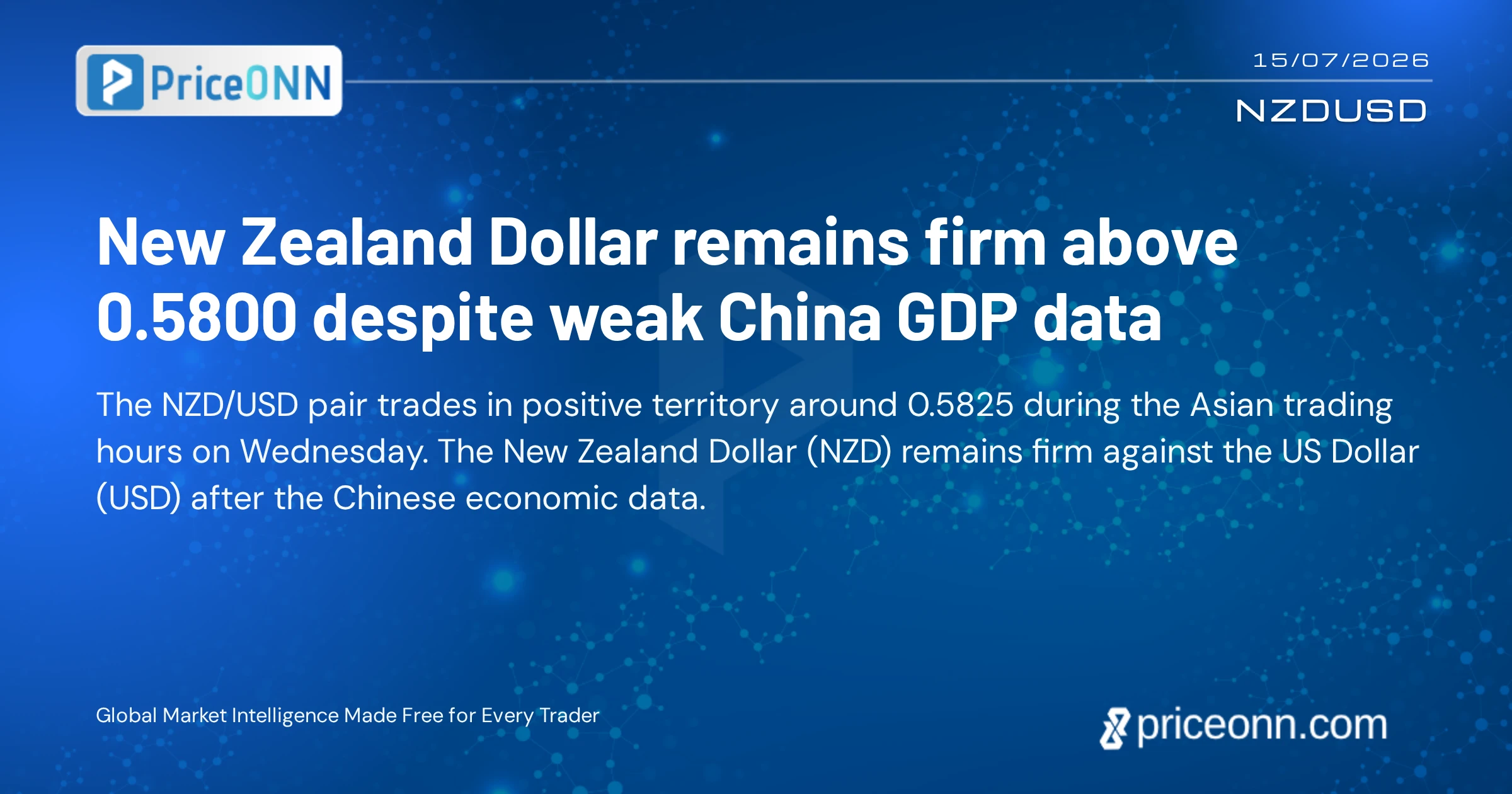
New Zealand Dollar remains firm above 0.5800 despite weak China GDP data
 PriceONN Editorial Desk
Multi-source verification
PriceONN Editorial Desk
Multi-source verification
Kiwi's Unexpected Fortitude
In a surprising display of market resilience, the New Zealand Dollar has managed to hold its ground, trading firmly above the 0.5800 level against its US counterpart. This steadfastness occurred during Wednesday's Asian session, defying expectations that weaker economic figures from China might exert significant downward pressure on the Kiwi.
The currency, affectionately known as the Kiwi, typically charts a course influenced by the economic vitality of New Zealand and the monetary policy decisions of its central bank, the Reserve Bank of New Zealand (RBNZ). However, its trajectory is also uniquely tethered to external forces. Chief among these is the economic health of mainland China. As New Zealand's largest trading partner, any downturn in the Chinese economy directly impacts demand for New Zealand exports, subsequently affecting the nation's economic output and, by extension, the value of its currency.
Furthermore, the global prices of dairy products play a pivotal role. Dairy farming forms the backbone of New Zealand's export revenue. When dairy prices surge, the nation's export income rises, providing a substantial boost to the overall economy and supporting the NZD. Conversely, a slump in these commodity prices can dampen economic prospects and weigh on the currency.
Monetary Policy and Market Sentiment Drivers
The RBNZ operates with a mandate to keep inflation within a 1% to 3% range over the medium term, ideally hovering around the 2% midpoint. To achieve this, the bank strategically adjusts interest rates. A tightening cycle, where rates are increased to curb inflation, can lead to higher bond yields. This increased yield can attract foreign investment, thereby strengthening the NZD. The inverse is also true: lower interest rates typically exert downward pressure on the Kiwi.
The concept of a 'rate differential' is also critical for the NZD/USD pairing. This refers to the gap between New Zealand's interest rates and those set by the US Federal Reserve. A widening positive differential in favor of New Zealand can make the pair more attractive for carry trades, driving demand for the NZD.
Domestic macroeconomic data releases are paramount for assessing the true state of the New Zealand economy and influencing NZD valuations. Strong economic indicators, such as robust GDP growth, low unemployment figures, and high consumer confidence, generally bode well for the Kiwi. Such strength can attract foreign capital and potentially signal to the RBNZ that rate hikes might be appropriate, especially if accompanied by rising inflation. Conversely, disappointing economic reports often lead to NZD depreciation.
The Kiwi also exhibits a tendency to perform well during 'risk-on' environments, periods characterized by investor optimism and a perceived reduction in broad market risks. In such climates, investors are more inclined to favor commodities and commodity-linked currencies like the NZD. However, during times of global financial stress or economic uncertainty, investors typically divest from riskier assets, seeking refuge in safer havens, which can lead to a weakening of the NZD.
Market Ripple Effects
Despite the release of underwhelming Gross Domestic Product (GDP) figures from China, which registered a 5.2% year-on-year increase for the first quarter, falling short of the projected 5.4%, the NZD/USD pair managed to hold its ground, trading around the 0.5825 mark. This resilience suggests that market participants may be looking past the immediate data point or perhaps anticipating further stimulus from Beijing. The underwhelming growth figures, however, do raise questions about the sustainability of global demand, particularly for export-reliant economies like New Zealand.
The implications extend beyond the immediate currency pair. A weaker Chinese economy could indirectly impact the Australian Dollar (AUD) due to strong trade linkages. Additionally, global commodity prices, including those for metals and agricultural products that New Zealand exports, might face headwinds if Chinese demand falters significantly. Investors will be closely watching for any signs of further economic deceleration in China, as this could eventually translate into renewed pressure on the Kiwi and other commodity currencies.
The immediate focus for traders will be on whether the NZD can sustain its current levels despite the negative read from its largest trading partner. Any sustained weakness in Chinese economic data could force a reassessment of the Kiwi's valuation. Key upcoming data from New Zealand itself, alongside any policy signals from the RBNZ, will be critical in determining the currency's next move.
Track markets in real-time
Empower your investment decisions with AI-powered analysis, technical indicators and real-time price data.
Join Our Telegram Channel
Get breaking market news, AI analysis and trading signals delivered instantly to your Telegram.
Join Channel PriceONN News
EUR/USD rose to 1.1429 on Thursday, with the US dollar continuing its moderate decline from the previous session. The market is assessing rising inflation risks driven by elevated energy prices against a backdrop of weakening economic data, while seeking further signals on Federal Reserve policy. At next week’s meeting, the regulator is expected to keep […] The post EUR/USD Recovers as Dollar Weakens appeared first on ActionForex.
PriceONN News
EUR/CHF may already be telling investors what to expect from today’s European Central Bank meeting. The cross broke decisively above 0.9278 this week, extending its recent rally as surging oil prices revived inflation concerns across Europe. The move suggests markets have begun positioning for a relatively more hawkish ECB even though policymakers are almost universally […] The post EUR/CHF Rally Points to Hawkish ECB Hold as Oil Reignites Inflation Risks appeared first on ActionForex.
PriceONN News
The Japanese Yen tumbled to another four-decade low today, with USD/JPY breaking above the 163 mark as investors continued to unwind Yen positions against the backdrop of widening global yield differentials and surging energy prices. The move has once again thrust Japan’s currency policy into the spotlight, raising familiar questions over whether authorities will step […] The post Yen Hits Fresh 40-Year Low. Can Japan Still Defend Its Currency? appeared first on ActionForex.
PriceONN News
The Euro’s (EUR) modest upside attempt against the US Dollar (USD) witnessed during Wednesday’s Asian session has been short-lived. The EUR/USD pair was capped below 1.1420, before pulling back to levels a few pips above 1.1400 during the European trading session.
PriceONN News
The Japanese Yen (JPY) attracts significant bids against its major currency peers during the European trading session on Wednesday. The USD/JPY pair falls vertically to near 162.65, but quickly recovers some losses and rebounds to around 162.90.
PriceONN News
The EUR/GBP cross gains momentum to near 0.8525 during the early European trading hours on Wednesday. The British Pound (GBP) weakens against the Euro (EUR) following the UK inflation report. All eyes will be on the European Central Bank (ECB) interest rate decision later on Thursday.
PriceONN News
The British Pound (GBP) consolidates losses against the US Dollar (USD) on Wednesday, as a string of UK inflation figures provided some leeway for the Bank of England to maintain its “wait-and-see” stance through the coming months.
PriceONN News
The Japanese Yen (JPY) hovers near a multi-decade high at around 163.24 against the US Dollar (USD) during the early European trading session on Wednesday. The USD/JPY pair reflects significant strength as the Japanese currency underperforms due to surging Oil prices.
PriceONN News
The Indian Rupee (INR) opens lower against the US Dollar (USD) on Wednesday after a slight relief the previous day. The USD/INR pair rises to near 96.45 as a fresh surge in oil prices due to intensifying fears of further global energy supply disruptions has weakened the Indian currency.
PriceONN News
Australia’s private sector gained momentum in July, with the S&P Global Flash Composite PMI rising from 50.4 to 52.6, its highest reading since the start of the year. The improvement was driven primarily by the services sector, where the Services PMI Business Activity Index climbed from 50.5 to 53.0, while Manufacturing PMI edged up from […] The post Australia PMI Composite Hits 2026 High at 52.6 as Domestic Demand Rebounds appeared first on ActionForex.
PriceONN News
Key insights from the week that was. The June Labour Force Survey offered both noise and signal. Employment surprised materially to the upside, rising 76.3k in the month. However, the gain was matched by a sizeable lift in labour supply, the participation rate bouncing 0.3ppts to 67.0%, a 13-month high. The ABS noted in the […] The post Cliff Notes: Markets on Edge appeared first on ActionForex.
PriceONN News
Canada’s retail sales rose 1.0% mom to CAD 73.7B in May, marking a broad-based improvement in consumer spending as all nine retail subsectors posted gains. The increase was led by gasoline stations and fuel vendors, reflecting higher fuel prices, while motor vehicle and parts dealers also contributed with a second consecutive monthly increase. Excluding the […] The post Canada Retail Sales Rise 1.0% in May, June Momentum Seen Continuing appeared first on ActionForex.