
Oil Surge Threatens US Inflation as Canada Balances Growth


The surge in oil prices is creating a complex dilemma for both the US and Canadian economies. While the US faces the risk of renewed inflationary pressures, Canada grapples with balancing the benefits of an oil-driven economy against the potential strain on household finances. The price of Brent crude has climbed above $85 a barrel, a level that could have significant ripple effects.
Market Context
February's US CPI data provided a brief moment of calm, aligning with expectations and showing a slight cooling in core inflation. The supercore measure, which excludes food and energy, decreased from 0.59% month-over-month in January to 0.35% in February, suggesting a moderation in tariff-driven price increases. However, this backward-looking data doesn't fully reflect the recent surge in oil prices. Meanwhile, Canada's economy is heavily influenced by its oil and gas sector, which accounted for approximately 6.6% of its GDP and 15% of total goods exports in 2025. Higher oil prices boost corporate profits and government royalties but simultaneously reduce household purchasing power, creating a challenging balancing act.
Analysis & Drivers
The primary driver behind the inflationary risk in the US is the potential for rising energy costs to permeate the broader economy. While February's CPI data was benign, analysts anticipate that rising oil prices will push headline inflation closer to the 3% mark in the coming months. This could complicate the Federal Reserve's policy decisions, potentially delaying any planned interest rate cuts. In Canada, the situation is more nuanced. While higher oil prices benefit the energy sector and government revenues, they also lead to increased expenses at the pump for consumers, curtailing spending on other goods and services. Investment in Canada’s oil and gas sector is now significantly lower than it once was, accounting for less than half of what it was in 2014 as a share of Canada's GDP.
Trader Implications
For traders, the key is to monitor oil price movements and their potential impact on inflation data in both the US and Canada. In the US, keep an eye on the 10-year Treasury yield, which is expected to remain range-bound between 4.0% and 4.3%. Consider buying dips in nominal and real rates when they approach the upper end of this range. In Canada, be aware of the potential for increased volatility in the Canadian dollar (CAD) as oil prices fluctuate. Key levels to watch include:
- USD/CAD: Monitor for potential breakouts above 1.36 or below 1.34.
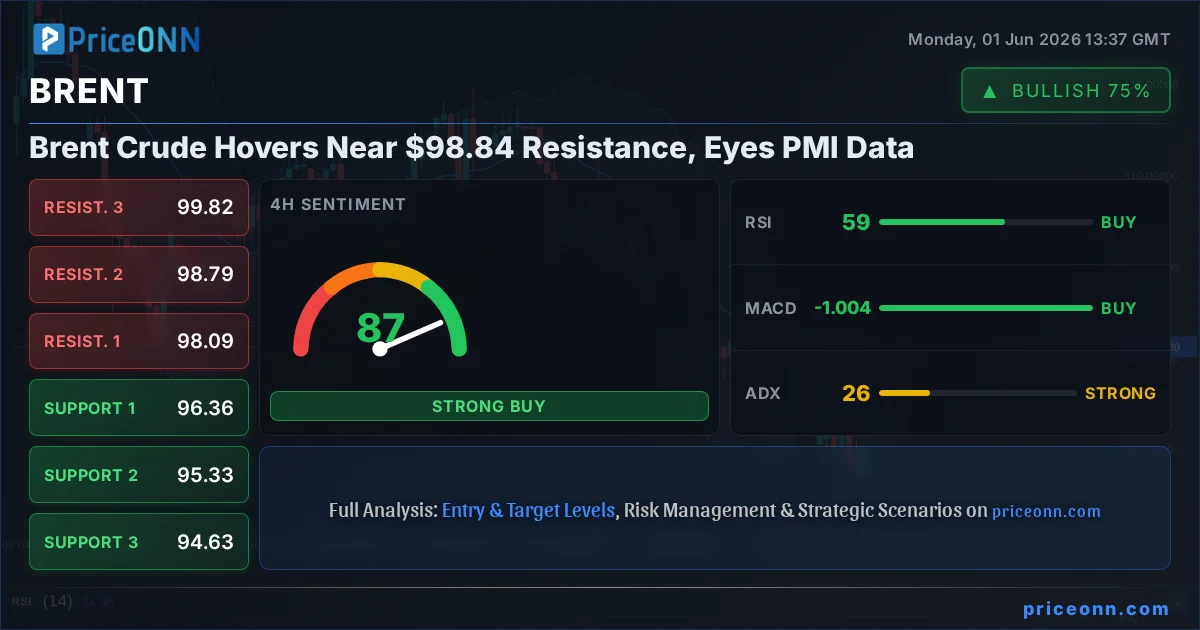
- Crude Oil (Brent): A sustained move above $87 could signal further upside, while a drop below $83 might indicate a correction.
Traders should also closely follow statements from the Federal Reserve and the Bank of Canada for any hints about future policy adjustments in response to these economic pressures.
Looking ahead, the market will be closely watching upcoming inflation data releases in both the US and Canada, as well as any further developments in oil prices. Geopolitical factors could also play a significant role in shaping the outlook for energy markets and the broader economy. Market sentiment remains cautious, with investors weighing the potential for continued economic growth against the risk of renewed inflationary pressures.
Track markets in real-time
Empower your investment decisions with AI-powered analysis, technical indicators and real-time price data.
Join Our Telegram Channel
Get breaking market news, AI analysis and trading signals delivered instantly to your Telegram.
Join Channel PriceONN News
The upcoming U.S. employment report for May is poised to reveal a labor market that is stabilizing but not accelerating, potentially influencing Federal Reserve policy. Traders are closely watching key inflation indicators from ISM surveys and Eurozone CPI data.
PriceONN News
Upcoming U.S. employment data is poised to reveal a labor market showing signs of stabilization rather than robust growth, potentially influencing Federal Reserve policy. Traders are closely watching key inflation indicators within the ISM surveys.
PriceONN News
US consumer confidence fell slightly to 93.1 in May, a modest decline from April's 93.8, driven by persistent inflation linked to Middle Eastern geopolitical events. While beating expectations, the drop signals growing household pressure.
PriceONN News
Canadian headline inflation rose to 2.8% in April, largely driven by gasoline prices, but core measures remain stable, suggesting the Bank of Canada has room to maintain a patient stance on interest rates.
PriceONN News
Upcoming U.S. employment data for May is expected to reveal a labor market that is no longer deteriorating but also failing to show significant improvement, with nonfarm payrolls projected to rise by 105,000 and the unemployment rate ticking up to 4.4%.
PriceONN News
Markets are closely watching Friday's U.S. employment report for May, with expectations of 105,000 new jobs and a 4.4% unemployment rate, which could indicate a labor market not deteriorating but also not significantly improving.
PriceONN News
Canadian headline inflation rose to 2.8% in April, primarily driven by gasoline prices, yet core inflation metrics showed surprising stability, offering the Bank of Canada room for a patient monetary policy stance.
PriceONN News
New York's manufacturing sector experienced a significant boost in May, with the Empire State Manufacturing Index jumping to 19.6, nearly three times the expected consensus. This marks the strongest reading since April 2022, signaling a robust expansion in regional industrial activity.
PriceONN News
US inflation is projected to rise modestly in April, with headline CPI approaching 3.8% year-over-year, driven by escalating energy costs impacting food and services, even as shelter inflation cools. This data will be crucial for upcoming Federal Reserve policy decisions.
PriceONN News
US inflation data for April is anticipated to show a modest uptick, with headline CPI potentially reaching 3.8% year-over-year. This rise is attributed to elevated energy prices impacting food and services, even as shelter costs continue to moderate. Retail sales are also expected to grow, though primarily driven by price increases rather than volume.
PriceONN News
US inflation figures for April are anticipated to show a modest uptick, with headline CPI potentially reaching 3.8% year-over-year. This rise is attributed to energy price pressures impacting food and services, even as shelter costs continue to moderate. Meanwhile, retail sales are expected to reflect price-driven growth rather than volume increases.
PriceONN News
US inflation is poised for a modest uptick in April, with headline CPI expected to approach 3.8% year-over-year, driven by rising energy costs that are beginning to influence food and services prices.