
Silver Price Analysis: Rebound capped below $70 with downside risks intact
Silver's Recent Performance
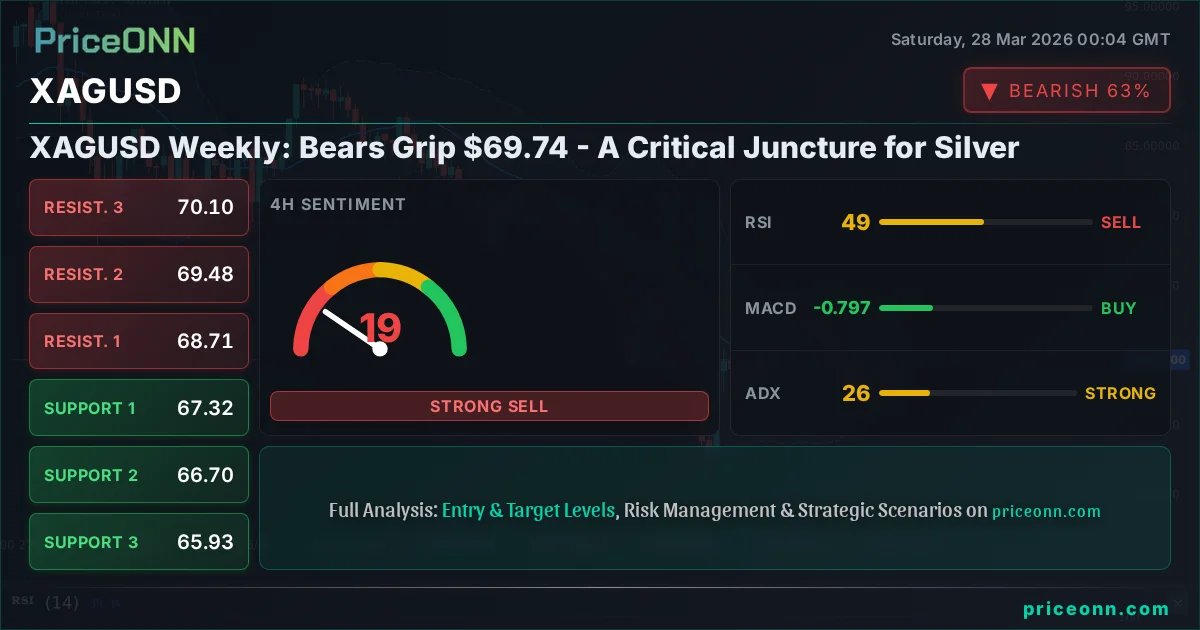
The white metal, often considered a secondary safe haven to gold, saw a shift in market sentiment on Friday. After experiencing two consecutive sessions of declines, Silver (XAG/USD) managed to reclaim some ground. However, this rebound occurred under the shadow of a strengthening US Dollar, which benefited from heightened geopolitical anxieties stemming from the Middle East. This dynamic suggests that, in the current climate, the Dollar's allure as a secure asset is temporarily overshadowing Silver's traditional role.
Market data shows that the interplay between geopolitical risk and currency strength is a critical factor for Silver. While instability can often drive investors toward precious metals, the immediate reaction this week saw capital flow into the greenback, a move that typically exerts downward pressure on dollar-denominated commodities like Silver. This highlights the complex and sometimes counterintuitive relationships that govern commodity pricing.
Understanding Silver's Market Drivers
Silver's journey as an investment vehicle is multifaceted. Historically valued for its scarcity and utility, it serves as both a store of value and, at times, a hedge against inflationary pressures. While not as prominent as gold, its appeal to investors stems from its intrinsic worth and its potential to diversify portfolios seeking protection against economic uncertainty.
Investment in Silver takes various forms, from tangible assets like coins and bars to financial instruments such as Exchange Traded Funds (ETFs) that mirror its international market performance. The price of Silver is sensitive to a broad spectrum of influences.
Geopolitical tensions or fears of economic downturns can theoretically propel Silver prices upward due to its safe-haven characteristics, though its impact is generally less pronounced than that of gold. As an asset that does not generate yield, Silver typically performs better in environments characterized by lower interest rates. Its valuation is also inextricably linked to the performance of the US Dollar, given that Silver is quoted in dollars. A robust dollar often suppresses Silver prices, while a weakening dollar tends to provide a tailwind for its appreciation.
Beyond these macroeconomic factors, supply dynamics play a significant role. Silver mining output, which is considerably more abundant than gold extraction, alongside recycling rates, directly impacts availability and, consequently, price. Furthermore, Silver's extensive use across industries, particularly in electronics and the burgeoning solar energy sector, due to its exceptional electrical conductivity, creates a substantial demand pull. Surges in industrial consumption can elevate prices, whereas contractions in demand tend to exert downward pressure.
Economic performance in major global economies, especially the United States, China, and India, also contributes to price volatility. China and the US, with their vast industrial bases, are significant consumers of Silver in manufacturing processes. In India, consumer appetite for Silver, particularly in jewelry, is a key determinant of global demand dynamics.
The relationship between Silver and Gold prices is also noteworthy. Typically, Silver follows Gold's upward trajectory, sharing a similar safe-haven status. The Gold/Silver ratio, a metric indicating how many ounces of Silver are required to purchase one ounce of Gold, offers insights into their relative valuations. A high ratio might suggest Silver is undervalued or Gold is overvalued, prompting strategic trading opportunities.
Market Ripple Effects
The recent dynamics in the Silver market, particularly the muted reaction to geopolitical risk and the concurrent strengthening of the US Dollar, have broader implications. This suggests a recalibration of safe-haven preferences, with the USD currently holding sway. For traders and investors, this environment necessitates a close watch on several interconnected markets.
Firstly, the performance of the US Dollar Index (DXY) becomes paramount. A sustained rise in the DXY, fueled by global uncertainty, will likely continue to act as a headwind for Silver prices. Conversely, any sign of de-escalation in geopolitical tensions or a shift in Federal Reserve policy expectations could weaken the dollar, potentially unlocking upside for Silver.
Secondly, the price action in Gold remains a critical benchmark. If Gold prices begin to falter despite ongoing global risks, it would further diminish Silver's safe-haven appeal and signal a broader risk-off sentiment that is not favoring precious metals. However, if Gold holds its ground or rises, it could eventually pull Silver higher, particularly if the Gold/Silver ratio expands significantly, indicating relative undervaluation in the white metal.
Thirdly, the US Treasury yields warrant attention. Higher yields generally increase the opportunity cost of holding non-yielding assets like Silver, making them less attractive. Any indication that yields are peaking or set to decline could provide a boost to Silver.
Finally, the broader risk appetite in equity markets, particularly in tech stocks, can serve as an indirect indicator. A sharp decline in equities often correlates with a flight to safety, which could benefit both Gold and Silver, provided the Dollar doesn't completely dominate the narrative.
The immediate risk for Silver lies in the potential for further Dollar strength if Middle East tensions intensify. However, the underlying industrial demand and the eventual normalization of interest rate expectations still present a case for longer-term upside, contingent on geopolitical stability and economic growth outlooks.
Track markets in real-time
Empower your investment decisions with AI-powered analysis, technical indicators and real-time price data.
Join Our Telegram Channel
Get breaking market news, AI analysis and trading signals delivered instantly to your Telegram.
Join Channel