
Will Gold Prices Push Towards $5,000 as Central Banks Ramp Up Holdings?
Gold prices are exhibiting renewed strength, sparking optimism among traders and analysts about a potential extension towards the $5,000 level. This upward momentum is significantly underpinned by a sustained and aggressive accumulation of the precious metal by central banks globally, a trend that has reached historic proportions.
Market Context
The yellow metal, after a modest dip to around $4,420 in Asian trading, is showing resilience, aiming to build on recent gains. This recovery highlights gold's enduring appeal as a safe-haven asset, a role that becomes increasingly critical during periods of economic uncertainty and geopolitical tension. Unlike fiat currencies, gold’s intrinsic value is not tied to any specific government or issuer, making it a powerful hedge against inflation and currency depreciation. The World Gold Council reported that central banks added an unprecedented 1,136 tonnes of gold, valued at approximately $70 billion, to their reserves in 2022. This marked the highest yearly purchase on record, with emerging economies such as China, India, and Turkey leading the charge in expanding their gold holdings.
Analysis & Drivers
Several key factors are driving gold's current market behavior. Firstly, the inverse correlation between gold and the U.S. Dollar remains a dominant theme. A weakening dollar typically provides a tailwind for gold prices, as the commodity is priced in USD. Conversely, a strong dollar tends to cap gold's upside. Secondly, gold acts as a counterpoint to riskier assets like equities. As market sentiment shifts towards risk aversion, capital often flows into gold, bolstering its price. This dynamic was evident following recent market sell-offs, which spurred demand for the precious metal. Furthermore, interest rate policies play a crucial role. As a non-yielding asset, gold tends to perform better in an environment of lower interest rates. Conversely, rising rates increase the opportunity cost of holding gold, potentially weighing on its price. However, the current narrative suggests that central bank demand and broader safe-haven flows are currently outweighing the impact of tighter monetary policy in some regions.
Trader Implications
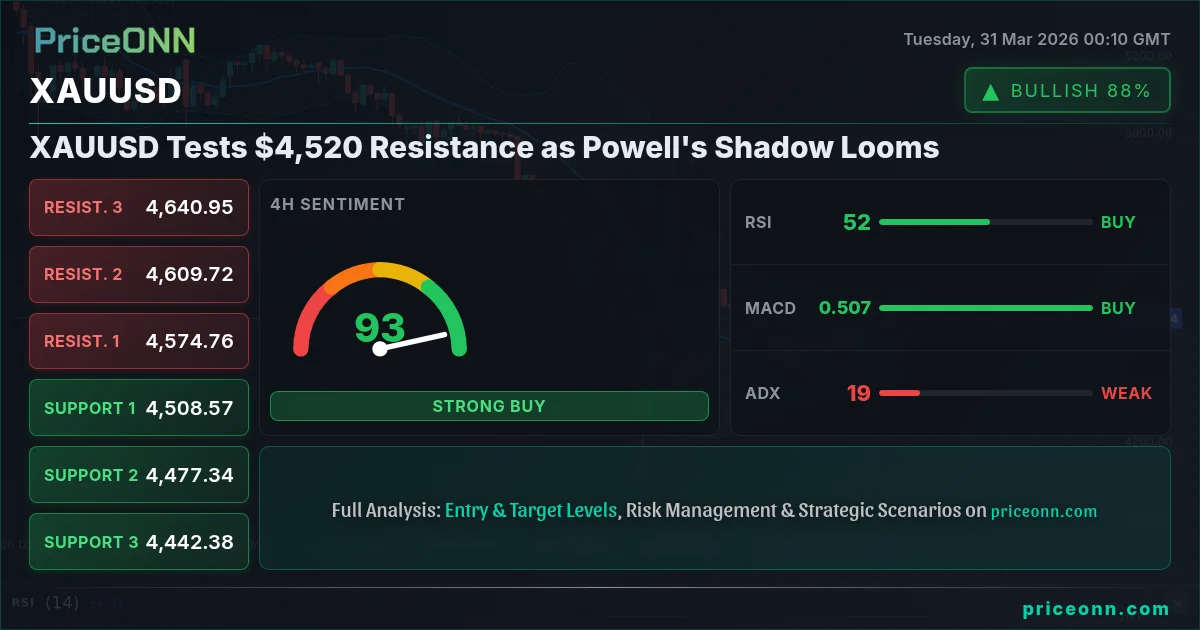
For traders, the current environment presents both opportunities and risks. The sustained central bank buying, coupled with ongoing geopolitical uncertainties, suggests that the floor beneath gold prices may be strengthening. Key technical levels to watch include the recent highs and potential resistance zones. Traders should closely monitor the U.S. Dollar Index (DXY) for directional cues, as a sustained downtick in the dollar could fuel further gains in XAU/USD. The Federal Reserve's monetary policy stance and upcoming economic data releases will also be critical. A more dovish tone from the Fed could accelerate gold's ascent, while hawkish signals might introduce headwinds. Watching for any major shifts in central bank reserve strategies could provide an early indication of future price movements. Key support levels are being observed around the $4,400 mark, while a decisive break above $4,500 could signal a continuation towards higher targets.
Outlook
The outlook for gold remains cautiously optimistic, supported by strong institutional demand and its established role as a safe-haven asset. While macroeconomic factors such as interest rates and currency movements will continue to influence short-term price action, the structural shift in central bank reserve management, particularly by emerging economies, provides a robust long-term bullish underpinning. Traders should prepare for potential volatility as markets digest economic data and central bank communications, but the overall trend appears to favor further appreciation if key support levels hold and the U.S. Dollar remains under pressure.
Frequently Asked Questions
What is the current price target for Gold (XAU/USD)?
Market analysts are observing a potential recovery extending towards the $5,000 area for Gold (XAU/USD), contingent on sustained central bank buying and favorable currency movements.
Why are central banks buying so much gold?
Central banks are increasing gold reserves as a strategy to diversify assets, hedge against inflation and currency devaluation, and bolster economic confidence, especially in emerging economies. In 2022, record purchases of 1,136 tonnes were noted.
What are the key levels traders should watch for Gold?
Traders should monitor the $4,400 level as a potential support zone and watch for a decisive breakout above $4,500, which could signal a move towards higher price targets. The U.S. Dollar's performance is also a critical factor.
Track markets in real-time
Empower your investment decisions with AI-powered analysis, technical indicators and real-time price data.
Join Our Telegram Channel
Get breaking market news, AI analysis and trading signals delivered instantly to your Telegram.
Join Channel
PriceONN