
Will New Zealand's Economic Slack Temper RBNZ's Response to Oil Price Shocks?


The Reserve Bank of New Zealand (RBNZ) is closely monitoring the nation's economic capacity as it prepares to address the inflationary pressures arising from elevated global oil prices. RBNZ Chief Economist Paul Conway stated that the presence of lingering economic slack will be a key factor in shaping the central bank's response strategy. This suggests that the RBNZ might opt for a more calibrated approach to monetary policy rather than an immediate, aggressive tightening.
Market Context
The New Zealand Dollar (NZD), often referred to as the Kiwi, is a significant currency in global forex markets. Its performance is closely tied to the health of the New Zealand economy and the RBNZ's policy decisions. However, domestic factors are not the sole drivers of the Kiwi's valuation. International economic trends, particularly those originating from China, New Zealand's largest trading partner, play a crucial role. A slowdown in the Chinese economy can dampen demand for New Zealand's exports, potentially weakening the NZD. Furthermore, the dairy industry, a bedrock of New Zealand's export earnings, has a direct impact. Fluctuations in global dairy prices affect the nation's export revenue, creating a direct link between commodity markets and the currency's strength. Rising dairy prices typically boost the economy and can lead to a stronger NZD.
Analysis & Drivers
The RBNZ's mandate includes maintaining inflation within a target band of 1% to 3%, with a preference for the 2% midpoint. The primary tool for achieving this objective is the manipulation of interest rates. When inflation accelerates beyond this range, the RBNZ typically raises interest rates to cool economic activity. This action also tends to increase bond yields. However, the presence of economic slack, meaning the economy is operating below its potential output, can mitigate inflationary pressures even with rising input costs like oil. This slack implies that there is underutilized labor and capital, which can absorb some of the price increases without immediately translating them into broad-based inflation.
The current global environment, characterized by volatile energy markets and ongoing geopolitical uncertainties, presents a complex challenge for central banks worldwide. For the RBNZ, the decision to raise rates or hold steady involves balancing the need to control inflation against the risk of stifling economic growth. Conway's comments suggest that the RBNZ believes it has room to maneuver, implying that the inflationary impact of higher oil prices may not necessitate a drastic policy shift if the slack can absorb some of the shock.
Trader Implications
Traders monitoring the New Zealand Dollar should pay close attention to RBNZ communications and economic data that sheds light on the degree of economic slack. Key indicators to watch include the unemployment rate, capacity utilization, and wage growth. A persistently high unemployment rate or evidence of underutilized industrial capacity would support the view that the RBNZ will adopt a more cautious stance. Conversely, signs of a tightening labor market or accelerating wage pressures would signal a greater likelihood of policy tightening.
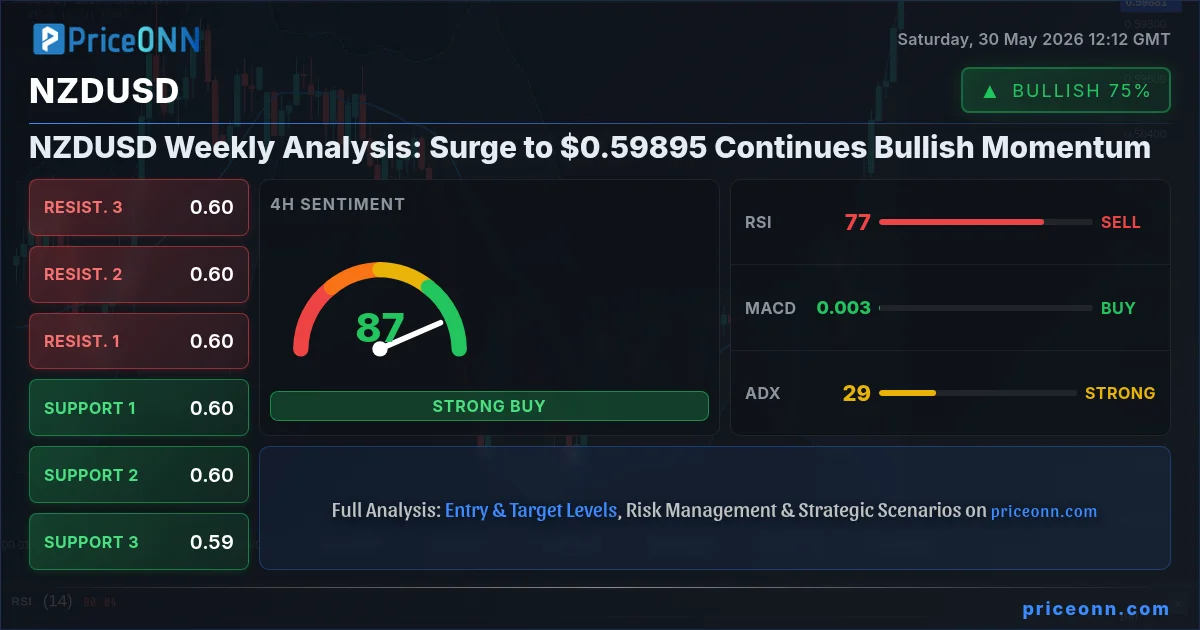
Immediate price action in the NZD will likely be sensitive to any shifts in market expectations regarding RBNZ policy. If oil prices continue to climb, but the RBNZ signals a dovish response due to economic slack, the NZD could come under pressure against its major counterparts. Key resistance levels for NZD/USD might be tested if market sentiment shifts towards risk aversion, while support levels could be vulnerable if the RBNZ's measured approach is perceived as insufficient to combat inflation. Traders should be prepared for potential volatility around upcoming RBNZ policy meetings and data releases.
Outlook
The RBNZ's forward-looking approach, as indicated by Chief Economist Conway, suggests a data-dependent strategy. The central bank will likely weigh the direct impact of oil price inflation against the underlying strength and capacity of the domestic economy. Should global oil prices stabilize or decline, the inflationary threat may diminish, allowing the RBNZ to maintain a more accommodative stance. However, sustained high energy costs coupled with any signs of the economic slack narrowing could force a more hawkish pivot. Upcoming inflation reports and employment figures will be critical in determining the RBNZ's next move and the subsequent trajectory of the New Zealand Dollar.
Frequently Asked Questions
What is economic slack and how does it affect RBNZ policy?
Economic slack refers to an economy operating below its full potential, with underutilized resources like labor and capital. It implies that demand is not strong enough to push prices up significantly. For the RBNZ, existing slack suggests they can absorb some inflationary pressures, like those from higher oil prices, without immediately needing to hike interest rates aggressively to avoid stifling growth.
What are the key indicators for New Zealand's economic slack?
Traders should monitor the unemployment rate, which the RBNZ aims to keep near its natural rate, and capacity utilization in industries. Other important metrics include wage growth, which can signal labor market tightness, and surveys on business confidence and investment intentions that reflect economic potential.
How might higher oil prices impact the New Zealand Dollar if the RBNZ takes a measured approach?
If oil prices rise significantly and the RBNZ responds cautiously due to economic slack, the NZD could weaken. This is because higher oil costs can act as a drag on economic growth, and a less aggressive monetary policy stance might make the currency less attractive to foreign investors seeking higher yields, potentially pushing NZD/USD lower.
Track markets in real-time
Empower your investment decisions with AI-powered analysis, technical indicators and real-time price data.
Join Our Telegram Channel
Get breaking market news, AI analysis and trading signals delivered instantly to your Telegram.
Join Channel PriceONN News
Upcoming U.S. employment data for May is expected to reveal a labor market that is no longer deteriorating but also failing to show significant improvement, with nonfarm payrolls projected to rise by 105,000 and the unemployment rate ticking up to 4.4%.
PriceONN News
The Canadian Dollar weakened against its U.S. counterpart following a disappointing jobs report that saw employment fall and the unemployment rate climb. This data suggests the Bank of Canada may maintain a cautious stance on monetary policy.
PriceONN News
The upcoming U.S. employment report for May is poised to reveal a labor market that is stabilizing but not accelerating, potentially influencing Federal Reserve policy. Traders are closely watching key inflation indicators from ISM surveys and Eurozone CPI data.
PriceONN News
Upcoming U.S. employment data is poised to reveal a labor market showing signs of stabilization rather than robust growth, potentially influencing Federal Reserve policy. Traders are closely watching key inflation indicators within the ISM surveys.
PriceONN News
Markets are closely watching Friday's U.S. employment report for May, with expectations of 105,000 new jobs and a 4.4% unemployment rate, which could indicate a labor market not deteriorating but also not significantly improving.
PriceONN News
US consumer confidence fell slightly to 93.1 in May, a modest decline from April's 93.8, driven by persistent inflation linked to Middle Eastern geopolitical events. While beating expectations, the drop signals growing household pressure.
PriceONN News
Canadian headline inflation rose to 2.8% in April, primarily driven by gasoline prices, yet core inflation metrics showed surprising stability, offering the Bank of Canada room for a patient monetary policy stance.
PriceONN News
Canadian headline inflation rose to 2.8% in April, largely driven by gasoline prices, but core measures remain stable, suggesting the Bank of Canada has room to maintain a patient stance on interest rates.
PriceONN News
New York's manufacturing sector experienced a significant boost in May, with the Empire State Manufacturing Index jumping to 19.6, nearly three times the expected consensus. This marks the strongest reading since April 2022, signaling a robust expansion in regional industrial activity.
PriceONN News
US inflation is projected to rise modestly in April, with headline CPI approaching 3.8% year-over-year, driven by escalating energy costs impacting food and services, even as shelter inflation cools. This data will be crucial for upcoming Federal Reserve policy decisions.
PriceONN News
US inflation data for April is anticipated to show a modest uptick, with headline CPI potentially reaching 3.8% year-over-year. This rise is attributed to elevated energy prices impacting food and services, even as shelter costs continue to moderate. Retail sales are also expected to grow, though primarily driven by price increases rather than volume.
PriceONN News
US inflation figures for April are anticipated to show a modest uptick, with headline CPI potentially reaching 3.8% year-over-year. This rise is attributed to energy price pressures impacting food and services, even as shelter costs continue to moderate. Meanwhile, retail sales are expected to reflect price-driven growth rather than volume increases.