AUDUSD Tests Resistance Near $0.70964 Amidst Dollar Strength and Gold's Plunge
AUDUSD hovers near $0.70964 resistance. With DXY strengthening and gold plummeting, the Aussie faces headwinds. Technicals suggest caution.
The Australian Dollar (AUD) is currently testing a significant resistance level against the US Dollar (USD) near the $0.70964 mark. This critical juncture for AUDUSD comes amidst a broader market environment characterized by a strengthening US Dollar Index (DXY), a sharp decline in gold prices, and increasing geopolitical jitters. While the AUDUSD pair shows some resilience, the confluence of these factors paints a cautious picture for the pair's immediate future, demanding close attention from traders and investors.
- With RSI at 41.4, the downward momentum for AUDUSD on the daily chart is significant, indicating potential for further downside pressure.
- Critical resistance sits at $0.70964, a level that has capped upside moves multiple times this week, highlighting its importance.
- The ADX reading of 32.5 on the daily chart signifies a strong downtrend, suggesting that any rallies might be short-lived unless major shifts occur.
- The correlation with DXY, currently at 99.85, is a key driver; a stronger dollar typically weighs on AUDUSD, reinforcing the bearish outlook.
The global economic landscape is currently dominated by a narrative of dollar strength, largely fueled by the Federal Reserve's hawkish stance and a general flight to safety. The US Dollar Index (DXY), currently trading around 99.85, has been a formidable force, putting pressure on riskier assets and major currency pairs. This strength in the greenback is a primary headwind for AUDUSD, which often exhibits an inverse correlation with the DXY. As the dollar gains traction, the 'Aussie' finds itself in a precarious position, struggling to build any substantial upside momentum.
Adding to the complexity is the dramatic plunge in gold prices, with XAUUSD testing levels around $4,625.9. Gold's sharp decline, down 4% today, often signals a 'risk-off' sentiment or expectations of tighter monetary policy. When gold tumbles, it can reflect reduced inflation expectations or a loss of confidence in traditional safe-haven assets, which can indirectly impact currencies like the AUD, sensitive to global commodity prices and risk appetite. The fact that gold is falling sharply while the dollar strengthens suggests a clear preference for dollar-denominated assets and a risk-averse environment, both of which are typically bearish for the Australian Dollar.

Navigating the Technical Landscape: AUDUSD's Tightening Grip
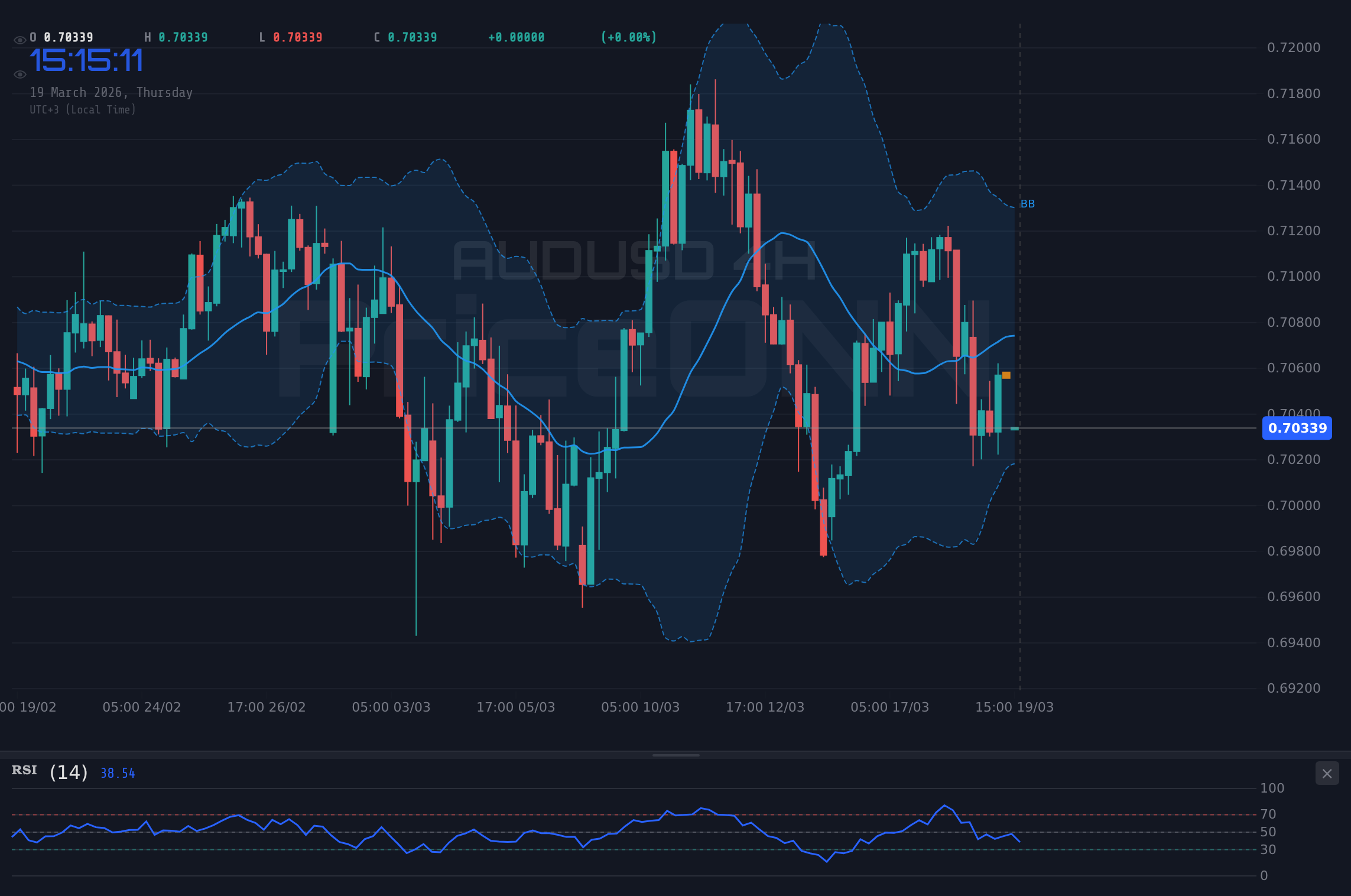
Looking at the AUDUSD chart, the technical picture on the 1-day timeframe reveals a currency pair caught in a strong downtrend, despite occasional intraday recoveries. The current price of $0.70384 finds itself hovering below key resistance levels, with the immediate barrier at $0.70477, followed by $0.70633 and $0.7072. The daily ADX stands at a robust 32.5, confirming a strong bearish trend. This indicates that the bears are firmly in control, and any upward movements are more likely to be pullbacks within a larger downward trajectory rather than the start of a new bullish phase.
The Relative Strength Index (RSI) on the daily chart is currently at 41.4, sitting in neutral territory but clearly leaning towards oversold conditions. While an RSI below 50 generally suggests bearish momentum, readings below 30 are typically considered oversold. The current level implies that while selling pressure is dominant, there isn't extreme oversold exhaustion yet, leaving room for further downside. The MACD indicator, also on the daily timeframe, continues to show negative momentum, with the MACD line below the signal line, reinforcing the bearish sentiment. This alignment of indicators suggests that the path of least resistance for AUDUSD remains to the downside.
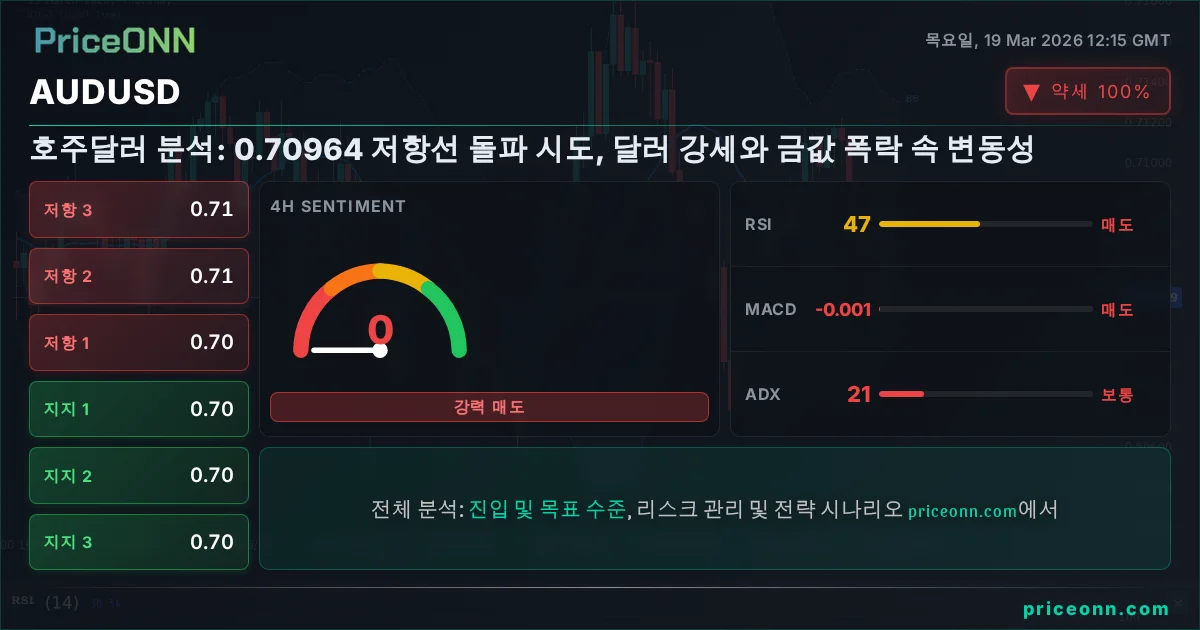
On the lower timeframes, the 1-hour and 4-hour charts paint an even more bearish picture. The 1H chart shows the trend as strongly bearish (90% strength) with RSI at 45.29 and ADX at 26.97. The 4H chart reinforces this, with a bearish trend (82% strength) and RSI at 47.35. The Stochastic Oscillator on both these shorter timeframes shows %K below %D, a classic bearish signal. The fact that multiple timeframes are aligned with a bearish outlook strengthens the case for caution. The current price action, while perhaps appearing to test resistance, is happening within a well-established bearish trend, making a sustained breakout above key resistance levels a significant challenge.
The trading range on the daily chart for AUDUSD has been between $0.70202 and $0.70622. This tight range suggests consolidation within the broader downtrend. Traders are watching closely to see if this consolidation leads to a breakdown or a bounce. Given the prevailing market conditions and the technical indicators, a breakdown seems more probable. If AUDUSD fails to hold the current levels and breaks below the daily support at $0.70234, it could accelerate its descent towards the next support level at $0.70147. Such a move would be a clear signal that the bearish trend is reasserting itself with renewed vigor.
Intermarket Dynamics: DXY, Gold, and the Aussie's Fate
The relationship between AUDUSD, the DXY, and gold is a critical one for understanding the current market dynamics. Historically, the Australian Dollar tends to move inversely to the DXY. As the DXY strengthens around 99.85, it exerts downward pressure on AUDUSD. This inverse correlation is currently playing out, with the dollar's ascent limiting any potential upside for the Aussie. The fact that the DXY itself is showing strong upward trends on multiple timeframes (93% strength on 1H, 87% on 4H, 98% on 1D) underscores the bullish sentiment surrounding the US currency.
Gold's sharp decline to $4,625.9 adds another layer to this narrative. While gold is often seen as a safe-haven asset, its recent performance suggests a shift in market sentiment. The plunge might indicate that investors are rotating out of gold and into the dollar, or that expectations of inflation are receding, diminishing gold's appeal. For the AUD, which is highly sensitive to commodity prices (as Australia is a major commodity exporter), a falling gold price is typically bearish. This reinforces the negative outlook for AUDUSD, as it faces pressure from both a strong dollar and weakening commodity prices.
The correlation between AUDUSD and commodities like gold is not always straightforward, but a significant sell-off in gold often coincides with broader risk aversion, which can hurt currencies like the AUD. The current market setup, with rising DXY and falling gold, presents a double whammy for the Aussie. It suggests that global liquidity might be tightening, or that investors are favoring the perceived safety and yield of US dollar-denominated assets over other markets. This risk-off sentiment is a significant factor that cannot be ignored when assessing AUDUSD's prospects.
Geopolitical Undercurrents and Their Impact
Escalating geopolitical tensions, particularly in the Middle East, are adding a layer of uncertainty to the global financial markets. Reports of Iran and Israel clashing over gas fields, and Brent Crude surging past $112, highlight the potential for supply disruptions and further inflationary pressures. While rising oil prices might typically support commodity-linked currencies like the AUD, the dominant narrative of dollar strength and risk aversion seems to be overshadowing this effect. In times of heightened geopolitical risk, capital often flows to perceived safe havens like the US dollar, irrespective of commodity price movements.
The recent news about the US easing sanctions on Venezuela, leading to a dip in WTI crude prices near $97.80, adds another dimension to the energy market's volatility. However, the overriding geopolitical narrative seems to be driving oil prices higher currently. The conflict in the Middle East, as highlighted by reports of China potentially dominating energy markets amidst the surge, creates a complex web of influences. For AUDUSD, the primary impact of these geopolitical events is likely to be through their influence on global risk sentiment and the subsequent demand for the US dollar, rather than a direct boost from commodity prices.
The implications of these geopolitical events are far-reaching. They can exacerbate inflation concerns, prompt central banks to maintain or even tighten monetary policy, and increase demand for safe-haven assets like the US dollar. This environment is generally unfavorable for currencies like the AUD, which are more sensitive to global growth and risk appetite. Therefore, while the headlines might focus on oil price surges, the underlying market reaction is likely to favor the dollar, keeping AUDUSD under pressure.
Economic Data: A Tale of Two Economies
Recent economic data releases provide further context for the AUDUSD's performance. New Zealand's economy expanding by a mere 0.2% in Q4 2025, falling short of forecasts, has put pressure on the NZD and, by extension, can influence sentiment around the AUD due to their close trading relationship and similar economic drivers. This disappointing GDP figure for New Zealand raises concerns about the broader economic momentum in the region, which can spill over into sentiment towards the Australian Dollar.
In contrast, the US economy continues to show resilience, which supports the Federal Reserve's current monetary policy stance and contributes to dollar strength. While specific US economic data releases are not detailed in the provided market context, the general narrative of economic resilience is a significant factor underpinning the DXY's strength. This divergence - weakness in a close regional economy like NZ and resilience in the US - further supports the bearish case for AUDUSD.
The Australian Dollar itself is sensitive to domestic economic data, particularly inflation and employment figures, as well as China's economic performance, given China's role as a major trading partner. Without specific recent Australian or Chinese data in the provided context, we rely on the broader macro and geopolitical themes. However, it's crucial to remember that any significant shift in Australian inflation or employment data, or any major economic news from China, could quickly alter the outlook for AUDUSD.
Trade Scenarios and Risk Management
Given the current technical and fundamental backdrop, several scenarios are plausible for AUDUSD. The prevailing trend is bearish, supported by strong ADX readings and aligned MACD/RSI signals on shorter timeframes, while the longer-term daily chart also shows a downtrend. The DXY strength and falling gold prices add significant headwinds.
Bearish Scenario: Downside Momentum Prevails
70% ProbabilityNeutral Scenario: Consolidation Continues
20% ProbabilityBullish Scenario: Unexpected Reversal
10% ProbabilityThe most probable scenario, given the strong daily downtrend (ADX 32.5) and the negative signals from RSI (41.4) and MACD, is a continuation of the bearish trend. A trigger for this scenario would be a close below the $0.70234 support level. Invalidation of this bearish thesis would occur if AUDUSD manages to decisively break and hold above the $0.70964 resistance level, a feat that seems unlikely in the current market climate. The first target for a bearish move would be the daily low of $0.70202, followed by the psychological level at $0.70000.
A neutral scenario, where AUDUSD continues to consolidate within its current range, is also possible, especially if upcoming economic data offers mixed signals or if market participants await further catalysts. This would likely involve price action remaining between the current support near $0.70202 and resistance around $0.70622. However, the strong ADX suggests that such consolidation might be temporary, potentially leading to a more decisive move once a breakout occurs.
The bullish scenario, while least probable at this moment, cannot be entirely dismissed. A strong break above the $0.70964 resistance, potentially fueled by unexpected dovish signals from the Fed or significantly positive Australian economic news, could open the door for further upside. Invalidation of this bullish case would be a swift return below the $0.70477 level, suggesting the breakout was a false move. For now, the evidence overwhelmingly points towards caution and a bearish bias.
Market Sentiment and Future Outlook
The prevailing market sentiment appears to be risk-averse, driven by geopolitical tensions and the prospect of sustained higher interest rates in the US. This sentiment directly impacts AUDUSD, as the Australian Dollar is often considered a risk-sensitive currency. When global risk appetite wanes, investors tend to shed riskier assets, including the AUD, and flock to safer havens like the US dollar.
The upcoming economic calendar will be crucial. While specific events are not detailed in the provided data, any significant shifts in inflation data, employment figures from major economies (US, Australia, China), or central bank commentary could drastically alter the outlook. For instance, a surprisingly strong US inflation report could reinforce hawkish Fed expectations, further strengthening the dollar and pressuring AUDUSD. Conversely, signs of cooling inflation or a significant economic slowdown in Australia could trigger a sharper decline in the pair.
The 1D ADX at 32.5 indicates a strong trend, and the RSI at 41.4 suggests room for further downside. The Stochastic Oscillator, with %K at 43.36 and %D at 49, also shows a bearish leaning. These technical indicators, combined with the macro picture of dollar strength and geopolitical uncertainty, suggest that the downside risks for AUDUSD are more pronounced than the upside potential in the short to medium term. Traders should remain vigilant, focusing on key support and resistance levels and managing risk accordingly.
What happens if AUDUSD breaks below the $0.70147 support level?
If AUDUSD closes decisively below the $0.70147 support level, it would likely confirm the continuation of the strong bearish trend indicated by the daily ADX of 32.5. This could trigger further selling pressure, with the next significant psychological level to watch being around $0.70000.
Should I consider buying AUDUSD at current levels around $0.70384 given the RSI at 41.4?
Buying at current levels around $0.70384 is not advisable given the bearish technical signals and the prevailing risk-off sentiment. While the RSI at 41.4 is not yet in oversold territory, the strong downtrend suggested by the ADX at 32.5 indicates that further downside is probable. A confirmation of a bullish reversal would require a sustained break above key resistance levels like $0.70964.
Is the Stochastic signal of %K (43.36) below %D (49) a sell signal for AUDUSD on the daily chart?
Yes, the Stochastic signal on the daily chart, with %K at 43.36 and %D at 49, is considered a bearish signal as %K is below %D. This aligns with the broader downtrend indicated by other indicators like the ADX and RSI, reinforcing the cautious outlook for AUDUSD.
How will the strengthening DXY at 99.85 affect AUDUSD this week?
The strengthening DXY, currently at 99.85 and showing strong upward trends across multiple timeframes, is expected to continue exerting downward pressure on AUDUSD. This inverse correlation means that as the dollar index rises, AUDUSD is likely to fall, especially in the current risk-averse market environment.
Track markets in real-time
AI-powered analysis, technical indicators and real-time price data.
Join Our Telegram Channel
Breaking market news, AI analysis and trading signals instantly.
Join Channel