

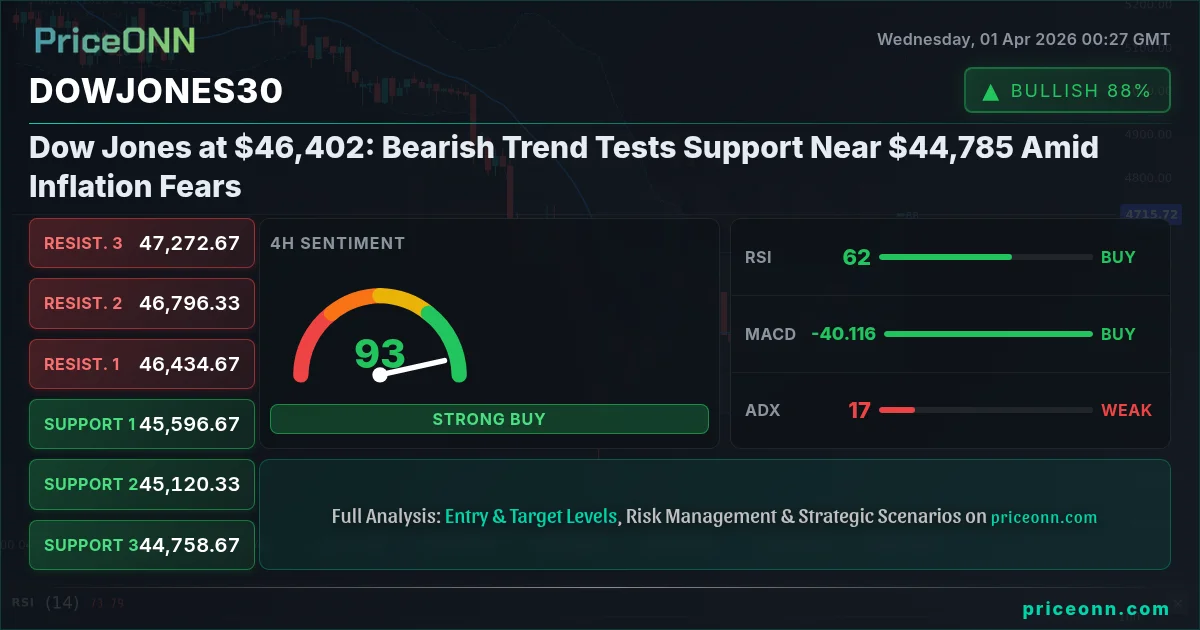
The relentless march of inflation and the shifting sands of central bank policy have cast a long shadow over equity markets, and the Dow Jones Industrial Average is no exception. Amidst ongoing geopolitical tensions that continue to fuel commodity prices and a strengthening US Dollar Index (DXY), the Dow Jones is currently facing significant headwinds. Trading at $46,402.00, the index is exhibiting clear bearish signals across multiple timeframes, with traders closely watching the $44,785 support level as a crucial battleground. This analysis delves into the confluence of technical indicators and fundamental drivers shaping the Dow Jones's immediate future.
- The Dow Jones is trading at $46,402.00, testing bearish trend signals.
- Critical support is identified at $44,785, with further levels at $44,371 and $43,935.
- Resistance is currently seen at $45,635, $46,071, and $46,485.
- The ADX at 42.01 on the daily chart indicates a strong downtrend.
- A strengthening DXY at 99.48 is adding pressure to risk assets.
The Bearish Momentum Takes Hold
The 1-day chart for the Dow Jones Industrial Average paints a decidedly bearish picture. The trend strength is currently pegged at 100% bearish, a stark indicator of the prevailing sentiment. The Relative Strength Index (RSI) hovers at 44.07, firmly in neutral territory but with a discernible downward eğilim, suggesting that while oversold conditions aren't imminent, the selling pressure is more potent than any buying interest. Complementing this, the Moving Average Convergence Divergence (MACD) shows negative momentum, with the MACD line positioned below its signal line, further reinforcing the bearish outlook. Bollinger Bands are also trading below the middle band, a classic sign of downward pressure. The Average Directional Index (ADX) at 42.01 signifies a strong downtrend, indicating that the market is not just moving lower, but doing so with conviction. This technical setup suggests that further downside is probable, with the first major test being the support level at $44,785.
The Stochastic Oscillator, with %K at 31.28 and %D at 36.25, is showing a slight upward crossover from oversold territory, but remains firmly within the lower half of its range. While this might hint at a potential short-term bounce, the overarching trend indicators on the daily timeframe do not support a significant reversal. The strength of the downtrend, as indicated by the ADX, means that any pullbacks are likely to be temporary, met by renewed selling pressure as traders attempt to capitalize on the prevailing bearish momentum. The market is clearly favoring sellers, and the current price action around $46,402.00 reflects this dominance.
Correlation with Global Markets and Currencies
The Dow Jones's current predicament cannot be viewed in isolation. Its movements are intricately linked to broader market sentiment, currency fluctuations, and commodity prices. The US Dollar Index (DXY), currently trading at 99.48, is a crucial factor. While the 1-hour and 4-hour DXY charts show a downtrend, the daily chart indicates a strong 100% bullish trend. This divergence suggests potential for a dollar rebound, which typically exerts downward pressure on risk assets like the Dow Jones. A stronger dollar makes US exports more expensive and can reduce foreign investment, acting as a drag on the index. As the DXY shows signs of finding support on its daily chart, this correlation becomes even more critical to monitor.
Furthermore, the performance of other major US indices, the S&P 500 and Nasdaq 100, offers a broader perspective. Both are currently exhibiting strong bullish trends on their 1-hour and 4-hour charts, despite bearish signals on their daily charts. This short-term strength in equities, contrasting with the Dow Jones's more pronounced bearish tilt, highlights potential divergence within the market. However, the daily bearish signals for the S&P 500 (RSI 43.46, MACD negative) and Nasdaq 100 (RSI 43.71, MACD negative) suggest that the broader equity market may also be susceptible to further declines. If these major indices falter, the Dow Jones's descent could accelerate, especially if the DXY begins to trend higher.
Oil prices, specifically Brent crude at $108.05, also play a significant role. While currently showing a bearish trend on its 1-hour and 4-hour charts, Brent's daily chart displays a strong 100% bullish trend. Elevated oil prices, driven by geopolitical instability in the Middle East and supply concerns, contribute to inflationary pressures. This persistent inflation can lead to expectations of tighter monetary policy from the Federal Reserve, which is generally negative for stock markets, including the Dow Jones. The interplay between oil prices, inflation, and Fed policy expectations creates a complex environment that favors caution.
The Crucial Role of Support at $44,785
The technical landscape for the Dow Jones clearly points towards the support level at $44,785 as the next significant area of interest. This level, along with subsequent supports at $44,371 and $43,935, represents potential floors where buying interest might emerge. However, the prevailing strong bearish trend on the daily chart suggests that these levels are more likely to be tested and potentially broken rather than holding firm. The ADX at 42.01 is a strong signal of a trending market, and in such conditions, established trends tend to persist until a clear catalyst for reversal appears.
The 4-hour chart offers a slightly different perspective, with a neutral trend strength and an ADX of 16.78, indicating a weaker trend. This timeframe might show some consolidation or minor bounces. Stochastic on the 4-hour chart shows a potential bullish signal with %K above %D, but this is occurring in an overbought zone. The RSI at 61.82 is also in neutral territory, leaning towards bullish but not yet overbought. This multi-timeframe analysis suggests that while short-term traders might find opportunities for minor gains on intraday or 4-hour charts, the dominant daily trend remains bearish. Breaking below $44,785 would invalidate any short-term bullish hopes and open the door for a steeper decline towards the lower support levels.
Navigating the Resistance Levels
On the upside, the Dow Jones faces immediate resistance at $45,635, followed by $46,071 and $46,485. The current price of $46,402.00 is hovering just below the R2 resistance level. For the bearish thesis to be invalidated, the index would need to decisively break through these resistance levels, particularly $46,485. The daily MACD, currently showing negative momentum, would need to flip positive, and the RSI would need to climb back above 50, ideally showing bullish divergence. The ADX would also need to fall below 20, indicating a weakening trend.
The 1-hour chart, showing a bullish trend with an RSI of 73.98, is in overbought territory. This suggests that any immediate upward movement might be met with profit-taking, potentially pushing the price back down towards the $46,402.00 mark or even lower. The strong ADX of 33.81 on this timeframe indicates that while the short-term trend is up, it's a strong trend, meaning a reversal would require significant force. The Stochastic Oscillator on the 1-hour chart is in extreme overbought conditions (K=94.16, D=84.54), further supporting the idea that any immediate upside may be limited and could lead to a pullback rather than a sustained rally.
Bearish Scenario: Trend Continuation
70% ProbabilityNeutral Scenario: Consolidation and Range-Bound Trading
20% ProbabilityBullish Scenario: Trend Reversal Attempt
10% ProbabilityEconomic Calendar and Geopolitical Undercurrents
While the technicals provide a clear roadmap, the fundamental backdrop is equally crucial in understanding the Dow Jones's trajectory. The economic calendar shows a period of heightened sensitivity, with several high-impact events for the US Dollar looming. Though specific dates are not provided for the immediate releases, the fact that previous data points for USD releases like consumer spending and inflation were significant underscores the potential market impact of upcoming figures. A stronger-than-expected inflation reading or a hawkish tone from the Federal Reserve, even if implied rather than explicit, could bolster the dollar and further pressure the Dow Jones. Conversely, signs of cooling inflation or a dovish shift in Fed commentary could provide some relief.
Geopolitically, the situation remains tense. The ongoing Middle East crisis continues to propel oil prices, with Brent crude trading above $108.00. This sustained high energy cost fuels inflation expectations, creating a challenging environment for equities. As mentioned, elevated oil prices often translate into higher input costs for businesses, potentially squeezing profit margins and impacting corporate earnings, which are the bedrock of stock valuations. The market's reaction to any escalation or de-escalation in the Middle East will be closely watched, as it directly influences inflation forecasts and, consequently, monetary policy expectations. The correlation between oil prices and the Dow Jones is complex: higher oil can mean higher inflation and thus tighter policy (bad for stocks), but it can also signal robust global demand (good for stocks). Currently, the inflation narrative seems to be dominating.
The strengthening DXY, despite some short-term weakness on lower timeframes, remains a persistent concern. The daily trend for the dollar index is strongly bullish, and any sustained upward move would likely coincide with further weakness in global equities. Traders are constantly assessing the Fed's stance on interest rates. While recent data might suggest a pause, the persistent inflationary pressures could keep the Fed on a tighter leash than the market anticipates. This uncertainty creates a cautious environment, where any negative news or data can trigger sharp sell-offs.
The Path Forward: Key Levels and Outlook
The immediate outlook for the Dow Jones Industrial Average is decidedly cautious, leaning bearish. The confluence of strong daily bearish technicals, a firm downtrend indicated by the ADX at 42.01, and the pressure from a strengthening dollar suggests that downside risk remains elevated. The critical support level to watch is $44,785. A decisive break below this level would confirm the bearish trend and likely trigger further selling, targeting $44,371 and then $43,935. On the flip side, for any significant bullish sentiment to return, the index would need to overcome immediate resistance at $45,635, $46,071, and crucially, break convincingly above the $46,485 level. Such a move would require a shift in momentum, evidenced by positive MACD crossovers and a rising RSI above 50, ideally with confirmation from the broader equity indices and a weakening DXY.
The current price action around $46,402.00 is a pivotal point. It sits just below the second resistance level, making it a challenging area for bulls to gain traction. The overbought conditions on the 1-hour RSI and Stochastic suggest that any immediate upward attempts may face selling pressure, potentially leading to a retest of lower levels. Traders should remain vigilant, paying close attention to the strength of the dollar and any new developments regarding inflation and Fed policy. The prevailing sentiment favors a bearish continuation, but the market always presents opportunities for those who are patient and disciplined in their approach. Managing risk will be paramount as the Dow Jones navigates these critical levels.
Frequently Asked Questions: DowJones30 Analysis
What happens if DowJones30 breaks below the $44,785 support level?
A break below $44,785 would likely confirm the strong daily bearish trend, potentially triggering further declines towards $44,371 and $43,935. The ADX at 42.01 suggests a strong trend, making this support level a critical point to watch.
Should I consider buying DowJones30 at current levels near $46,402 given the mixed signals?
Given the strong bearish daily trend and the critical support level being tested, buying at current levels carries significant risk. While short-term charts show some bullishness, the daily indicators suggest caution. A more prudent approach might be to wait for a clear break of resistance above $46,485 or a confirmed bounce from the lower support levels.
Is the RSI at 44.07 a strong sell signal for DowJones30 right now?
An RSI of 44.07 is not inherently a strong sell signal; it indicates neutral territory with a slight downward eğilim. While it suggests bears are in control, it doesn't signal immediate oversold conditions. The strength of the downtrend is better indicated by the ADX at 42.01.
How will the strengthening DXY at 99.48 affect DowJones30's trend this week?
A strengthening DXY typically puts downward pressure on risk assets like the Dow Jones. With the DXY showing a strong daily bullish trend, it reinforces the bearish outlook for the index, potentially accelerating declines if support levels fail.
Track markets in real-time
AI-powered analysis, technical indicators and real-time price data.
Join Our Telegram Channel
Breaking market news, AI analysis and trading signals instantly.
Join Channel