

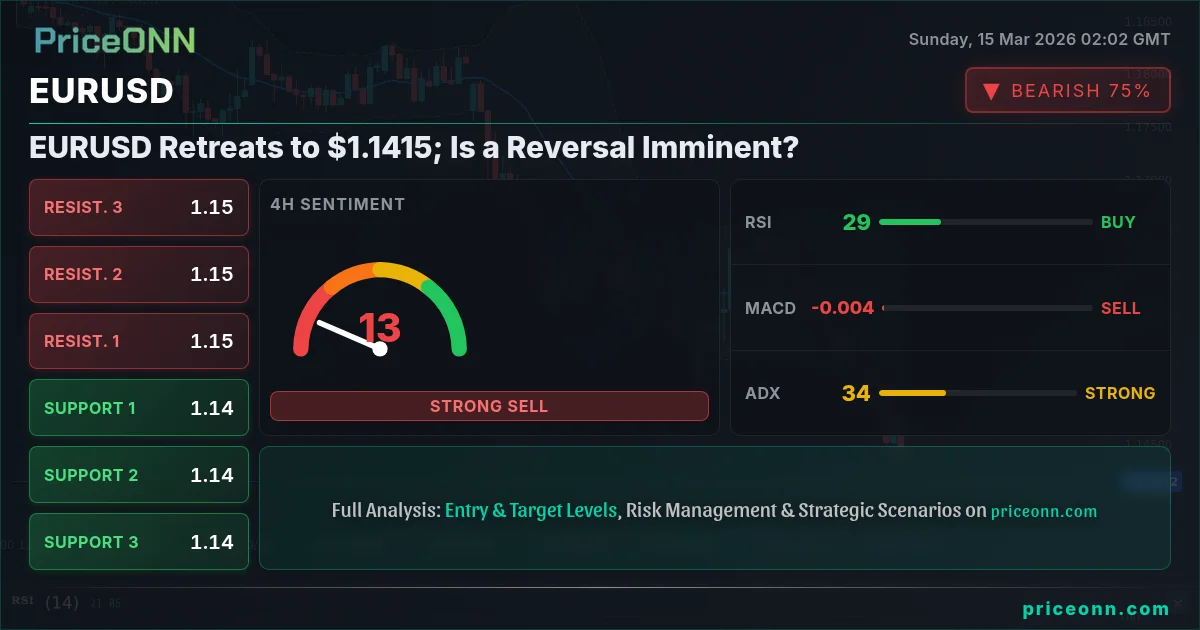
EURUSD is under pressure, trading at $1.1415, a 0.82% decline from last Friday’s close. The euro faces headwinds as the ECB signals caution amidst an oil price surge, per recent reports. The question now is whether the pair can find support or if further declines are on the horizon.
Macroeconomic Pressures Weighing on EURUSD
The euro has been facing significant headwinds, particularly as the ECB adopts a more cautious stance while grappling with rising oil prices. News outlets have noted the pressure on the euro as the ECB prioritizes communication over immediate action. This cautious approach contrasts with the dollar's relative strength, as indicated by the DXY's rise to 100.07, a 0.67% increase. With the DXY at 100.07, EURUSD faces considerable downside pressure. This inverse correlation between the dollar index and EURUSD often intensifies during periods of economic uncertainty.
The key here is the divergence in monetary policy expectations. While the market anticipates potential rate hikes from the Federal Reserve to combat inflation, the ECB appears hesitant to tighten its monetary policy aggressively. This divergence creates a favorable environment for the dollar, pushing EURUSD lower. Recent economic data from the U.S. has also supported the dollar's strength. The upcoming GBP economic data on March 13 will be closely watched for any signs of weakness that could further bolster the dollar's appeal.
Technical Overview: EURUSD at Critical Juncture
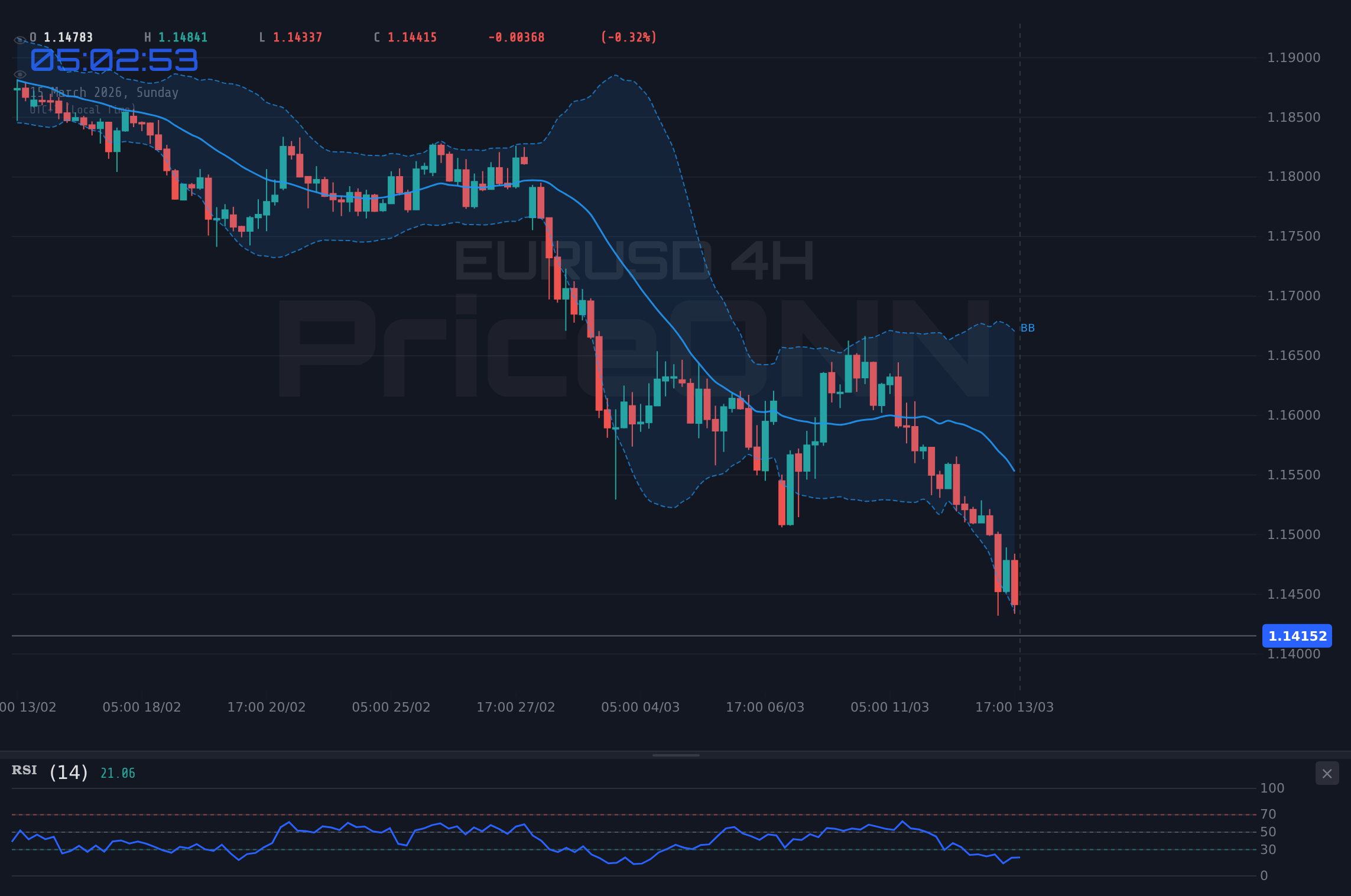
From a technical perspective, EURUSD is currently testing critical support levels. The pair is trading below its 200-day moving average, a bearish signal indicating a potential shift in the long-term trend. The 1-hour chart shows a strong downtrend with 96% strength, suggesting that the bearish momentum is likely to continue in the short term. The pair finds immediate support at 1.143, 1.14249 and 1.14188. A break below the 1.14188 level could open the door for further declines toward the 1.1400 level and beyond.
The Relative Strength Index (RSI) on the 1-hour chart reads 23.05, indicating oversold conditions. While oversold conditions can often lead to a short-term bounce, it's crucial to consider the overall trend. In a strong downtrend, oversold signals can be unreliable. The Moving Average Convergence Divergence (MACD) also confirms the bearish momentum, with the MACD line below the signal line and the histogram in negative territory. With the ADX at 41.97, the downtrend is classified as strong.
Multi-Timeframe Analysis: Identifying Key Levels
A multi-timeframe analysis provides a more comprehensive view of EURUSD's technical outlook. On the 4-hour chart, the trend is also bearish, with the pair trading below its 50-period moving average. The 4H RSI is at 31.08, still indicating bearish momentum. Key support levels on the 4-hour chart are 1.14566, 1.14349, and 1.14185. Resistance levels are identified at 1.14947, 1.15111, and 1.15328. A break above the 1.15328 level would be needed to negate the bearish bias.
Looking at the daily chart, the overall trend remains bearish. The pair is trading below its 200-day moving average, and the RSI is at 23.59, indicating oversold conditions. The daily MACD also confirms the bearish momentum. Key support levels on the daily chart are 1.14881, 1.14663, and 1.14237. Resistance levels are located at 1.15525, 1.15951, and 1.16169. The daily ADX reads 32.84, confirming a strong downtrend.
EURUSD and DXY: A Critical Correlation
The inverse correlation between EURUSD and the Dollar Index (DXY) is a crucial factor to consider. Currently, the DXY is trading at 100.07, reflecting a strengthening dollar. Historically, when the DXY rises, EURUSD tends to decline. This correlation is driven by the fact that the euro is a significant component of the DXY. As the dollar strengthens, it becomes more expensive to purchase euros, leading to a decline in EURUSD. Traders should closely monitor the DXY for further clues about the future direction of EURUSD. If the DXY continues to rise, EURUSD is likely to face further downside pressure. With the DXY trending strongly upwards, as indicated by the ADX at 29.75 on the daily chart, EURUSD remains vulnerable.
Economic Data and ECB Policy: What to Watch
Several economic data releases and ECB policy decisions could significantly impact EURUSD in the coming weeks. Market participants will be closely watching the upcoming GBP economic data on March 13. Any signs of weakness in the UK economy could further bolster the dollar's appeal, adding to the downward pressure on EURUSD. Furthermore, any indications that the ECB is considering easing its monetary policy could also weigh on the euro. The key is to monitor economic data and central bank commentary for clues about the future direction of monetary policy.
The Euro Faces Headwinds as ECB Signals Caution Amid Oil Price Surge. The euro is under pressure as the ECB adopts a more cautious stance, prioritizing communication over immediate action. Reuters' reported that Fed officials emphasized that inflation remains 'stubborn', which could lead to a more hawkish stance. Big Tech's Energy Alliance Targets $100 Billion in Savings. A coalition of tech giants, including Google and Tesla, is pledging to save U.S. consumers over $100 billion in energy costs, this could have an impact on future inflation rates and the value of the dollar.
Potential Scenarios: Bullish vs. Bearish Outlook
Given the current technical and fundamental backdrop, there are two potential scenarios for EURUSD:
EURUSD finds support at 1.14188, RSI bounces from oversold levels, and the DXY weakens. A break above 1.15328 could signal a potential reversal.
EURUSD breaks below 1.14188, DXY continues to strengthen, and economic data favors the dollar. A move towards 1.1400 is likely.
Frequently Asked Questions: EURUSD Analysis
What happens if EURUSD breaks below 1.14188?
If EURUSD breaks below the 1.14188 level, it could trigger a further decline toward the 1.1400 level. This scenario is supported by the strong downtrend on the 1-hour chart and the negative momentum indicated by the MACD.
Should I buy EURUSD at current levels of $1.1415 given RSI at 23.05?
While the RSI at 23.05 indicates oversold conditions, buying EURUSD at current levels carries significant risk. The overall trend is bearish, and oversold signals can be unreliable in a strong downtrend. It's prudent to wait for confirmation of a reversal before considering a long position.
Is the EURUSD decline correlated with the DXY?
Yes, the EURUSD decline is strongly correlated with the DXY. The DXY is currently trading at 100.07, reflecting a strengthening dollar. This inverse correlation between the dollar index and EURUSD often intensifies during periods of economic uncertainty.
How will the upcoming GBP economic data on March 13 affect EURUSD this week?
The upcoming GBP economic data on March 13 will be closely watched for any signs of weakness in the UK economy. Any weakness in the UK economy could further bolster the dollar's appeal, adding to the downward pressure on EURUSD.
Technical Outlook Summary
| Indicator | Value | Signal |
|---|---|---|
| RSI (14) | 23.05 | Oversold |
| MACD Histogram | Negative | Bearish |
| Stochastic | 8.21 | Oversold |
| ADX | 41.97 | Strong Downtrend |
| Bollinger | Lower Band | Watch |
Key Levels
Support Levels
Resistance Levels
Track markets in real-time
AI-powered analysis, technical indicators and real-time price data.
Join Our Telegram Channel
Breaking market news, AI analysis and trading signals instantly.
Join Channel