

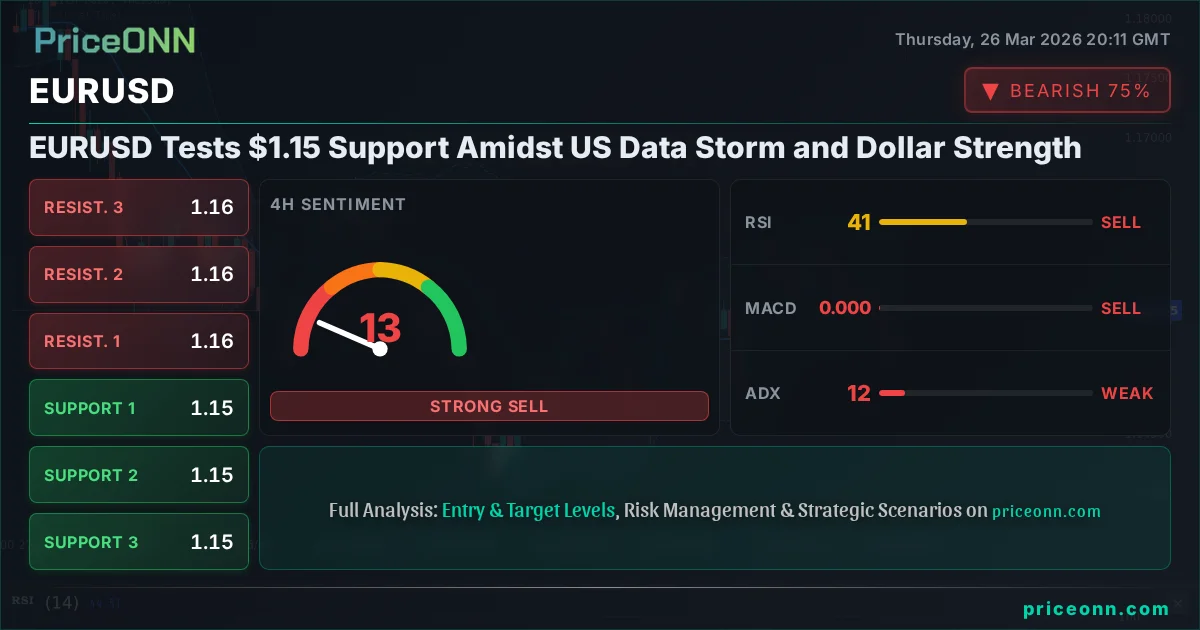
The relentless march of the US Dollar, bolstered by a potent combination of robust economic data and hawkish central bank signals, is casting a long shadow over the Euro. EURUSD is currently testing the critical psychological support level of $1.15, a move that has traders and investors on the edge of their seats. This isn't just a minor fluctuation; it's a significant test of the pair's resilience in the face of strong headwinds, driven by a narrative that increasingly favors the greenback over its European counterpart. The current price action suggests that the market is pricing in a scenario where the Federal Reserve maintains a tighter monetary policy for longer, a stark contrast to the more dovish outlook perceived in some other major economies.
- EURUSD is currently trading at $1.15, testing critical support levels.
- The US Dollar Index (DXY) is surging towards 100, currently at 99.81, exerting pressure on EURUSD.
- Technical indicators suggest a bearish bias on EURUSD across multiple timeframes, with RSI readings in oversold or neutral-downward territory.
- Strong US economic data, including a positive PMI reading, is fueling dollar strength and challenging the Euro's stability.
The narrative driving the Dollar's ascent is multi-faceted, but recent US economic data releases have played a starring role. The latest Purchasing Managers' Index (PMI) figures for the services sector came in stronger than expected, registering 52.4 against a forecast of 51.5. This robust reading signals continued expansion in the US services economy, a crucial engine of growth. Simultaneously, the manufacturing PMI, while showing a slight dip to 51.1 from a previous 51.7, still indicates that the sector is in expansionary territory, defying broader recessionary fears that have plagued other global economies. This economic resilience in the US, particularly when contrasted with the more mixed economic signals emanating from the Eurozone, creates a compelling case for continued Dollar strength. The market's interpretation of this data is clear: the US economy is demonstrating a capacity to withstand higher interest rates, making the Dollar an attractive proposition for investors seeking stability and yield.
The Dollar's Ascendancy: A Tale of Two Economies
DXY's Charge Towards 100: A Critical Juncture
The Dollar Index (DXY), a key barometer of the greenback's strength against a basket of major currencies, has been on an impressive run, currently hovering around 99.81. This upward trajectory isn't just a technical blip; it's a reflection of fundamental divergence. As the US economy continues to show signs of robustness, particularly with the latest PMI data exceeding expectations, the Federal Reserve's stance remains a pivotal factor. With an ADX reading of 31.9 on the daily chart, the DXY is exhibiting a strong upward trend, underscoring the Dollar's current dominance. The RSI at 60.79, while in neutral territory, shows a clear upward bias, indicating room for further appreciation before reaching overbought conditions. This strength in the Dollar directly translates into pressure on currency pairs like EURUSD, pushing it towards significant support levels.
The contrast with the Eurozone's economic landscape is stark. While specific Eurozone data points are not provided in detail for this analysis, the general market sentiment suggests a more cautious outlook. Persistent inflation concerns, coupled with the ongoing geopolitical tensions and their impact on energy prices, create a challenging environment for the European Central Bank (ECB). Any perceived dovishness or hesitation from the ECB in addressing these challenges further widens the interest rate differential with the US, making the Euro less attractive. This fundamental divergence is not just a short-term phenomenon but is shaping up to be a key theme for the foreseeable future, underpinning the Dollar's strength and weighing on EURUSD.
EURUSD's Test of $1.15: Technical Signals Align with Macro Trends
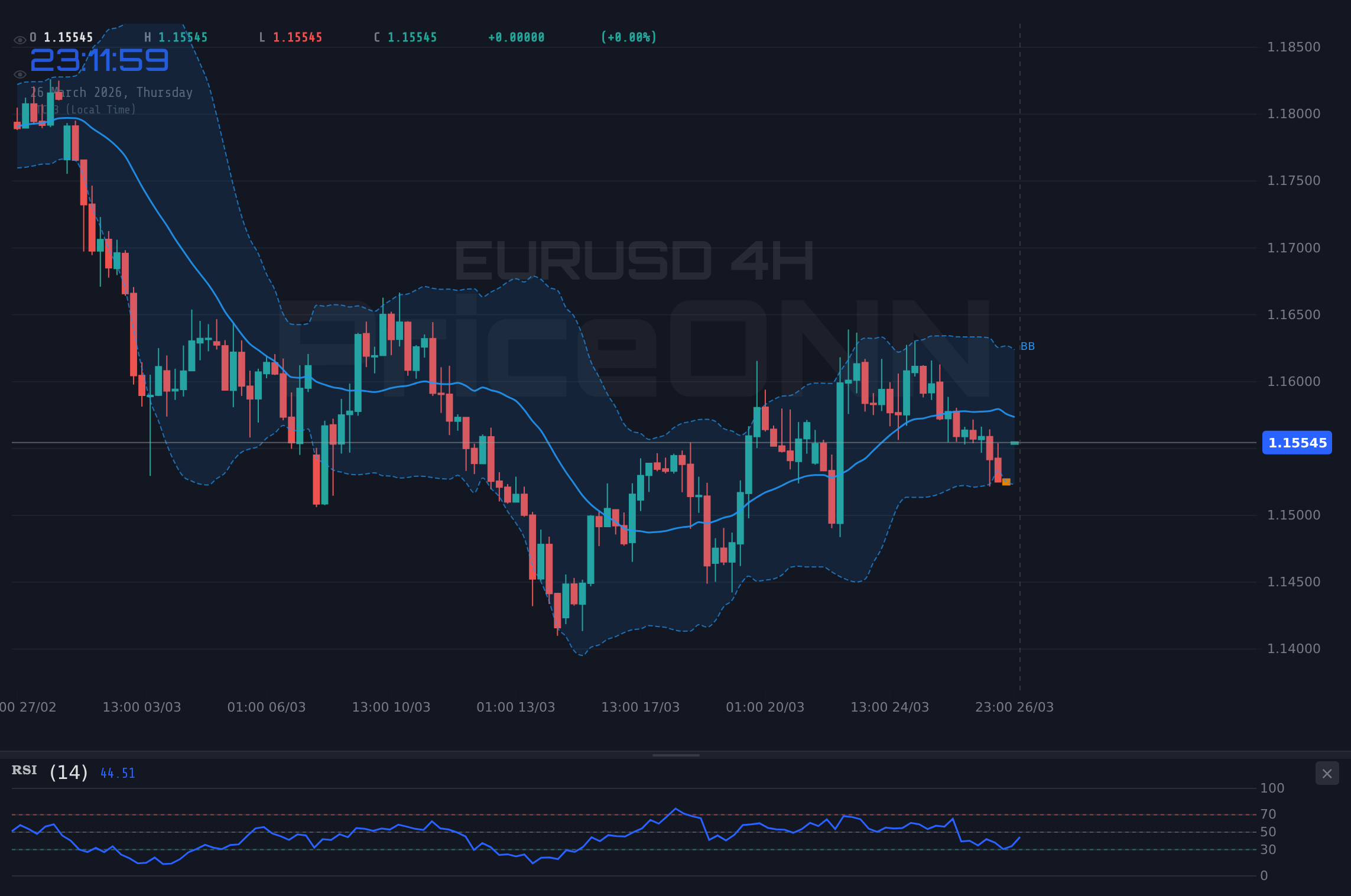
From a technical perspective, EURUSD's descent to the $1.15 mark is supported by a confluence of indicators across various timeframes. On the 1-hour chart, the trend is definitively bearish with a strength of 99%, supported by a MACD that shows negative momentum and an RSI at 35.88, indicating downward pressure. While the Bollinger Bands here suggest a slight upward tendency, this is likely a minor retracement within a larger downtrend, especially given the ADX reading of 27.92, which points to a strong trend. The Stochastic Oscillator, with %K at 11.73 and %D at 32.25, reinforces the bearish signal, indicating further downside potential.
The 4-hour chart paints a similar, albeit slightly more neutral, picture. The trend strength is at 50%, reflecting a period of consolidation or potential transition, but the overall momentum remains cautious. The RSI at 40.77 still leans towards a bearish sentiment, and the MACD remains negative. The ADX at 12.37 signals a weakening trend, suggesting that the current price action might be more range-bound in this timeframe, awaiting a catalyst for a decisive move. However, the Stochastic Oscillator, deep in oversold territory at K=13.16 and D=13.74, hints at a potential short-term bounce, though the daily chart's overall bearish sentiment tempers this optimism.
The daily timeframe analysis provides the most critical context for the current move. EURUSD's daily trend is neutral, but the overall sentiment is bearish, with a strong ADX reading of 34.2 indicating a powerful trend is in play. The RSI at 41.1, while not in oversold territory, shows a clear downward bias. The MACD's positive momentum is a slight anomaly here, potentially indicating a divergence or a lagging signal, but it's overshadowed by the bearish signals from other indicators. The Stochastic Oscillator, with K=66.32 and D=65.12, shows a bullish signal, suggesting potential for a rebound. However, this is occurring within the context of a strong daily downtrend indicated by the ADX. The conflict between the Stochastic's bullish crossover and the broader bearish trend is a classic sign of market indecision or a potential bear flag formation, where a brief upward correction precedes a further decline.
Navigating the $1.15 Level: What's Next for EURUSD?
The $1.15 level for EURUSD is more than just a number; it represents a significant psychological and technical battleground. Historically, this level has acted as a key pivot point, and its current testing signifies a critical moment for the pair. A decisive break below $1.15, driven by continued Dollar strength and potentially weaker Eurozone data, could open the floodgates to further downside. On the daily chart, the next significant support level lies around $1.15324, followed by $1.15057. A break below these could easily see EURUSD retesting levels closer to $1.14569, levels not seen in some time. The strength of the Dollar, currently at 99.81, and its upward trend (ADX 31.95 on the daily chart) strongly suggest that bearish pressure could persist, making a sustained break below $1.15 a plausible scenario.
Conversely, a failure to break below $1.15 could signal a potential short-covering rally or a consolidation phase. This would likely be triggered by a shift in market sentiment, perhaps a less hawkish tone from the Fed, or surprisingly strong Eurozone data. The Stochastic Oscillator on the daily chart, showing a bullish crossover (K=66.32, D=65.12), could be the harbinger of such a move. However, for this bullish case to gain traction, EURUSD would need to decisively break above the immediate resistance levels, starting with $1.15361 on the 1-hour chart, then $1.15635 on the 4-hour, and ultimately challenging the daily resistance at $1.16079. Without a clear catalyst for such a shift, the path of least resistance appears to be downwards, especially with the broader market sentiment favoring the US Dollar.
The Impact of US Data and Fed Expectations
The recent slew of positive US economic data, particularly the higher-than-expected PMI figures, has significantly recalibrated market expectations regarding the Federal Reserve's monetary policy. Traders are now pricing in a higher probability that the Fed might delay or even forgo interest rate cuts this year, or at the very least, maintain a cautious, data-dependent approach. This shift in expectations is a powerful driver for the US Dollar. When interest rate differentials widen in favor of a currency, it tends to attract capital, boosting demand for that currency. For EURUSD, this means that as long as the US economy shows resilience and the Fed maintains a relatively hawkish stance compared to the ECB, the downward pressure on the pair is likely to persist.
The market's reaction to these data points has been swift and decisive. The strengthening DXY and the corresponding weakness in EURUSD are direct consequences of this repricing of Fed policy expectations. The fact that the US equity markets, like the S&P 500 and Nasdaq, have also seen significant declines (S&P 500 down 1.71% and Nasdaq down 2.32%) adds another layer to the narrative. This 'risk-off' sentiment often leads investors to seek the safety of the US Dollar, further amplifying its strength. While gold prices have tumbled, suggesting a move away from traditional safe havens, the Dollar's role as a primary safe haven remains robust in this environment. This complex interplay of data, central bank policy, and risk sentiment creates a challenging environment for the Euro.
Geopolitical Undercurrents and Commodity Linkages
While the focus remains squarely on economic data and monetary policy, geopolitical developments continue to cast a long shadow over global markets, including EURUSD. Recent news highlights escalating tensions in the Middle East, with reports of Russian oil tankers being hit near Istanbul and concerns over the Strait of Hormuz blockade impacting Iraq's economy. These events, while not directly tied to the Eurozone, contribute to a general increase in global risk aversion. In such environments, investors often flock to perceived safe-haven assets, and the US Dollar typically benefits significantly. This 'flight to safety' can exacerbate the downward pressure on riskier currencies or those tied to economies facing greater geopolitical risk, indirectly affecting EURUSD.
Furthermore, the commodity markets are reacting sharply to these geopolitical shifts. Brent and WTI crude oil prices have seen significant surges (Brent up 3.73%, WTI up 3.58%), driven by supply concerns. Higher energy prices can have a dual effect: they fuel inflation expectations globally, potentially prompting more aggressive central bank action, but they also act as a drag on economic growth, particularly for import-dependent economies like those in Europe. Gold, traditionally a safe haven, has seen a sharp decline (XAUUSD down 3.34%), which is somewhat counterintuitive in a risk-off environment. This complex behavior in gold, coupled with the surge in oil prices, underscores the uncertainty and volatility currently gripping the markets. For EURUSD, these factors primarily reinforce the Dollar's safe-haven appeal, as global uncertainty tends to favor the world's reserve currency.
Scenario Analysis: Charting the Path Forward for EURUSD
Bearish Scenario: Downside Break Below $1.15
70% ProbabilityNeutral Scenario: Consolidation Around $1.15
20% ProbabilityBullish Scenario: Short-Covering Rally
10% ProbabilityThe path ahead for EURUSD hinges critically on the interplay between US economic data, Federal Reserve policy expectations, and broader market sentiment. The current technical setup, with the pair hovering precariously above the $1.15 support level, suggests that the bears have the upper hand. The strong upward trend in the DXY, currently at 99.81, and the bearish signals across multiple timeframes for EURUSD, including RSI readings in the 30s and 40s and strong ADX trend indicators, point towards a potential continuation of the downtrend. The US economic data, particularly the strong PMI figures, reinforces the narrative of a resilient US economy and a Fed likely to remain hawkish, further supporting the Dollar.
For traders, the $1.15 level is the immediate focus. A break below this key psychological support could trigger further selling, with targets potentially extending towards $1.15057 and $1.14569. On the other hand, if $1.15 holds, we might see a temporary consolidation or a short-covering rally, especially given the oversold readings on some oscillators like the daily Stochastic. However, for a sustained bullish reversal, EURUSD would need to overcome significant resistance levels, starting with $1.15361 and then $1.15635, ultimately challenging the daily resistance at $1.16079. The prevailing market conditions, characterized by Dollar strength and geopolitical uncertainty, make such a bullish scenario less probable in the short term. Patience and careful observation of price action around the $1.15 mark will be crucial in navigating the coming sessions.
Frequently Asked Questions: EURUSD Analysis
What happens if EURUSD breaks below the $1.15 support level?
If EURUSD breaks decisively below $1.15, it signals continued Dollar strength and potential Euro weakness. Immediate downside targets would be the daily support at $1.15057, followed by $1.14569. This scenario is favored by the strong DXY trend and bearish technical signals on EURUSD.
Should I consider buying EURUSD at current levels around $1.15 given the oversold Stochastic signal?
While the daily Stochastic shows a bullish crossover, the overall trend on EURUSD remains bearish with a strong ADX of 34.2. A contrarian buy signal here is risky; confirmation such as a close above $1.15635 resistance would be needed before considering long positions, with a 10% probability assigned to this bullish scenario.
Is the RSI at 41.1 on the daily chart a sell signal for EURUSD right now?
An RSI of 41.1 indicates a downward bias but is not yet in oversold territory. It aligns with the prevailing bearish trend and suggests that there is still room for prices to fall. This reading supports the bearish outlook, especially when viewed alongside other technical indicators and the strong DXY.
How will upcoming US Non-Farm Payrolls (NFP) data affect EURUSD this week?
Stronger-than-expected NFP data would likely further bolster the US Dollar, reinforcing the bearish case for EURUSD and potentially pushing it below $1.15. Conversely, weaker NFP figures could trigger a short-covering rally, offering a temporary reprieve for the Euro, but the overall trend would depend on Fed commentary.
The market is at a critical juncture for EURUSD. While technical indicators present a mixed picture across different timeframes, the overarching macroeconomic narrative strongly favors the US Dollar. The resilience of the US economy, evidenced by strong data releases, and the Federal Reserve's cautious stance are potent drivers. As long as these conditions persist, the pressure on EURUSD is likely to remain intense, making the $1.15 support level a key battleground. Vigilance around this price point, coupled with close monitoring of upcoming economic data and central bank commentary, will be paramount for navigating the volatile currency markets in the days ahead.
Track markets in real-time
AI-powered analysis, technical indicators and real-time price data.
Join Our Telegram Channel
Breaking market news, AI analysis and trading signals instantly.
Join Channel