

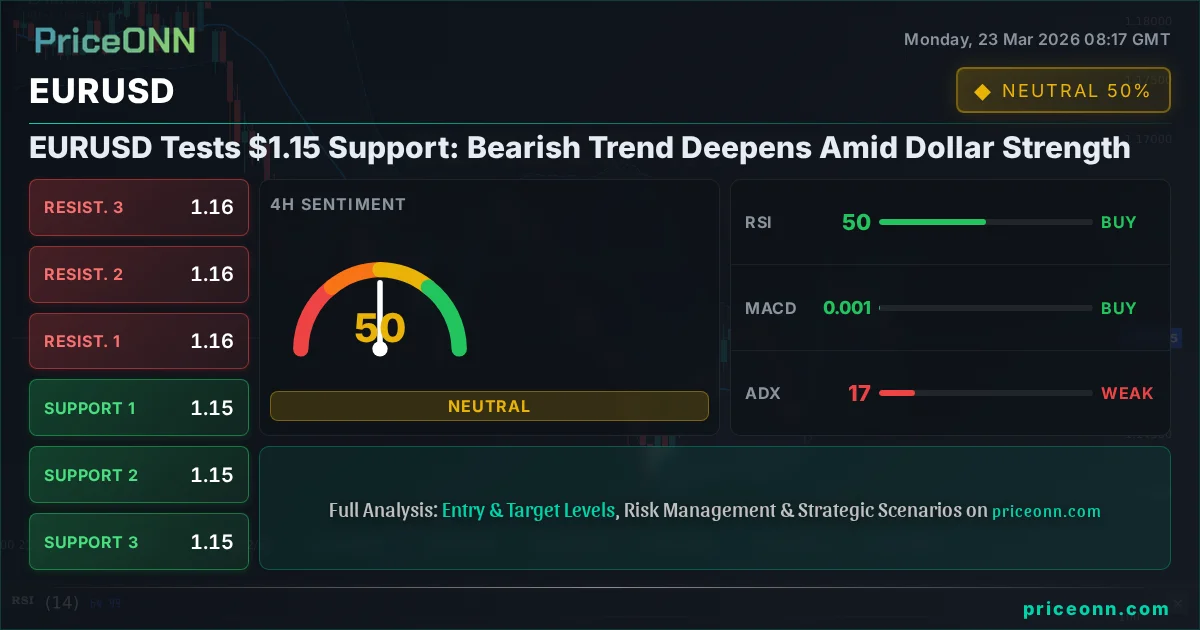
The EURUSD pair is currently locked in a tense battle around the crucial $1.15 psychological level. This pivotal point is being rigorously tested as the US Dollar Index (DXY) continues its upward march, fueled by persistent inflation fears and escalating geopolitical tensions. The prevailing risk-off sentiment across global markets further amplifies the dollar's safe-haven appeal, putting significant pressure on the Euro. With the DXY currently trading at 99.56, indicating a strong dollar, and major stock indices like the S&P 500 down 1.14% at 6460.9, the macro environment paints a bearish picture for EURUSD.
- EURUSD is testing critical support near $1.1530, with RSI(14) at 40.69 on the 1H chart indicating further downside potential.
- The US Dollar Index (DXY) is strong at 99.56, correlating with increased pressure on EURUSD, especially as risk appetite wanes (SP500 down 1.14%).
- A sustained close below $1.1530 could trigger a further decline towards $1.15219, driven by negative MACD momentum.
- Upcoming economic data, particularly from the US and Eurozone, will be crucial in determining if this bearish trend continues or if a short-term bounce is possible.
The Dollar's Grip: A Strong DXY at 99.56
The strength of the US Dollar, as measured by the DXY index currently at 99.56, is arguably the most significant factor weighing on the EURUSD pair. On the 1-hour timeframe, the DXY shows a neutral trend with strong upward momentum indicated by its MACD and a bullish stochastic signal. While the ADX at 19.53 suggests a weaker trend, the overall picture from the daily timeframe, where the DXY has a strong upward trend (ADX: 34.82), points to continued dollar strength. This persistent dollar strength creates a challenging environment for the Euro, as it typically leads to a decline in EURUSD. Traders are closely watching the DXY's ability to hold above key levels, anticipating that any further upward momentum will translate into downside pressure on the Euro.
The correlation between the DXY and EURUSD is a well-established relationship in the forex market. When the dollar strengthens, as it is doing now with the DXY trading above its 1-hour middle Bollinger Band and showing a strong signal, the EURUSD pair often faces selling pressure. This dynamic is further exacerbated by the current global market sentiment. The S&P 500 is down 1.14% and the Nasdaq 100 has fallen 1.21%, reflecting a clear risk-off environment. In such conditions, investors tend to flock to perceived safe-haven assets, with the US dollar often being a primary beneficiary. This flight to safety means that capital is likely flowing out of riskier assets and currencies, like the Euro, and into the dollar, reinforcing the bearish outlook for EURUSD.
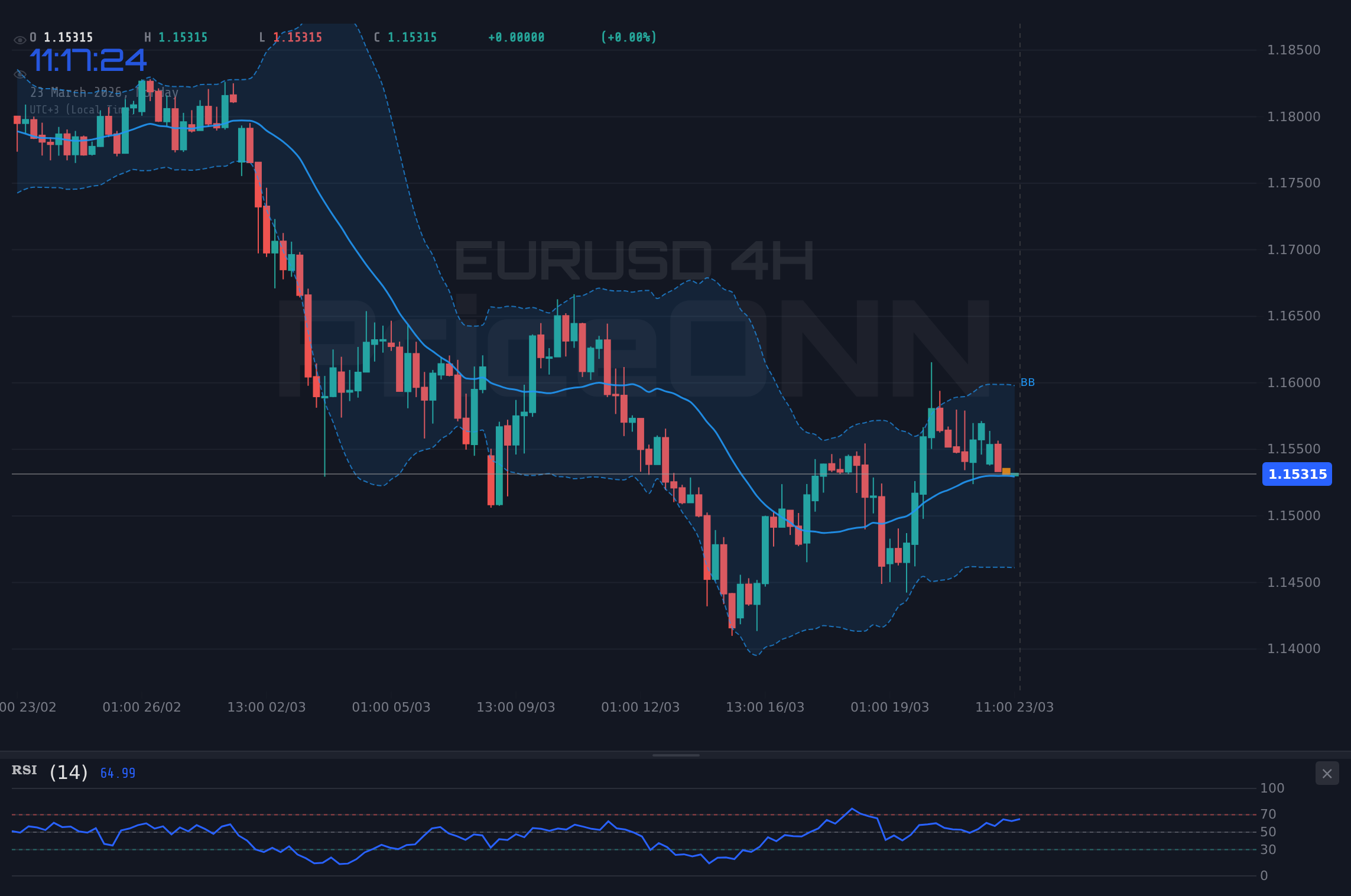
Technical Indicators Flash Bearish Signals for EURUSD
Diving into the technical indicators for EURUSD, the picture is predominantly bearish, especially on the shorter timeframes. On the 1-hour chart, the RSI(14) stands at 40.69, indicating a downward trend but still some distance from oversold territory. However, the MACD is firmly in negative territory, trading below its signal line, which suggests that bearish momentum is building. The Bollinger Bands on this timeframe are also showing price action above the middle band, hinting at upward pressure, but this is contradicted by the generally weak overall signal. The Stochastic Oscillator, with K=12.4 and D=24.05, is flashing a clear sell signal, reinforcing the bearish sentiment.
The 4-hour timeframe presents a more mixed, yet still cautious, outlook. Here, the RSI(14) is hovering around 50.23, suggesting a neutral stance but with a slight upward bias. The MACD has turned positive, trading above its signal line, which could indicate a potential shift in momentum. The Bollinger Bands are also above the middle band, supporting this upward view. However, the Stochastic Oscillator remains bearish with K=42.55 and D=59.11, signaling a potential decline. The ADX at 16.87 indicates a weak trend, suggesting that any move might lack sustained conviction. Despite some conflicting signals on this timeframe, the daily chart paints a clearer bearish picture. The RSI(14) at 42.83 leans bearish, and the MACD remains positive, but the Bollinger Bands are below the middle band, and the strong ADX of 37.3 confirms a robust downtrend. The overall signal for EURUSD across multiple timeframes leans towards selling, with 6 out of 8 signals on the 1-hour and 1-day charts indicating a sell.
Navigating Key Levels: Support Under Pressure
The current price action for EURUSD around $1.15364 places it precariously close to significant support levels. On the 1-hour chart, the immediate support is identified at $1.15219, followed by $1.1514 and $1.15082. A break below these levels could signal a continuation of the bearish trend. The 4-hour chart offers slightly lower support levels, with the first significant floor at $1.15397, then $1.15258, and $1.15137. The daily chart shows more substantial support zones, with the first key level at $1.15308, followed by $1.14923 and $1.14607. The fact that the pair is currently trading near the upper end of these daily support zones, while the overall trend is bearish, suggests that a breakdown is a tangible risk.
Resistance levels on the upside are currently capped, preventing any significant bullish recovery. On the 1-hour chart, resistance is seen at $1.15356, $1.15414, and $1.15493. The 4-hour chart presents resistance at $1.15657, $1.15778, and $1.15917. On the daily chart, the first significant resistance hurdle is at $1.16009, followed by $1.16325 and $1.1671. The proximity of the current price to the lower support levels, coupled with the strong bearish signals from technical indicators and the dominant dollar strength, suggests that the path of least resistance is to the downside. The ability of EURUSD to hold above the $1.15308 support level will be critical in determining whether the bearish trend continues or if a temporary consolidation or bounce is on the cards.
Fundamental Drivers: Inflation, Interest Rates, and Geopolitics
The macroeconomic landscape is currently a significant driver of the EURUSD's bearish trajectory. Persistent inflation data, both in the US and to a lesser extent in the Eurozone, is keeping central banks on edge. The US Federal Reserve, in particular, is facing pressure to maintain a hawkish stance, or at least delay any dovish pivot, to combat rising price pressures. This is reflected in the CME FedWatch Tool, which, while not explicitly provided here, generally indicates market expectations for interest rates. If US interest rates are perceived to remain higher for longer, it will continue to support the dollar against the Euro, where the European Central Bank (ECB) might be closer to a rate-cutting cycle, especially if Eurozone growth falters.
Upcoming economic events will be crucial. Key releases such as Purchasing Managers' Index (PMI) data from both the US and the Eurozone are on the horizon. If US PMIs come in strong, reinforcing the narrative of economic resilience despite inflation, it could further bolster the dollar. Conversely, weak Eurozone PMIs would amplify concerns about stagflation, a scenario where high inflation coincides with stagnant economic growth, which is a particularly damaging outlook for the Euro. Geopolitical tensions, especially in the Middle East, are also playing a significant role. Escalating conflicts can lead to spikes in oil prices, as seen with Brent crude trading above $100. Higher energy prices can exacerbate inflation concerns globally, potentially leading to more aggressive central bank tightening in the US, further strengthening the dollar and pressuring EURUSD. The recent news of AUD/JPY retreating amid escalating geopolitical fears and Silver facing a critical test below $60 highlights the broader risk-off sentiment impacting currency markets, which generally favors the US dollar.
The Path Forward: What to Watch for EURUSD
Looking ahead, the EURUSD pair remains vulnerable to further declines as long as the DXY maintains its strength and risk aversion persists. The technical indicators, particularly on the daily and 1-hour charts, lean heavily towards a bearish outlook. The ADX values across multiple timeframes (20.04, 16.87, 37.3) suggest that while the trend might be weak on intraday charts, the daily trend is firmly established. Confirmation of a sustained move below the $1.15308 support level on the daily chart would be a significant bearish signal, potentially opening the door for a test of lower levels towards $1.14923. Traders should be particularly attentive to the upcoming PMI data releases. Strong US data could reinforce the dollar's strength, while weak Eurozone data would add further pressure on the Euro.
Conversely, any signs of de-escalation in geopolitical tensions or a significant shift in central bank rhetoric towards a more dovish stance could provide some respite for EURUSD. However, based on the current data and market sentiment, the primary risk remains to the downside. The ability of the Euro to find a footing will largely depend on whether the ECB can signal a more optimistic growth outlook or if US inflation shows clear signs of cooling, prompting a less hawkish Fed. Until then, the bears appear to have the upper hand, with the $1.15308 support level being the immediate line in the sand.
Scenario Analysis: Navigating the $1.15 Level
Bearish Scenario: Breakdown Below Support
65% ProbabilityNeutral Scenario: Consolidation Around $1.15
25% ProbabilityBullish Scenario: Unexpected Reversal
10% ProbabilityFrequently Asked Questions: EURUSD Analysis
What happens if EURUSD breaks below the $1.15308 key support level?
A break below $1.15308 would likely trigger further downside, with the first target being the 1-hour support at $1.15219. This scenario is supported by the strong dollar index (DXY at 99.56) and bearish technical signals across multiple timeframes.
Should I consider buying EURUSD at current levels near $1.15364 given the RSI is at 40.69?
Buying at current levels carries significant risk due to the prevailing bearish trend and strong dollar. While the RSI is not yet oversold, a break below key support could lead to further losses. It would be prudent to wait for a clear bullish signal or a confirmed bounce from a stronger support level, perhaps closer to $1.14923.
Is the MACD negative momentum a strong sell signal for EURUSD at $1.15364?
Yes, the negative MACD momentum, with the MACD line below its signal line on multiple timeframes, indicates building selling pressure. This reinforces the bearish outlook, especially when combined with the ADX suggesting a strong trend on the daily chart.
How will upcoming US PMI data impact EURUSD this week?
Stronger-than-expected US PMI data would likely boost the dollar further, potentially pushing EURUSD below $1.15308. Conversely, weaker data could lead to dollar retracement and a short-term relief rally for EURUSD, possibly testing resistance near $1.15657.
| Indicator | Value | Signal | Interpretation |
|---|---|---|---|
| RSI (14) | 40.69 | Neutral | Leaning bearish, but not oversold. |
| MACD | Negative | Bearish | Negative momentum building. |
| Stochastic | K:12.4, D:24.05 | Bearish | Sell signal confirmed. |
| ADX | 20.04 | Weak Trend | Intraday trend lacks conviction. |
Track markets in real-time
AI-powered analysis, technical indicators and real-time price data.
Join Our Telegram Channel
Breaking market news, AI analysis and trading signals instantly.
Join Channel