

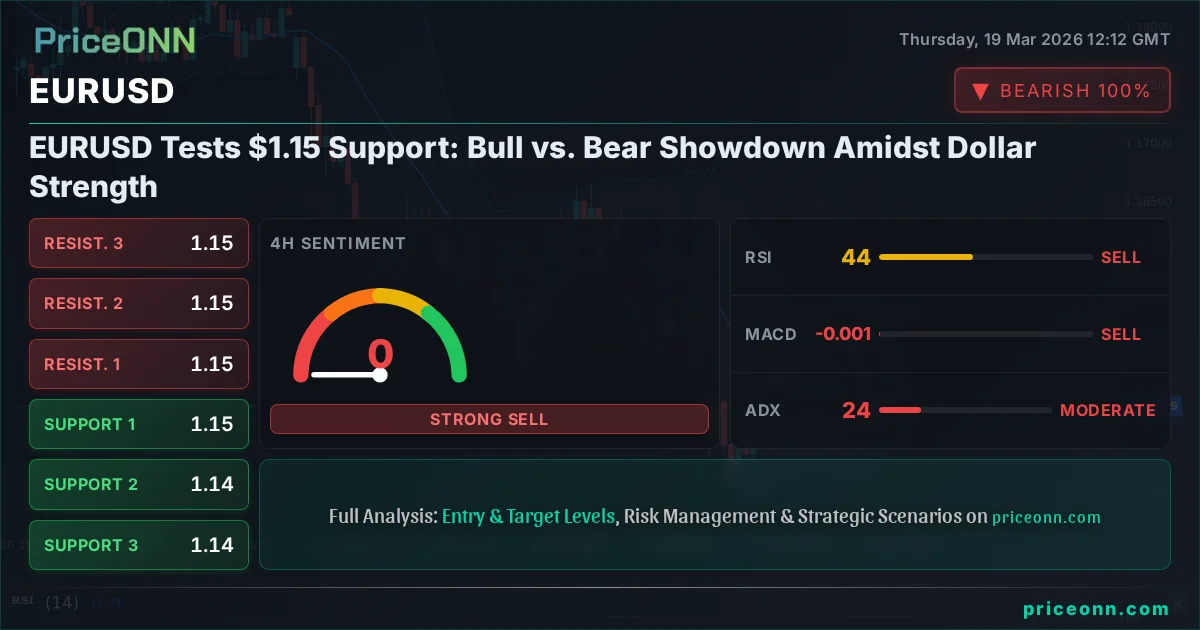
The tug-of-war between bulls and bears on the EURUSD currency pair is reaching a critical juncture, with the pair currently trading precariously around the $1.15 mark. This pivotal level is not just a number; it's a battleground where opposing market forces clash, each attempting to dictate the next significant move. As the US Dollar Index (DXY) shows signs of renewed strength, climbing to 99.84, the pressure on the Euro intensifies, creating a challenging environment for currency traders. This analysis will dissect the arguments for both bullish and bearish scenarios, leveraging real-time market data and fundamental drivers to understand the underlying forces shaping EURUSD's immediate future.
- EURUSD is trading at $1.15, testing key support levels as the DXY reaches 99.84.
- Bearish momentum dominates on 1H and 4H charts, with RSI readings in the low 40s and strong ADX trends.
- The bullish case hinges on potential Fed policy shifts and divergence from broader risk-off sentiment.
- Critical support for EURUSD is identified at $1.14551, while resistance looms at $1.14829 and $1.15282.
- Upcoming economic data from the US and Eurozone will be crucial in determining the next directional bias.
The Bear Case: Dollar Dominance and Euro Weakness
The prevailing narrative for EURUSD leans bearish, supported by a confluence of technical indicators and macroeconomic signals. On the 1-hour chart, the trend is decidedly downwards with a strength of 90%, a sentiment echoed on the 4-hour chart with 92% strength. The Relative Strength Index (RSI) on the 1-hour chart sits at a neutral but declining 48.43, indicating a slight lack of buying pressure, while the 4-hour RSI at 43.86 reinforces this cautious outlook. MACD indicators on both shorter timeframes show negative momentum, with the MACD line below its signal line, suggesting that selling pressure is currently outweighing buying interest. This is further corroborated by Stochastic oscillators, where the %K line is below the %D line on the 4-hour chart (24.54 vs 43.4), a classic bearish signal indicating potential downward continuation. The ADX, a measure of trend strength, is also telling a story: at 20.17 on the 1-hour and 24.13 on the 4-hour, it suggests a moderate but persistent downtrend is in play, not a choppy, directionless market. This technical setup paints a picture of a currency pair under pressure, with sellers holding the advantage.
Fundamentally, the strengthening US Dollar Index (DXY), currently at 99.84, acts as a significant headwind for EURUSD. A stronger dollar typically makes Euro-denominated assets more expensive for holders of other currencies, thereby dampening demand for the Euro. This inverse correlation is a well-established market dynamic. Furthermore, recent economic data, while mixed, has shown a degree of resilience in the US economy, contrasting with some softer readings from the Eurozone. While specific Eurozone GDP figures were not provided in the live data, the general market sentiment often reflects underlying economic health. If US economic outperformance continues, it could prompt further hawkish speculation regarding the Federal Reserve's monetary policy, even if rate cuts are on the horizon, thereby supporting the dollar. The lack of a strong bullish catalyst for the Euro further solidifies the bearish outlook, leaving EURUSD vulnerable to further declines towards its immediate support levels.
The Bull Case: A Potential Reversal or Consolidation?
Despite the prevailing bearish technicals, there are arguments to be made for a potential bullish reversal or at least a period of consolidation for EURUSD. The daily chart, while still showing a dominant downtrend (99% strength), presents a slightly different picture in some indicators. The Stochastic oscillator on the daily timeframe shows a 'buy' signal with the %K line (31.98) above the %D line (22.7), suggesting that the pair might be oversold and due for a bounce. While the RSI(14) at 35.66 is still in neutral territory, it is moving away from extreme oversold conditions seen on shorter timeframes. The ADX on the daily chart, however, at 38.83, indicates a strong downtrend, which means any bullish move might face significant headwinds and could be short-lived or part of a larger corrective wave rather than a sustained trend change. The fact that the EURUSD is trading near $1.15, a significant psychological level and a key support area identified at $1.14551, could also attract dip-buyers.
The fundamental backdrop also offers some counterpoints to the bearish narrative. While the DXY is strong, market sentiment can shift rapidly based on central bank rhetoric and incoming economic data. If the Federal Reserve signals a more dovish stance than anticipated, or if upcoming US inflation data (CPI) comes in softer than expected, it could reduce the appeal of the dollar and provide a tailwind for EURUSD. Conversely, any surprisingly strong economic data from the Eurozone, such as a PMI reading that beats forecasts, could inject some life back into the Euro. Historically, major currency pairs often experience periods of consolidation even within a strong trend, as market participants reassess their positions. The current price action around $1.15 could represent such a consolidation phase, where buyers step in to defend the level, anticipating a short-term bounce before the prevailing downtrend potentially resumes. The $1.14793 resistance level on the 1-hour chart, and more significantly $1.15282 on the daily chart, will be crucial to watch for any signs of a sustained upward move.
Technical Deep Dive: Chart Patterns and Momentum
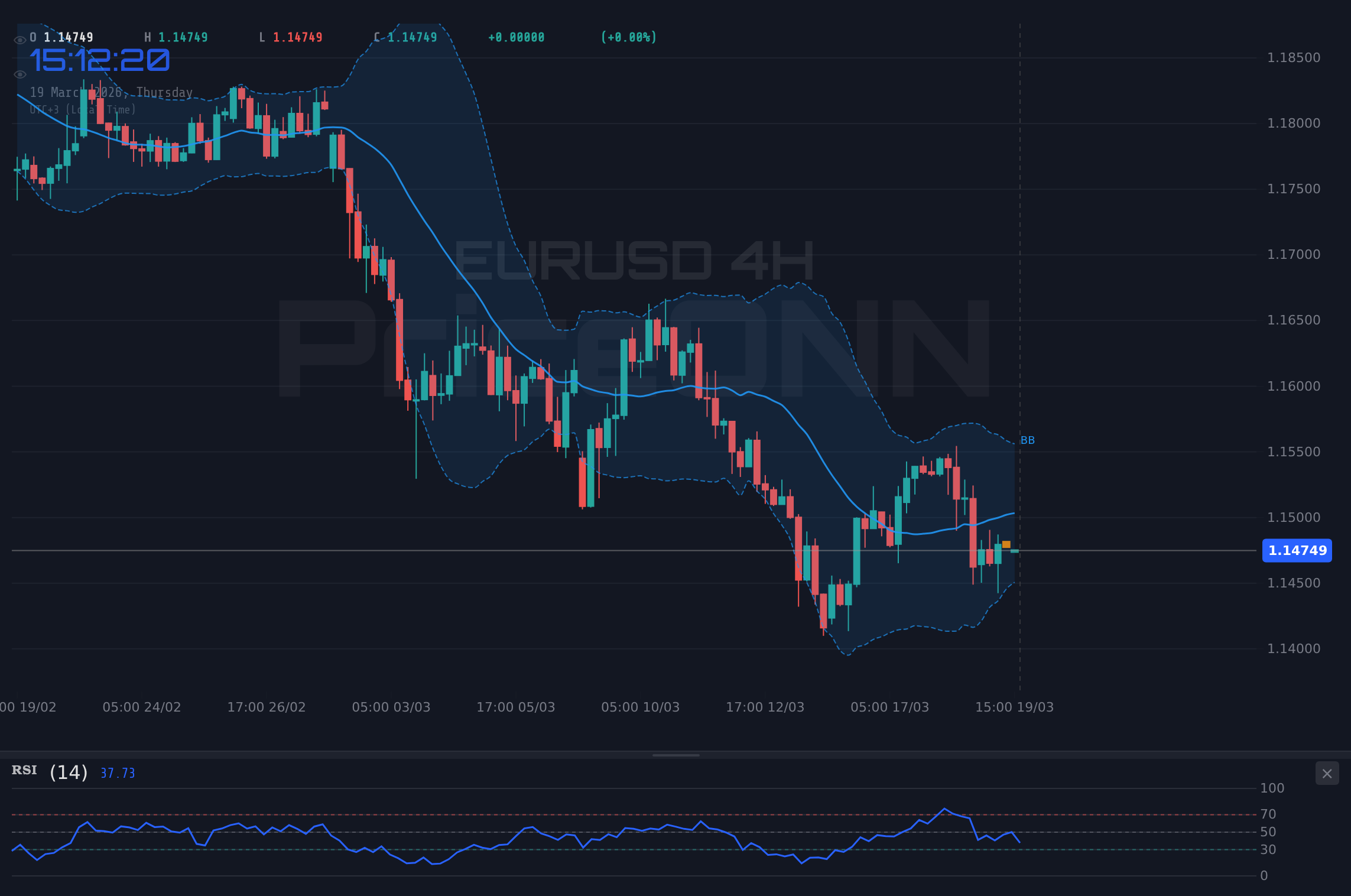
Examining the EURUSD's technical landscape reveals a pair firmly entrenched in a bearish trend on shorter to medium timeframes. On the 1-hour chart, the price action is consistently printing lower highs and lower lows, a hallmark of a downtrend. The Bollinger Bands are also illustrating this bearish momentum, with the price currently trading below the middle band and flirting with the lower band on the 4-hour chart, indicating significant downward pressure. The ADX reading of 24.13 on the 4-hour chart signifies a moderately strong trend, suggesting that the current downward move has conviction behind it. The RSI at 43.86 on the 4-hour chart, while not yet oversold, indicates a lack of bullish momentum, leaving room for further downside before reaching oversold territory. The MACD histogram on the same timeframe is negative and below the signal line, reinforcing the bearish sentiment. This technical confluence paints a clear picture of a market favoring sellers in the short to medium term.
However, looking at the daily chart introduces a layer of complexity. The ADX at 16.63 suggests a weakening trend, or potentially a period of consolidation before the next major move. While the MACD remains negative, the RSI at 32.97 is approaching oversold territory, and the Stochastic oscillator is showing a bullish crossover (%K: 5.54, %D: 16.57), hinting at a potential bounce. This divergence between the shorter-term bearish trends and the daily chart's potential for a reversal or oversold bounce creates a critical decision point for traders. The support levels at $1.14664, $1.14596, and $1.14535 on the 1-hour chart are immediate areas where a bounce could originate. However, a decisive break below these levels, particularly the 4-hour support at $1.14551, would invalidate any short-term bullish thesis and likely accelerate the move towards lower daily support levels like $1.14226.
Macroeconomic Crosscurrents: DXY, Interest Rates, and Data
The performance of the US Dollar Index (DXY) is intrinsically linked to the fate of EURUSD. With the DXY currently at 99.84 and showing a strong uptrend on all analyzed timeframes (93% on 1H, 87% on 4H, 98% on 1D), it presents a formidable challenge for Euro bulls. This dollar strength is often driven by expectations surrounding Federal Reserve policy. While the market anticipates potential rate cuts later in the year, any indication from Fed officials or incoming economic data that suggests inflation remains sticky or that the US economy is more resilient than feared can bolster the dollar. For instance, if the upcoming US Non-Farm Payrolls (NFP) data, scheduled for release next Friday, shows a significantly stronger-than-expected job growth, it could further fuel dollar strength and push EURUSD lower. The current DXY uptrend suggests that the path of least resistance for the dollar remains to the upside in the short term, at least until a clear shift in Fed policy expectations occurs.
On the Eurozone side, the economic outlook and the European Central Bank's (ECB) monetary policy stance are critical. While specific upcoming economic events were not detailed in the provided data, general knowledge suggests that upcoming inflation figures (CPI) and Purchasing Managers' Index (PMI) data will be closely watched. If these indicators point to persistent inflation or slowing economic growth within the Eurozone, it would likely pressure the ECB to consider easing policy sooner rather than later, or at least signal a less hawkish stance compared to the Fed. Such a divergence in monetary policy expectations would be a strong catalyst for further EURUSD depreciation. The correlation between EURUSD and the DXY is currently very strong, with the DXY's upward trajectory acting as a direct drag on the pair. Traders will be keenly observing any signs of a potential pivot in Fed policy or a significant downturn in US economic data that could weaken the dollar and allow EURUSD to find its footing.
Navigating the Levels: Support and Resistance Watch
The current price of $1.15 for EURUSD places it in a critical zone where both support and resistance levels are tightly clustered, suggesting potential volatility. On the 1-hour chart, immediate support is seen at $1.14793, followed by $1.14664 and $1.14596. A break below these levels would signal a continuation of the short-term bearish trend and could quickly test the 4-hour support zone. The 4-hour chart identifies key support at $1.14551, then $1.14451, and further down at $1.14273. A decisive close below $1.14551 on the 4-hour timeframe would be a strong bearish signal, potentially opening the door for a move towards the daily support levels. The daily support levels are more significant, with the first line of defense at $1.14226, followed by $1.13830 and a more substantial floor at $1.13170. These levels represent areas where significant buying interest could emerge, potentially halting or reversing the downtrend.
Conversely, any bullish momentum would face immediate resistance. On the 1-hour chart, resistance is located at $1.14793, $1.14854, and $1.14922. A sustained move above these levels would be the first sign of a potential short-term bounce. However, the more significant resistance lies on the 4-hour chart at $1.14829, followed by $1.15007 and $1.15107. A break and hold above the $1.15000 psychological level and the 4-hour resistance at $1.15007 would be crucial for bulls to gain traction. The daily resistance levels are also important: $1.15282, $1.15942, and a more distant target at $1.16338. For the bearish trend to be significantly challenged, EURUSD would need to convincingly break through these daily resistance levels, especially the $1.15282 mark. Until then, the bias remains tilted towards the downside, with these levels acting as critical reference points for potential trading opportunities.
The Verdict: Bears Hold the Edge, But Watch for the Bounce
Synthesizing the technical indicators and macroeconomic context, the current picture for EURUSD strongly favors the bears in the short to medium term. The consistent downtrend signals across the 1-hour and 4-hour charts, coupled with the strengthening US Dollar Index (DXY) at 99.84, create a challenging environment for the Euro. The RSI readings hover in neutral territory but show a lack of strong buying conviction, while MACD and Stochastic oscillators on these shorter timeframes lean bearish. The ADX readings confirm the presence of a trend, suggesting that the current downward pressure is likely to persist unless a significant catalyst emerges.
However, the daily chart offers a glimmer of hope for bulls, showing potential oversold conditions and a bullish crossover on the Stochastic oscillator. The $1.15 level itself is a significant psychological barrier and a key support zone. This suggests that while the prevailing trend is bearish, a short-term bounce from current levels is a distinct possibility. Traders should remain vigilant for signs of capitulation from dollar bulls or a shift in Fed expectations. A decisive break below the $1.14551 support level would likely confirm the continuation of the downtrend, targeting lower levels. Conversely, a sustained move above $1.15282 could signal the start of a corrective rally. For now, the bears appear to have the upper hand, but the market's reaction at the $1.15 support will be critical in defining the next move.
Bearish Scenario: Dollar Strength Persists
65% ProbabilityNeutral Scenario: Consolidation Around $1.15
25% ProbabilityBullish Scenario: Short-Term Bounce
10% ProbabilityFrequently Asked Questions: EURUSD Analysis
What happens if EURUSD breaks below the $1.14551 support level?
A break below the 4-hour support at $1.14551 would likely confirm the bearish thesis, potentially accelerating the decline towards the daily support at $1.14226. This would indicate that the dollar's strength and Euro's weakness are set to continue.
Should I consider buying EURUSD at current levels around $1.15 given the RSI is at 43.86?
Buying EURUSD solely based on the current RSI of 43.86 would be premature. While the RSI is not overbought, the overall trend remains bearish on shorter timeframes. A more prudent approach would be to wait for confirmation, such as a hold above $1.14551 and a break of resistance at $1.15282, or look for oversold conditions on daily charts.
Is the MACD signal on the 4-hour chart a strong sell signal for EURUSD?
Yes, the negative MACD momentum with the MACD line below its signal line on the 4-hour chart is a strong bearish signal. It indicates that selling pressure is currently dominating, reinforcing the downward trend and suggesting further downside potential.
How will upcoming US economic data, like NFP, affect EURUSD's trajectory near $1.15?
Stronger-than-expected US NFP data could further bolster the DXY to 99.84 and beyond, increasing pressure on EURUSD to break below $1.15. Conversely, weaker data might trigger dollar profit-taking and a potential bounce for EURUSD, especially if Eurozone data also shows resilience.
Track markets in real-time
AI-powered analysis, technical indicators and real-time price data.
Join Our Telegram Channel
Breaking market news, AI analysis and trading signals instantly.
Join Channel