

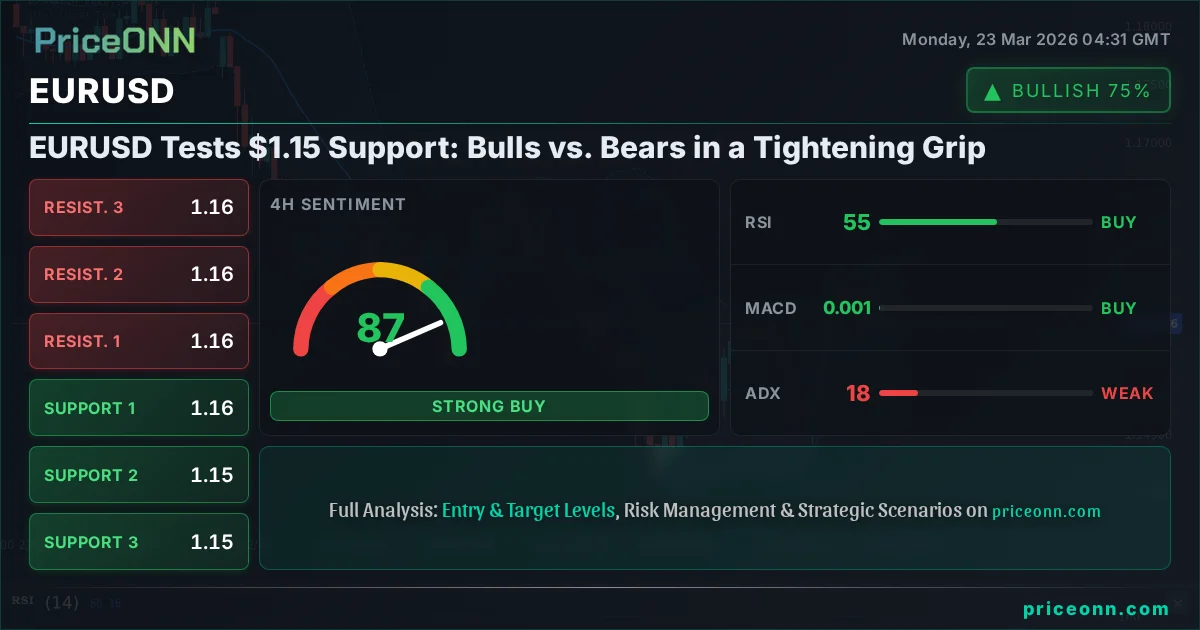
The tug-of-war between bulls and bears in the EURUSD currency pair is reaching a fever pitch, with the pair currently testing crucial support levels around the $1.15 mark. This isn't just another trading day; it's a pivotal moment where the underlying economic forces and technical setups are battling for control. As traders, our job is to dissect this tension, understand the data, and position ourselves for the most probable outcome. The current price action suggests a market in flux, with conflicting signals from various timeframes demanding a closer look. Today, we'll break down the bullish and bearish arguments, scrutinize the technical indicators, and ultimately chart a path forward for navigating this critical juncture.
- EURUSD is testing support near $1.15308, with a significant daily close below this level potentially accelerating the bearish trend.
- The Dollar Index (DXY) is showing strength, currently trading at 99.47, which historically puts pressure on EURUSD.
- Technical indicators present a mixed picture: RSI(14) on the 1H is 48.12 (neutral), but the 4H RSI is 54.78 (neutral, upward inclination), while the daily RSI sits at 42.83 (neutral, downward inclination).
- A daily close above the resistance level of $1.16009 would be required to invalidate the current bearish outlook and signal a potential shift in momentum.
- Geopolitical tensions in the Middle East are currently supporting the US Dollar as a safe-haven asset, adding to the headwinds for EURUSD.
The Battle for $1.15: A Crucial Juncture for EURUSD
The EURUSD currency pair is currently locked in a fierce battle around the $1.15 psychological level. This area has become a battleground where opposing market forces are trying to assert dominance. On one side, we have the bears, pushing the pair lower, supported by a strengthening US Dollar and concerning economic undertones in the Eurozone. On the other, the bulls are attempting to defend key support levels, hoping for a turnaround fueled by potential shifts in monetary policy or a broader risk-on sentiment in global markets. The data from our live API paints a complex picture, with conflicting signals across different timeframes and indicators. Understanding this dynamic is paramount for any trader looking to navigate the choppy waters ahead. The question isn't just about where the price is going, but *why* it's behaving this way, and what confirmation we need to see before committing to a trade.
The Dollar Index (DXY), a key barometer for the greenback's strength against a basket of major currencies, currently stands at 99.47. This upward movement in DXY historically correlates with downward pressure on EURUSD, as a stronger dollar makes the Euro relatively more expensive for foreign buyers. This correlation is a significant factor that cannot be ignored. When the DXY rallies, it often signals a 'risk-off' sentiment or a tightening monetary policy outlook from the Federal Reserve, both of which tend to weigh on riskier assets and currency pairs like EURUSD. We need to watch how this DXY strength evolves, as it provides a consistent backdrop against which the EURUSD's movements will be judged.
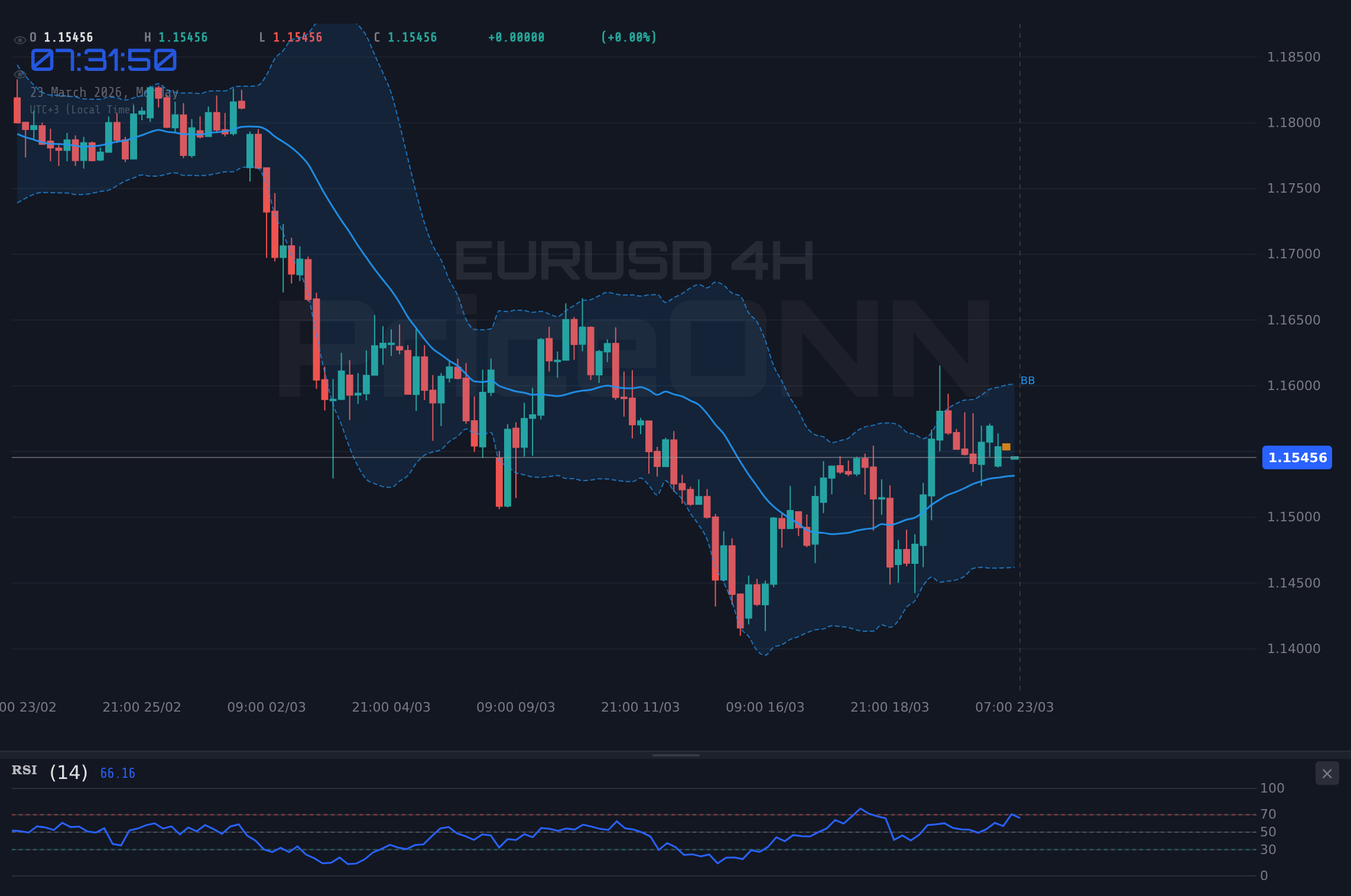
The Bull Case: Searching for a Foothold Above $1.15
For the bulls to regain control, they need to establish a firm foothold above the current price action and decisively break through key resistance levels. The primary target would be to reclaim the $1.16009 resistance level. A sustained move above this point, ideally with increasing volume and positive momentum indicators, would signal a potential reversal. On the 4-hour chart, the RSI(14) at 54.78 shows a slight upward inclination, and the MACD is currently above its signal line, hinting at some underlying bullish momentum building in this timeframe. This could be interpreted as a sign that while the daily trend might be bearish, the shorter-term charts are showing pockets of strength. The Stochastic indicator on the 4-hour chart is also showing a potential for upward movement, although its daily counterpart is still signaling caution.
Furthermore, any hints of a dovish shift from the Federal Reserve, or conversely, a more hawkish stance from the European Central Bank (ECB), could provide the catalyst needed for a bullish turnaround. While current data doesn't strongly support this, market sentiment can shift rapidly based on central bank rhetoric or unexpected economic data. For instance, if upcoming US employment figures were to significantly miss expectations, it could dampen the dollar's strength and open the door for EURUSD to rally. Similarly, if inflation in the Eurozone proves more persistent than anticipated, it might force the ECB to adopt a less accommodative stance, bolstering the Euro. These are the 'what ifs' that bulls are clinging to, hoping for a fundamental shift that technicals can then confirm.
The daily chart, however, presents a more challenging scenario for the bulls. The RSI(14) at 42.83 indicates a downward inclination, and the ADX at 37.3 points to a strong existing downward trend. For a bullish reversal to gain traction, we would need to see a clear break above the daily resistance at $1.16009, followed by a sustained period of trading above this level. The MACD on the daily chart is also showing positive momentum, but it's still hovering above the signal line, meaning the trend is not yet decisively bullish. The Stochastic on the daily chart, at 62.49/39.23, is showing a bullish crossover, which could be an early sign of a potential upward move, but it needs confirmation from other indicators and price action to be considered reliable. The key here is confirmation – without it, any bullish moves could be short-lived 'bear market rallies'.
The Bear Case: $1.15 as a Springboard for Further Declines
The bearish argument for EURUSD is currently well-supported by several technical and fundamental factors. The pair is trading below its 1-hour, 4-hour, and daily moving averages, with the daily trend strength rated at 94% bearish. The most immediate support level to watch is $1.15308 on the daily chart. A decisive break below this level could trigger a cascade of selling, pushing the price towards the next support at $1.14923 and potentially even $1.14607. The ADX indicator across all timeframes suggests a strong prevailing trend: 18.62 on the 1H (weak trend, but aligned with downtrend), 37.3 on the 1D (strong downtrend), and 37.3 on the daily chart (strong downward trend). This consistent bearish signal across multiple timeframes strengthens the case for further downside.
The RSI values also lean bearish, particularly on the longer timeframes. The 1-hour RSI at 48.12 is nearing the 50-midpoint, but the 4-hour RSI at 54.78 is higher, suggesting some potential for a bounce, while the daily RSI at 42.83 clearly indicates a downward bias. MACD readings are also predominantly negative, with histograms below the signal line on the 1H and 4H charts, reinforcing the bearish momentum. The Stochastic on the 1H and 4H charts are showing potential for a bounce, but the daily Stochastic is at 62.49/39.23, indicating a bullish signal. This conflicting signal from the daily Stochastic is something to be cautious about; it might be a leading indicator of a potential rebound, or it could simply be a temporary retracement within a larger downtrend. However, the overall picture, especially when considering the strong ADX values, points towards bears having the upper hand.
From a fundamental perspective, the strengthening US Dollar is a major headwind for EURUSD. The DXY's current level of 99.47 and its upward trajectory suggest that market participants are favoring the greenback. This is often driven by expectations of tighter monetary policy from the Federal Reserve or increased global uncertainty. Geopolitical tensions in the Middle East, as highlighted by recent news, are likely to further bolster demand for the dollar as a safe-haven asset. This environment makes it difficult for the Euro to find significant upward traction. Additionally, economic data from the Eurozone has shown signs of weakness, with PMI figures potentially indicating slowing manufacturing and services sectors. This fundamental backdrop provides a solid foundation for the bearish technical signals.
Technical Evidence: A Deep Dive into Indicators and Trends
When we look at the technical landscape, the EURUSD pair presents a compelling case for caution, with a slight lean towards the downside, especially when considering the longer timeframes. On the 1-hour chart, the trend is neutral (50% strength), with support at $1.15399 and resistance at $1.15542. The RSI(14) is at 48.12, sitting squarely in neutral territory, indicating no strong directional bias on this very short-term view. MACD is showing negative momentum, below its signal line, which aligns with the bearish sentiment. Stochastic K line at 31.94 and D line at 53.62 also suggest a bearish bias, as the K line is below the D line.
However, the 4-hour timeframe offers a slightly different perspective. Here, the trend is also neutral (50% strength), but the RSI(14) has climbed to 54.78, suggesting a potential for upward movement. The MACD is positive, with its histogram above the signal line, indicating bullish momentum on this timeframe. The Stochastic K line at 61.17 and D line at 63.87 show a bearish signal as K is below D, but they are in the upper range, implying some strength. This divergence between the RSI and Stochastic on the 4-hour chart highlights the choppy nature of the current market. The ADX at 17.98 confirms that the trend strength is weak, suggesting a range-bound environment or a period of consolidation before a decisive move.
The daily chart, where the longer-term trend is established, paints the clearest picture. The trend is strongly bearish with 94% strength. The key support level we are watching is $1.15308, and resistance is capped around $1.16009. The daily RSI(14) at 42.83 clearly indicates a downward inclination, suggesting that sellers have the upper hand over a longer period. The MACD is positive, but its histogram is below the signal line, which can be interpreted as a weakening bullish momentum or a precursor to a bearish crossover. The daily Stochastic K line at 62.49 and D line at 39.23 shows a bullish crossover and is in the upper half, which is a conflicting signal within the broader bearish trend. The ADX at 37.3 confirms a strong trend, but the Stochastic's upward movement might suggest a potential for a counter-trend move or a significant retracement. This conflict means traders should be extra vigilant, waiting for clearer signals rather than jumping into positions prematurely.
Market Context: Geopolitics, Rates, and Oil's Influence
The current market environment is heavily influenced by geopolitical tensions and shifting central bank expectations. The ongoing geopolitical risks, particularly in the Middle East, are acting as a tailwind for the US Dollar, increasing its safe-haven appeal. This phenomenon is directly impacting EURUSD, as a stronger dollar naturally exerts downward pressure on the pair. News reports highlight this dynamic, with analysts noting the dollar's resilience amidst escalating tensions. This increased demand for the dollar is a significant factor that could override other fundamental drivers in the short to medium term.
Central bank policies remain a key focus. While the Federal Reserve has signaled a cautious approach to rate cuts, any deviation from this stance, or even hawkish rhetoric, could further strengthen the dollar. Conversely, the European Central Bank (ECB) is also navigating a complex economic landscape. If inflation data from the Eurozone continues to surprise to the upside, it might force the ECB to reconsider its dovish outlook, potentially offering some support to the Euro. However, for now, the market seems to be pricing in a more favorable environment for the dollar. The interplay between Fed expectations and ECB actions will be crucial in determining the future direction of EURUSD.
The energy markets, particularly crude oil, also play a role. WTI crude oil trading above $99.58 and Brent crude above $113.12 signifies elevated energy prices. Higher oil prices can contribute to inflation expectations, which in turn influence central bank policy. If sustained, this could lead to a scenario where central banks maintain tighter policies for longer, potentially supporting currencies like the USD. The current upward trend in oil prices, driven by geopolitical factors and supply concerns, adds another layer of complexity to the economic outlook and reinforces the safe-haven demand for the dollar.
Trade Scenarios: Navigating the Uncertainty
Bearish Scenario: Downside Breakout
65% ProbabilityNeutral Scenario: Consolidation Around $1.15
25% ProbabilityBullish Scenario: Reclaiming the Highs
10% ProbabilityThe Verdict: Patience and Risk Management are Key
The current technical picture for EURUSD is decidedly mixed, but the weight of evidence, particularly from the daily timeframe and the prevailing DXY strength, leans towards a bearish bias. The pair is teetering on the edge of a significant support level at $1.15308. A break below this could initiate a substantial downward move, aligning with the strong ADX readings on the daily chart.
However, the conflicting signals from shorter timeframes and the daily Stochastic should not be entirely dismissed. A bounce from current levels towards the $1.15500-$1.15600 range is certainly possible, especially if the market interprets upcoming economic data or central bank commentary in a way that weakens the dollar. This highlights the importance of waiting for confirmation. For the bearish scenario to play out, we need to see that decisive break below $1.15308. Until then, a period of consolidation or a minor retracement is also a significant possibility.
As traders, our primary objective must be to manage risk effectively. This means not forcing trades when the signals are unclear. Waiting for a confirmed break of the key support at $1.15308 or a solid confirmation above the $1.16009 resistance is crucial. The market is currently presenting a 'watch zone' rather than a clear, high-probability setup. Patience will be rewarded, and disciplined risk management will be the cornerstone of successful trading in this environment. Remember, the market always offers opportunities; the key is to wait for the right conditions and trade with conviction when they appear.
Frequently Asked Questions: EURUSD Analysis
What happens if EURUSD breaks below the $1.15308 support level?
A daily close below $1.15308 would likely trigger further selling pressure, potentially accelerating the bearish trend towards $1.14923. This would confirm the dominance of the bears, supported by strong ADX readings on the daily chart.
Should I consider buying EURUSD at current levels around $1.15, given the mixed technical signals?
Buying at current levels carries significant risk due to the prevailing bearish trend and the proximity of key support. A more prudent approach would be to wait for a confirmed break above $1.16009 resistance, or for price to hold firmly above $1.15308 with clear bullish confirmation, indicating a potential reversal with a higher probability.
Is the daily RSI at 42.83 a strong sell signal for EURUSD?
An RSI of 42.83 on the daily chart indicates a downward inclination, suggesting that bearish momentum is stronger than bullish momentum. While not an immediate 'sell' signal in isolation, it reinforces the bearish outlook and suggests that rallies might be limited.
How are current geopolitical tensions and DXY strength impacting EURUSD's outlook?
Escalating geopolitical tensions are boosting the US Dollar's safe-haven appeal, pushing the DXY towards 99.47. This increased dollar strength acts as a significant headwind for EURUSD, potentially exacerbating any downside moves and making a bullish reversal more challenging without a clear shift in global risk sentiment.
Track markets in real-time
AI-powered analysis, technical indicators and real-time price data.
Join Our Telegram Channel
Breaking market news, AI analysis and trading signals instantly.
Join Channel