

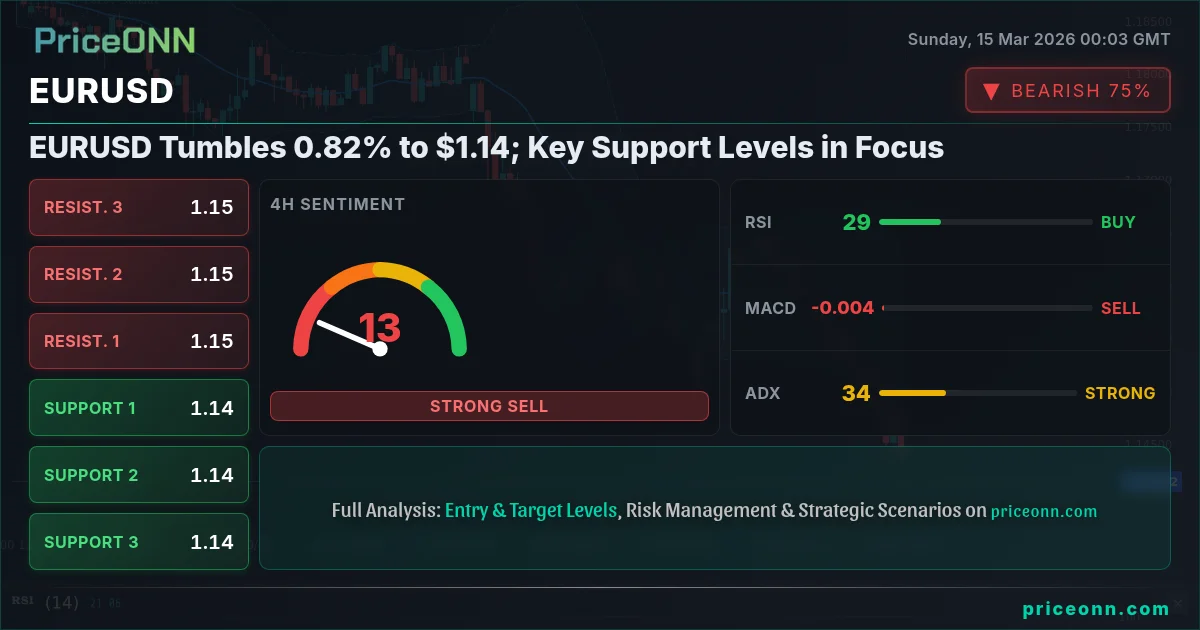
EURUSD is under pressure, trading near $1.14 after a 0.82% decline, as a stronger dollar and cautious signals from the ECB weigh on the euro. The pair is testing key support levels, with traders closely monitoring upcoming economic data and geopolitical developments. The recent surge in oil prices, fueled by Middle East tensions, adds another layer of complexity, potentially impacting inflation and central bank policies.
The recent decline in EURUSD can be attributed to a confluence of factors. The dollar index (DXY) has surged to 100.07, reflecting increased demand for the greenback as a safe-haven asset. This rise puts downward pressure on EURUSD, given their inverse correlation. Furthermore, the European Central Bank (ECB) has signaled a more cautious stance, prioritizing communication over immediate action. This contrasts with expectations of potential rate hikes, leaving the euro vulnerable. According to a news report, the euro is under pressure as the ECB adopts a more cautious stance, prioritizing communication over immediate action. Rising oil prices, driven by escalating tensions in the Middle East, also pose a threat to the Eurozone economy, potentially exacerbating inflationary pressures and further complicating the ECB's policy decisions.
From a technical perspective, the one-hour chart shows a strong downtrend, with the ADX at 41.97 indicating a powerful bearish momentum. The RSI at 23.05 suggests oversold conditions, which could lead to a short-term bounce. However, the MACD remains negative, confirming the prevailing bearish sentiment. Key support levels to watch are 1.143, 1.14249, and 1.14188. A break below these levels could trigger further losses, potentially targeting the daily support at 1.14881. On the upside, immediate resistance lies at 1.14412, followed by 1.14473 and 1.14524. Overcoming these hurdles would require a significant shift in market sentiment and a weakening of the dollar.
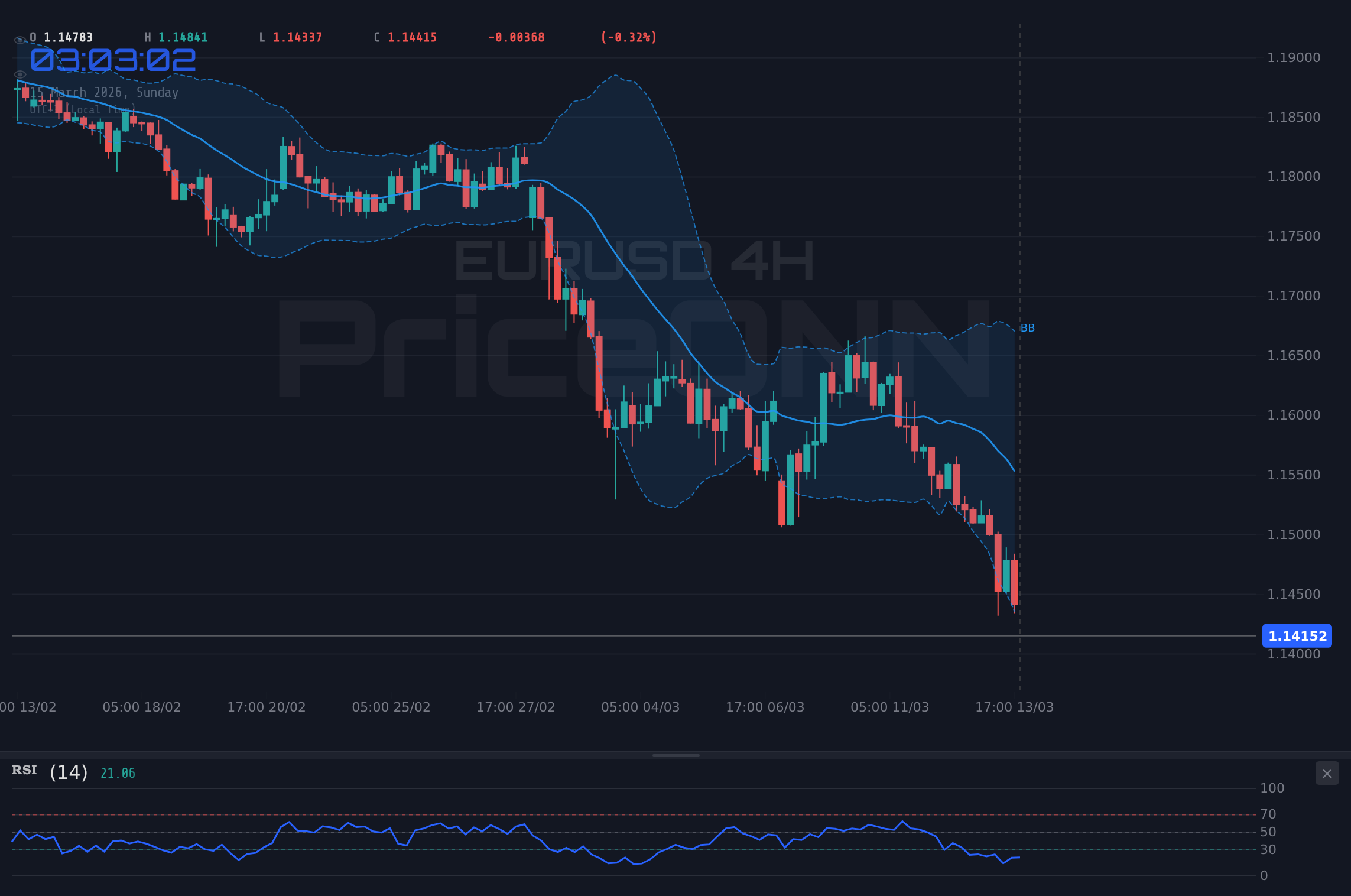
The four-hour chart reinforces the bearish outlook, with the ADX at 32.2 confirming the strong downtrend. The RSI at 31.08 remains in neutral territory, suggesting further downside potential. The MACD histogram is negative, signaling continued bearish momentum. Key support levels on this timeframe are 1.14566, 1.14349, and 1.14185. Resistance levels are observed at 1.14947, 1.15111, and 1.15328. It's worth noting that the Stochastic oscillator is in oversold territory, with %K at 18.68 and %D at 9.34, which could trigger a short-term pullback.
Looking at the daily chart, the downtrend is even more pronounced, with the ADX at 32.84. The RSI at 23.59 is firmly in oversold territory, indicating that the pair may be due for a correction. However, the MACD remains negative, suggesting that the bearish trend is still intact. Key support levels on this timeframe are 1.14881, 1.14663, and 1.14237. Resistance levels are found at 1.15525, 1.15951, and 1.16169. The daily Bollinger bands show the price trading below the lower band, further emphasizing the oversold conditions and the potential for a reversal.
The strength of the dollar index (DXY) is a critical factor influencing EURUSD. The DXY has surged to 100.07, with the one-hour chart showing a strong uptrend and the RSI at 75.96 indicating overbought conditions. However, the ADX at 40.19 confirms the strong bullish momentum. Key support levels for the DXY are 99.9, 99.86, and 99.81, while resistance levels are 99.99, 100.04, and 100.08. On the four-hour chart, the DXY is also in a strong uptrend, with the RSI at 71.27 and the ADX at 31.93. The daily chart shows a similar picture, with the DXY trading above the upper Bollinger band and the RSI at 73.95, suggesting that the dollar may be overextended and due for a pullback.
Considering the technical picture and the fundamental drivers, the overall bias for EURUSD remains bearish in the short-term. However, the oversold conditions and the potential for a dollar pullback could lead to a temporary bounce. Traders should closely monitor the key support and resistance levels, as well as upcoming economic data releases, to identify potential trading opportunities. The Zimbabwe's sudden ban on raw lithium exports has disrupted global battery supply chains, particularly impacting Chinese Companies. This indicates the potential for further economic disruption and uncertainty.
The euro faces headwinds as the ECB signals caution amid oil price surge. This cautious stance is evident in the ECB's recent communications, where policymakers have emphasized the need to carefully assess the economic outlook before making any significant policy changes. This measured approach reflects concerns about the potential impact of rising energy prices and geopolitical tensions on the Eurozone economy. As a result, the euro is likely to remain under pressure in the near term, particularly if the dollar continues to strengthen.
The current market sentiment for EURUSD is predominantly bearish, driven by dollar strength and ECB caution. However, the oversold conditions and the potential for a short-term bounce suggest that traders should exercise caution and avoid chasing the downtrend. Instead, they should focus on identifying potential reversal patterns and waiting for confirmation before entering any long positions. It's also important to manage risk effectively by using stop-loss orders and avoiding excessive leverage.
Given the technical and fundamental backdrop, a well-defined trade plan can help navigate the current market conditions. Here's a possible strategy:
If EURUSD breaks above 1.14412 resistance, it could target 1.14473 and potentially 1.14524. This scenario requires a weakening dollar and positive economic data from the Eurozone.
If EURUSD breaks below 1.143 support, it could target 1.14249 and potentially 1.14188. This scenario is supported by a strengthening dollar and continued ECB caution.
The high-impact events on Friday, March 13, are worth noting. The market's reaction to these events could significantly influence EURUSD's trajectory. Traders should stay informed and adjust their strategies accordingly. The Euro Faces Headwinds as ECB Signals Caution Amid Oil Price Surge. The euro is under pressure as the ECB adopts a more cautious stance, prioritizing communication over immediate action. Rising oil prices, driven by escalating tensions in the Middle East, also pose a threat to the Eurozone economy, potentially exacerbating inflationary pressures and further complicating the ECB's policy decisions.
As we look ahead, the key levels to watch for EURUSD are the support levels at 1.143, 1.14249, and 1.14188, and the resistance levels at 1.14412, 1.14473, and 1.14524. A break of these levels could trigger significant price movements. Traders should also monitor the DXY and upcoming economic data releases, as these factors are likely to continue influencing EURUSD's direction.
Frequently Asked Questions: EURUSD Analysis
What happens if EURUSD breaks below 1.143 support?
If EURUSD breaks below the 1.143 support level, it could trigger further losses, potentially targeting the next support levels at 1.14249 and 1.14188. This scenario is supported by the strong downtrend indicated by the ADX at 41.97 on the one-hour chart.
Should I sell EURUSD at current levels of $1.14 given the RSI at 23.05?
While the RSI at 23.05 indicates oversold conditions, suggesting a potential short-term bounce, the overall trend remains bearish. A safer approach would be to wait for a confirmed reversal pattern before entering any long positions, and to manage risk with stop-loss orders.
Is the negative MACD signal a reliable indicator for EURUSD trend analysis?
The negative MACD signal confirms the prevailing bearish sentiment, but it should be used in conjunction with other indicators and price action analysis. A sustained break below key support levels, combined with a negative MACD, would provide a stronger confirmation of the downtrend.
How will the high-impact events on Friday, March 13, affect EURUSD this week?
The high-impact events on Friday, March 13, could significantly influence EURUSD's trajectory, depending on the actual data releases. Positive economic data from the Eurozone could provide a boost to the euro, while stronger-than-expected data from the US could further strengthen the dollar, putting downward pressure on EURUSD.
Technical Outlook Summary
| Indicator | Value | Signal |
|---|---|---|
| RSI (14) | 23.05 | Oversold |
| MACD Histogram | Negative | Bearish |
| Stochastic | 8.21/25.03 | Oversold |
| ADX | 41.97 | Strong Downtrend |
| Bollinger | Lower Band | Watch |
Key Levels
Support Levels
Resistance Levels
Track markets in real-time
AI-powered analysis, technical indicators and real-time price data.
Join Our Telegram Channel
Breaking market news, AI analysis and trading signals instantly.
Join Channel