

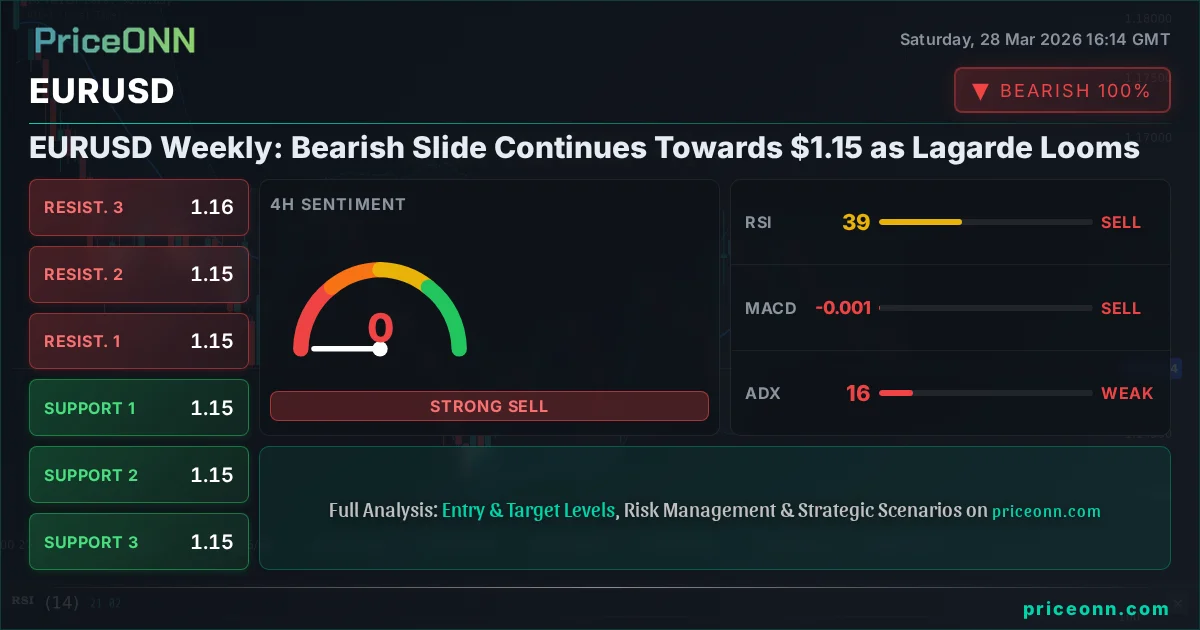
The narrative around EURUSD continues to be one of persistent bearish pressure, with the pair trading precariously close to the $1.15 mark. Last week’s price action, heavily influenced by a strengthening US Dollar and lingering geopolitical tensions, has set a cautious tone heading into the new trading week. As traders digest the implications of these macro forces, all eyes are now turning towards upcoming central bank commentary, particularly from the European Central Bank (ECB), which could provide crucial direction. The current technical setup suggests that further downside is possible, but significant levels loom that could offer a reprieve for the Euro. Understanding the interplay between global economic data, central bank policy expectations, and geopolitical risk is paramount for navigating this complex market landscape.
- EURUSD is trading near $1.15, reflecting ongoing bearish sentiment driven by US Dollar strength and geopolitical risks.
- The 1-Day RSI at 39.98 indicates a bearish trend, with the MACD also showing negative momentum.
- Key support for EURUSD is identified at $1.15093, with critical resistance at $1.15621.
- Upcoming ECB commentary and global economic data releases will be crucial in determining the next directional move for the pair.
The forex market has been a dynamic arena, and the EURUSD pair is no exception. Last week’s trading session painted a clear picture: the US Dollar, bolstered by its safe-haven appeal amidst escalating geopolitical tensions in the Middle East, continued its ascent. This strength, reflected in the Dollar Index (DXY) pushing towards 100, exerted significant downward pressure on major currency pairs, including EURUSD. The pair ended the week trading near the pivotal $1.15 level, a psychological barrier that has held significant sway in previous market cycles. This persistent weakness in the Euro is not merely a function of a strong dollar; it is also underpinned by a challenging economic outlook within the Eurozone and the anticipation of dovish signals from the ECB. As we step into a new trading week, the confluence of these factors creates a high-stakes environment for EURUSD traders.
The macroeconomic backdrop for the Eurozone remains a significant headwind for the single currency. While recent economic data has shown pockets of resilience, the overall picture is one of subdued growth and persistent inflationary pressures that are starting to moderate but remain a concern for the ECB. The latest PMI data, for instance, painted a mixed picture, with some sectors showing a slight improvement while manufacturing activity continues to struggle. This divergence complicates the path forward for policymakers. Unlike the Federal Reserve, which has been signaling a more hawkish stance, or at least a prolonged period of higher interest rates, the ECB has adopted a more cautious approach. Market participants are keenly awaiting any further clues from ECB President Christine Lagarde’s upcoming speeches, hoping to gauge the bank's outlook on inflation, growth, and its future monetary policy trajectory. Any hint of a more accommodative stance, or a lack of conviction in fighting inflation, could further weigh on the Euro.
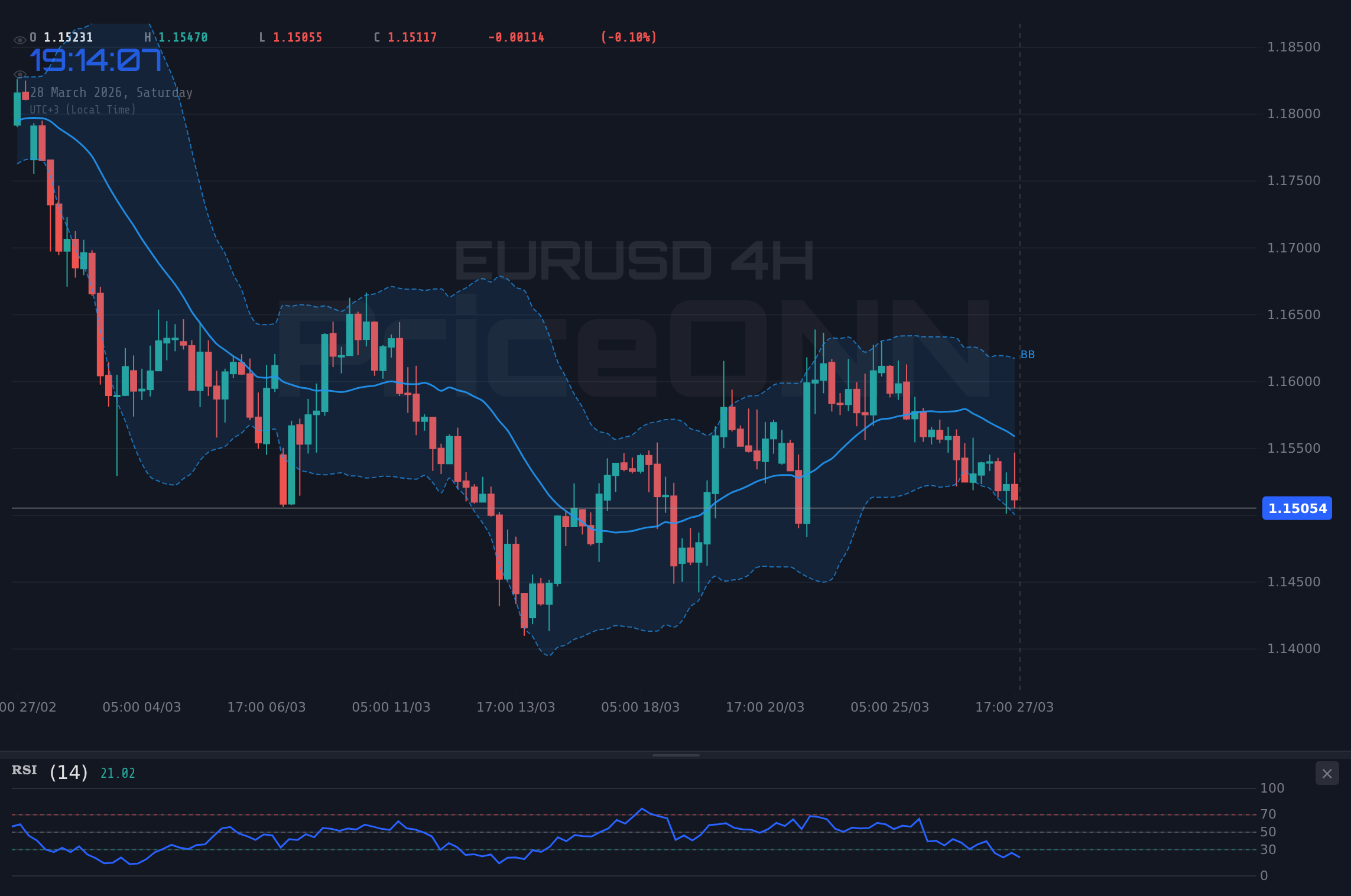
Technically, the EURUSD pair presents a predominantly bearish outlook across multiple timeframes, especially on the daily chart. The 1-Day trend is firmly established as bearish, with a strength of 97%. The current price of $1.15089 sits below key moving averages, and indicators are flashing cautionary signals. The Relative Strength Index (RSI) on the daily chart is hovering around 39.98, well within the neutral zone but displaying a downward eğilim, suggesting that sellers have the upper hand. Similarly, the Moving Average Convergence Divergence (MACD) is exhibiting negative momentum, with the MACD line positioned below its signal line. This technical configuration indicates that the downside momentum is building, and further declines are plausible. The Bollinger Bands on the daily chart are also positioned below the middle band, reinforcing the bearish sentiment. While short-term fluctuations can occur, the longer-term technical picture suggests that the path of least resistance for EURUSD remains to the downside.
Navigating the Dollar's Dominance: A Tale of Two Economies
The strength of the US Dollar has been the dominant theme in global currency markets, and its impact on EURUSD cannot be overstated. The Dollar Index (DXY), which measures the dollar's performance against a basket of major currencies, has been on an upward trajectory, recently trading around 99.91. This strength is largely attributed to a combination of factors: the Fed's relatively hawkish stance compared to other major central banks, robust US economic data in certain sectors, and, crucially, its role as a safe-haven asset during times of geopolitical uncertainty. The ongoing tensions in the Middle East, coupled with other global hotspots, have driven investors towards perceived safe havens, and the US Dollar has been a primary beneficiary. This dynamic creates an inverse correlation for EURUSD; as the DXY strengthens, EURUSD tends to weaken, and vice versa. The current DXY level of 99.91 is a clear indication of dollar strength, putting significant pressure on the Euro.
The correlation between the DXY and EURUSD is a critical aspect for traders to monitor. Historically, a rising DXY often signals trouble for the Euro. When the dollar gains strength, it makes dollar-denominated assets more attractive and other currencies relatively cheaper. For EURUSD, this typically translates to a decline in price. The current market data shows the DXY at 99.91, a level that has historically coincided with periods of Euro weakness. This strong dollar environment creates a challenging backdrop for the Eurozone economy, potentially exacerbating existing headwinds and making exports more expensive for Eurozone countries. For traders, understanding this relationship is key to anticipating potential price movements and managing risk effectively. The sustained strength of the dollar suggests that this trend could persist unless there are significant shifts in monetary policy expectations or a de-escalation of geopolitical risks.
Looking at the technical indicators on shorter timeframes, we see a more nuanced picture, though the overall bias remains bearish. On the 1-Hour chart, the trend is currently neutral with a power of 50%. The RSI at 42.93 indicates a bearish eğilim, but it's not yet in oversold territory. The MACD is showing momentum that is balancing, suggesting a potential pause or consolidation. However, the Bollinger Bands are trading above the upper band, which could signal an overbought condition or a strong upward push that might be unsustainable. The Stochastic oscillator, with %K at 27.07 and %D at 38.9, gives a bearish signal as %K
Eurozone Economic Woes vs. US Resilience
The divergence in economic performance and outlook between the Eurozone and the United States continues to be a primary driver of the EURUSD exchange rate. While the US economy has demonstrated remarkable resilience, with strong labor market data and consumer spending holding up despite inflationary pressures, the Eurozone has faced more significant challenges. The ongoing energy crisis, supply chain disruptions, and the proximity to the conflict in Ukraine have all contributed to a more fragile economic environment in Europe. This disparity in economic fortunes naturally leads to divergent monetary policy paths, with the Fed leaning towards tighter policy for longer, while the ECB faces a more delicate balancing act of combating inflation without stifling growth.
The latest economic calendar data provides further context. While specific dates for some releases are missing, the actual figures reveal a mixed picture. For instance, the USD figure of 6.926 for a release (likely Non-Farm Payrolls or similar employment data) significantly surpassed the forecast of -1.3, indicating robust job growth. This kind of positive surprise from the US economy typically strengthens the dollar. Conversely, the Eurozone data, where available (e.g., a previous value of 0.2 for an unspecified release), suggests a less dynamic economy. These economic disparities are not just academic points; they translate directly into market expectations for interest rate differentials, which are a cornerstone of currency valuation. As long as the US economy continues to outperform, and the Fed remains more hawkish than the ECB, the fundamental case for a weaker EURUSD remains intact.
On the 4-Hour chart, the bearish sentiment for EURUSD becomes even more pronounced. The trend is classified as neutral with a strength of 50%, but the indicators lean towards the downside. The RSI at 39 shows a clear downward eğilim, and the MACD is firmly in negative momentum territory, with the MACD line below its signal line. This suggests that selling pressure is building. The Bollinger Bands are situated below the middle band, reinforcing the bearish outlook. The Stochastic oscillator is also giving a bearish signal, with %K at 18.51 and %D at 20.08, indicating that the pair is approaching oversold conditions but the bearish momentum is still dominant. The ADX at 16.34 points to a weak trend, suggesting that the market is not yet strongly committed to a direction on this timeframe, but the prevailing condition is bearish. The overall signal on the 4H chart is 'SELL', with all 8 indicators pointing towards a bearish outcome, underscoring the short-to-medium term downside risks.
The geopolitical landscape remains a critical, albeit volatile, factor influencing currency markets. The ongoing tensions in the Middle East, including recent escalations and potential disruptions to oil supplies, have injected a significant degree of uncertainty into the global economic outlook. Such events typically lead to a flight to safety, benefiting currencies like the US Dollar and Japanese Yen, while putting pressure on riskier assets and currencies associated with commodity exporters or regions perceived as more vulnerable. For EURUSD, this translates into an increased likelihood of further depreciation as investors seek the perceived safety of the dollar. Recent news highlights the impact: Brent crude prices have surged, and the US Dollar is on track for significant monthly gains, driven by these very geopolitical concerns. This environment makes it challenging for the Euro, which is more sensitive to regional stability and economic performance, to find consistent upward momentum.
The daily chart provides the most compelling evidence for a bearish outlook on EURUSD. The trend is decisively bearish, with a strength of 90%, and the price action confirms this. The current price of $1.15089 is well below the daily resistance level of $1.15621. The RSI at 39.98 is in neutral territory but shows a consistent downward eğilim, indicating that sellers are in control. The MACD is generating negative momentum, and the Bollinger Bands are positioned below the middle band, confirming the prevailing downtrend. The Stochastic oscillator, while showing a potential for a bounce with %K at 49.73 and %D at 66.15, still suggests a bearish signal as %K
Given the prevailing bearish technical and fundamental conditions, the key levels to watch for EURUSD are critical. On the downside, immediate support is found at $1.15093, followed by $1.14876 and $1.14565. A decisive break below $1.15093 would confirm the bearish bias and could open the door for a move towards the lower support levels. On the upside, resistance is seen at $1.15621, followed by $1.15932 and $1.16149. For the bearish sentiment to be challenged, EURUSD would need to convincingly break and hold above the $1.15621 resistance level. Until then, the path of least resistance appears to be downwards, with sellers likely to defend the upper resistance levels. The interplay between these levels and the broader macroeconomic and geopolitical themes will dictate the pair's trajectory in the coming days and weeks.
The upcoming economic calendar will be crucial in shaping the narrative for EURUSD. While specific dates are not always provided, the importance of certain releases is clear. For instance, any significant deviations in US employment figures (like the reported 6.926 actual vs. -1.3 forecast) tend to have a pronounced impact on dollar strength and, consequently, on EURUSD. Similarly, upcoming Eurozone data releases, especially those concerning inflation and growth, will be closely scrutinized for signs of economic recovery or further deterioration. The market will also be highly sensitive to any forward guidance or commentary from ECB officials, including President Lagarde. Her remarks could either reinforce the bearish outlook if they signal a continued dovish stance or offer some respite if she indicates a firm commitment to price stability. Traders will be looking for confirmation of the current trends or clear signals of a potential reversal.
Market Sentiment and Future Outlook
Market sentiment surrounding EURUSD is decidedly cautious, leaning towards bearish. The combination of a strong dollar, geopolitical uncertainty, and a challenging Eurozone economic outlook paints a picture where further downside remains a distinct possibility. The technical indicators, particularly on the daily chart, reinforce this view, showing a strong downtrend and negative momentum. However, it's important to acknowledge the potential for short-term bounces or consolidation, especially on lower timeframes, as the pair approaches significant support levels. The $1.15 mark is a crucial psychological level, and a decisive break below it could trigger further selling pressure as stop-loss orders are likely to be activated.
The critical question for traders is whether the current bearish momentum will be sustained. Several factors could influence this. A de-escalation of geopolitical tensions could reduce the demand for the safe-haven dollar, potentially offering some relief to the Euro. Conversely, any further negative surprises from the Eurozone economy or a more hawkish-than-expected stance from the Fed could accelerate the downtrend. The upcoming ECB commentary will be a key event to watch. If Lagarde signals a strong commitment to fighting inflation and maintains a relatively hawkish tone, it could provide a much-needed boost to the Euro. However, given the current economic divergences, the path of least resistance still appears to be downwards. Risk management remains paramount, and traders should pay close attention to the key support and resistance levels as the market navigates these complex dynamics.
Considering the current technical picture and the prevailing macroeconomic environment, the outlook for EURUSD remains subdued. The strength of the US Dollar, driven by both economic resilience and safe-haven demand, continues to exert pressure. While short-term consolidation or minor rallies are possible, the underlying trend suggests that sellers are likely to remain in control. The key support level at $1.15093 is critical; a break below this could signal a further leg down towards $1.14876 and potentially $1.14565. On the other hand, any sustained move above the resistance at $1.15621 would be needed to challenge the current bearish sentiment. Traders should remain vigilant, closely monitoring economic data releases, central bank commentary, and geopolitical developments for any shifts in the market narrative.
The current market conditions, with the DXY at 99.91, suggest a strong dollar environment. This typically translates to downward pressure on EURUSD. The daily RSI at 39.98 reinforces the bearish trend, indicating that sellers have the advantage. The MACD's negative momentum further supports this view. While the 1-hour chart shows some potential for consolidation with an ADX of 12.97, the overwhelming signal across multiple timeframes points towards further weakness. The critical support level to watch is $1.15093. A break below this level would likely trigger more significant selling, targeting $1.14876 and $1.14565. Resistance remains at $1.15621. The upcoming economic calendar and ECB commentary will be pivotal in determining whether this bearish trend continues or if a consolidation phase is imminent.
The strategy for traders should focus on risk management and patience. Given the prevailing bearish trend, looking for opportunities to sell on rallies or on a confirmed break of key support levels might be prudent. However, it's crucial to remain aware of potential volatility around major economic releases and central bank speeches. The $1.15 level is a significant psychological barrier, and its breach could lead to increased volatility. For those looking to fade rallies, the resistance at $1.15621 and above would be key areas to consider. Conversely, a confirmed break of support would open up downside targets. The current market sentiment, reinforced by geopolitical uncertainties and economic divergences, suggests that the bearish bias for EURUSD is likely to persist in the near term, but traders must remain adaptable to changing market conditions.
The EURUSD pair is navigating a challenging period characterized by dollar strength, geopolitical risks, and divergent economic outlooks. The technical indicators, particularly on the daily chart, signal a predominantly bearish trend, with key support at $1.15093 being closely watched. While short-term consolidation may occur, the prevailing sentiment suggests that further downside is possible. Upcoming economic data and central bank commentary, especially from the ECB, will be critical in shaping the pair's trajectory. Traders should maintain a disciplined approach, focusing on risk management and paying close attention to the key technical levels and fundamental drivers that are influencing market sentiment. The market always presents opportunities, but patience and a clear strategy are essential for success.
Frequently Asked Questions: EURUSD Analysis
What happens if EURUSD breaks below the $1.15093 support level?
A decisive break below the $1.15093 support level would confirm the prevailing bearish sentiment and could trigger further selling pressure. This would likely open the door for EURUSD to target the next significant support levels at $1.14876 and subsequently $1.14565. Such a move would indicate that the dollar's strength and Eurozone's economic challenges are continuing to weigh heavily on the pair.
Should I consider selling EURUSD at current levels near $1.15 given the bearish trend?
Given the strong bearish signals on the daily chart, including an RSI at 39.98 and negative MACD momentum, selling on rallies or on a confirmed break of support could be a strategy. However, it's crucial to manage risk diligently. Consider waiting for confirmation, such as a break below $1.15093, or looking for clear signs of rejection at resistance levels like $1.15621. The probability favors further downside, but caution is advised around major psychological levels.
Is the daily RSI at 39.98 a strong sell signal for EURUSD right now?
An RSI of 39.98 on the daily chart is not yet in oversold territory, but it does indicate that the momentum is skewed towards the downside, favoring sellers. While not an immediate standalone sell signal, it aligns with the broader bearish trend confirmed by other indicators like the MACD and Bollinger Bands. It suggests that any upward movement might be limited, and the risk of further declines remains elevated.
How will upcoming ECB commentary affect EURUSD this week, given the current $1.15 price?
Upcoming commentary from ECB President Lagarde could be pivotal. If she signals a continued commitment to fighting inflation or hints at a less dovish policy stance than anticipated, it might offer some support to EURUSD, potentially pushing it back towards resistance at $1.15621. Conversely, any indication of concern over Eurozone growth or a more accommodative tone could reinforce the bearish trend, potentially leading to a break below $1.15093.
Track markets in real-time
AI-powered analysis, technical indicators and real-time price data.
Join Our Telegram Channel
Breaking market news, AI analysis and trading signals instantly.
Join Channel