
Head & Shoulders Pattern Explained; A Beginner's Guide
Have you ever felt lost staring at a price chart? Learn to identify the Head & Shoulders pattern, a powerful tool for predicting potential trend reversals in forex trading.
Imagine staring at a currency chart, the price zigzagging confusingly, and feeling completely lost. That's exactly when the Head and Shoulders pattern can become your best friend, offering clues about potential trend reversals. This guide will break down this powerful chart pattern step-by-step, showing you how to spot it and use it to make smarter trading decisions.
- Understand the structure and psychology behind the Head & Shoulders pattern.
- Learn to identify the key components: the left shoulder, head, right shoulder, and neckline.
- Discover how to use the pattern to anticipate potential trend reversals and plan your trades.
- Avoid common mistakes when identifying and trading the Head & Shoulders pattern.
What is the Head & Shoulders Pattern?
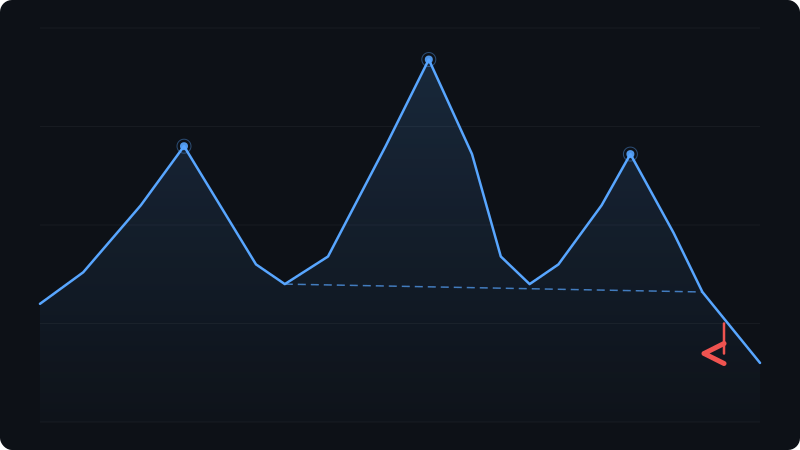
The Head & Shoulders pattern is a bearish reversal pattern that, when formed, signals that an upward trend may be coming to an end. It gets its name from its resemblance to a human head and two shoulders. It's a visual representation of a struggle between buyers and sellers, where the bulls initially push the price higher, but eventually, the bears take control.
Head & Shoulders Pattern: A bearish chart pattern that indicates a potential trend reversal from bullish to bearish. It consists of a left shoulder, a head (higher peak), a right shoulder, and a neckline.
Think of it like this: Imagine a tug-of-war between two teams. The first team (buyers) pulls the rope (price) higher, creating the left shoulder. They pull even harder, creating a new high – the head. But the second team (sellers) starts to gain strength, and while the first team manages to pull the rope up again, they can't reach the same height as the head, forming the right shoulder. Finally, the second team wins, breaking the rope (neckline) and pulling it downwards, signaling a trend reversal.
Anatomy of the Head & Shoulders Pattern; Key Components
The Head & Shoulders pattern is composed of four main parts, each playing a crucial role in the pattern's formation and interpretation:
- Left Shoulder: This is the first peak in the pattern, representing the initial attempt by buyers to push the price higher. It's essentially a high within an existing uptrend.
- Head: The head is the highest peak in the pattern, exceeding the height of the left shoulder. This represents a stronger push by buyers, but also indicates that the upward momentum may be slowing down.
- Right Shoulder: The right shoulder is another peak, but it fails to reach the height of the head. This is a crucial sign that the buying pressure is weakening, and sellers are gaining control.
- Neckline: The neckline connects the lows between the left shoulder and the head, and the head and the right shoulder. It acts as a support level. A break below the neckline confirms the pattern and signals a potential downtrend.
It is worth noting that the neckline is not always a straight horizontal line. It can be sloping upwards or downwards, depending on the price action. The slope of the neckline can provide additional clues about the strength of the potential reversal.
How the Head & Shoulders Pattern Works; A Step-by-Step Guide
Identifying and trading the Head & Shoulders pattern involves a series of steps. Here's a breakdown of the process:
- Identify an Uptrend: The pattern must form after a sustained uptrend for it to be valid. Look for a series of higher highs and higher lows.
- Spot the Left Shoulder: Watch for the formation of the first peak (the left shoulder) within the uptrend.
- Identify the Head: Look for a higher peak (the head) that exceeds the height of the left shoulder.
- Spot the Right Shoulder: Watch for the formation of another peak (the right shoulder) that fails to reach the height of the head. This is a critical confirmation signal.
- Draw the Neckline: Connect the lows between the left shoulder and the head, and the head and the right shoulder to draw the neckline.
- Confirm the Breakout: Wait for the price to break below the neckline. This confirms the pattern and signals a potential downtrend.
- Determine the Target: Measure the vertical distance between the head and the neckline. Subtract this distance from the breakout point on the neckline to estimate the potential price target.
Real-World Examples of Head & Shoulders Pattern
Let's look at a couple of hypothetical examples to see how the Head & Shoulders pattern works in practice:
Example 1: EUR/USD
Imagine the EUR/USD currency pair has been in an uptrend for several weeks. The price reaches 1.1200, forming the left shoulder. Buyers push the price even higher to 1.1350, creating the head. However, they struggle to maintain the momentum, and the price forms a right shoulder at 1.1250. The neckline is drawn at 1.1150. The price then breaks below the neckline at 1.1150, confirming the pattern. The vertical distance between the head (1.1350) and the neckline (1.1150) is 0.0200 (200 pips). Subtracting this from the breakout point (1.1150) gives a target of 1.0950.
Example 2: GBP/JPY
Suppose the GBP/JPY currency pair has been trending upwards. The price forms a left shoulder at 185.00. The price then rallies to 187.50, forming the head. The right shoulder forms at 186.00. The neckline is at 184.00. The price breaks below the neckline at 184.00, confirming the pattern. The distance between the head (187.50) and the neckline (184.00) is 3.50. Subtracting this from the breakout point (184.00) gives a target of 180.50.
Common Mistakes When Trading the Head & Shoulders Pattern
While the Head & Shoulders pattern can be a powerful tool, it's essential to avoid common mistakes that can lead to false signals and losing trades:
- Ignoring the Uptrend: The pattern must form after a sustained uptrend. If it forms within a range or a downtrend, it's less reliable.
- Prematurely Entering the Trade: Wait for the price to break below the neckline before entering a short position. Entering too early can result in a false signal.
- Not Confirming the Breakout: Look for confirmation that the breakout is genuine. This can be done by observing the trading volume or using other technical indicators.
- Setting Inappropriate Stop-Loss Levels: Place your stop-loss order above the right shoulder to protect your capital in case the pattern fails.
- Ignoring Other Factors: Don't rely solely on the Head & Shoulders pattern. Consider other technical indicators, fundamental analysis, and market sentiment before making trading decisions.
Practical Tips for Trading the Head & Shoulders Pattern
Here are some practical tips to help you improve your trading performance when using the Head & Shoulders pattern:
- Practice Identifying the Pattern: Spend time studying price charts and identifying the Head & Shoulders pattern in different market conditions. The more you practice, the better you'll become at spotting it.
- Use a Demo Account: Before trading the pattern with real money, practice using a demo account to test your strategy and get comfortable with the process.
- Combine with Other Indicators: Use other technical indicators, such as moving averages, RSI, or MACD, to confirm the pattern and improve your trading signals.
- Manage Your Risk: Always use appropriate risk management techniques, such as setting stop-loss orders and limiting your position size.
- Stay Disciplined: Stick to your trading plan and avoid making impulsive decisions based on emotions.
Frequently Asked Questions
How reliable is the Head & Shoulders pattern?
The Head & Shoulders pattern is generally considered a reliable pattern, but it's not foolproof. Its reliability increases when it forms after a well-defined uptrend and when the breakout is confirmed by increased volume or other indicators. It's always wise to combine it with other analysis techniques.
Can the Head & Shoulders pattern be used on all timeframes?
Yes, the Head & Shoulders pattern can be used on all timeframes, from short-term (e.g., 5-minute chart) to long-term (e.g., daily or weekly chart). However, patterns on higher timeframes tend to be more reliable than those on lower timeframes.
What if the right shoulder is higher than the head?
If the right shoulder is higher than the head, the pattern is invalidated. The Head & Shoulders pattern requires the right shoulder to be lower than the head to signal a weakening of the uptrend.
Is there an inverse Head & Shoulders pattern?
Yes, there is an inverse Head & Shoulders pattern, also known as a reverse Head & Shoulders pattern. It's a bullish reversal pattern that forms at the bottom of a downtrend and signals a potential uptrend. The inverse pattern is simply the Head & Shoulders pattern flipped upside down.
The Head & Shoulders pattern is a valuable tool for any forex trader looking to improve their ability to anticipate trend reversals. By understanding the pattern's structure, identifying its key components, and avoiding common mistakes, you can increase your chances of success in the forex market. Remember to always combine the pattern with other technical indicators and risk management techniques to make informed trading decisions. Happy trading!