
Naked Chart Trading; Why Less is More in Forex
Simplify your forex trading with naked chart analysis. Learn to read price action directly, without relying on complex indicators.
Imagine walking into a library filled with thousands of books, each promising a secret to success. Overwhelmed, you grab a handful at random, hoping one will hold the answer. That’s how many traders approach forex, loading their charts with indicators, each contradicting the other. But what if the real secret was to simply read the story already written on the chart itself? That's the power of naked chart trading.
- Naked chart trading focuses on price action and chart patterns without relying on technical indicators.
- It emphasizes understanding market sentiment and identifying key support and resistance levels.
- This approach can lead to cleaner charts, reduced analysis paralysis, and a more intuitive understanding of market movements.
- Mastering naked chart trading requires patience, practice, and a deep understanding of candlestick patterns and chart formations.
What is Naked Chart Trading?
Naked chart trading is a methodology that relies solely on price action to make trading decisions. This means analyzing candlestick patterns, chart formations, support and resistance levels, and trend lines directly on a clean chart, free from the clutter of technical indicators. The core idea is that all the information needed to make informed trading decisions is already present in the price movement itself.
Naked Chart Trading: A trading approach that uses only price action and chart patterns, without any technical indicators, to make trading decisions.
Think of it like learning to read a book in its original language. Instead of relying on someone else's interpretation (indicators), you learn to understand the story directly from the source (price action). This can provide a more nuanced and immediate understanding of market sentiment.
Why Less is More
Many new traders fall into the trap of over-complicating their charts with dozens of indicators. They believe that more indicators equal more accuracy. However, this often leads to analysis paralysis, where conflicting signals make it difficult to make clear decisions. Naked chart trading offers a solution by stripping away the noise and focusing on what really matters: price.
The beauty of this approach is its simplicity. By removing indicators, you gain a clearer view of price movements, allowing you to identify key levels and patterns more easily. It forces you to truly understand the market's behavior, rather than blindly following indicator signals. Furthermore, naked chart trading can be applied to any market and any timeframe, making it a versatile tool for any trader.
How Naked Chart Trading Works; A Step-by-Step Guide
Naked chart trading might seem daunting at first, but it can be broken down into a few key steps:
- Clean Your Chart: Remove all indicators from your chart. Start with a blank canvas.
- Identify Key Levels: Look for areas where price has previously bounced or stalled. These are potential support and resistance levels.
- Analyze Candlestick Patterns: Learn to recognize common candlestick patterns, such as dojis, engulfing patterns, and hammers. These patterns can provide clues about potential reversals or continuations.
- Spot Chart Formations: Identify chart formations like head and shoulders, double tops, and triangles. These formations can signal potential breakouts or breakdowns.
- Draw Trend Lines: Connect higher lows in an uptrend and lower highs in a downtrend to identify the direction of the trend.
- Observe Price Action: Pay attention to how price reacts at key levels and trend lines. Is it bouncing strongly, or is it struggling to break through?
- Confirm with Volume: While technically not 'naked', volume can be a valuable confirmation tool. Look for increased volume on breakouts or bounces to confirm the strength of the move.
This is not about eliminating tools, but about prioritizing direct observation. Think of it like learning to cook. You start with basic ingredients and learn how they interact before adding complex sauces and spices.
Practical Examples of Naked Chart Trading
Let's look at a couple of hypothetical examples of how naked chart trading might work:
Example 1: Bullish Engulfing Pattern at Support
Imagine you're looking at the EUR/USD chart. You've identified a key support level at 1.1000. Price approaches this level and forms a bearish candlestick. The next candlestick is a large bullish candlestick that completely engulfs the previous bearish candlestick. This is a bullish engulfing pattern at a key support level. A naked chart trader might interpret this as a strong signal that the price is likely to bounce off the support level and move higher.
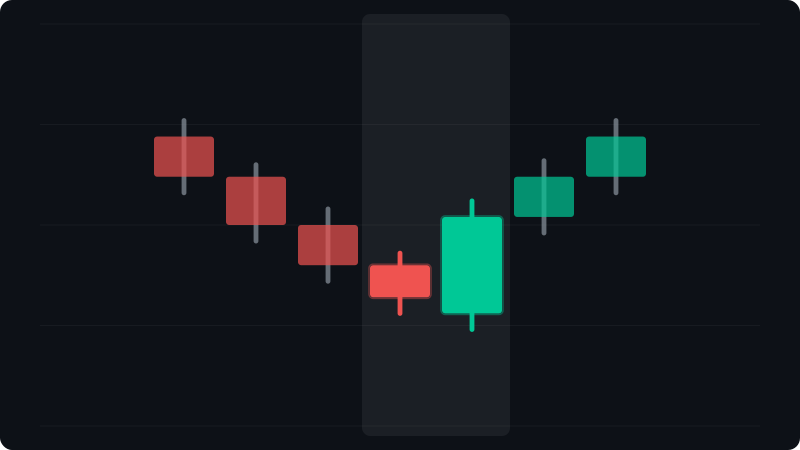
They might then look for confirmation, such as increased volume on the bullish candlestick, before entering a long position. A stop-loss order would be placed just below the support level to manage risk.
Example 2: Head and Shoulders Formation
Now, let's say you're looking at the GBP/USD chart and you spot a head and shoulders formation. The left shoulder forms, followed by the head (a higher peak), and then the right shoulder (a peak lower than the head but similar to the left shoulder). A neckline can be drawn connecting the lows between the shoulders and the head.
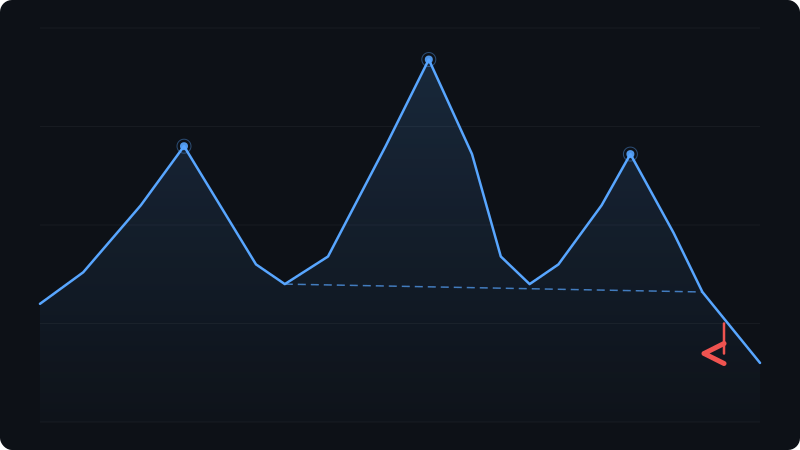
A naked chart trader would wait for the price to break below the neckline before considering a short position. This breakdown confirms the formation and suggests that the price is likely to move lower. A stop-loss order would be placed just above the neckline to protect against a false breakout.
Common Mistakes and Misconceptions
One common mistake is to assume that naked chart trading is easy. It requires a deep understanding of price action and chart patterns, which takes time and practice to develop. Another misconception is that it's a completely objective approach. While it eliminates indicators, interpretation of price action is still subjective to some extent.
Many beginners also struggle with patience. They expect to see clear signals all the time, but the market is often choppy and uncertain. It's important to be selective and only trade when you see a high-probability setup. Over-trading is a surefire way to lose money, regardless of your trading strategy.
Naked Chart Trading for Different Trader Types
The principles of naked chart trading can be adapted for different trading styles:
- Scalpers: Scalpers can use naked charts to identify short-term price movements and scalp small profits. They might focus on candlestick patterns and support/resistance levels on very short timeframes.
- Swing Traders: Swing traders can use naked charts to identify potential swing trades that last for a few days or weeks. They might look for chart formations and trend line breaks on daily or weekly charts.
- Long-Term Investors: Even long-term investors can benefit from naked chart trading by using it to identify long-term trends and key support/resistance levels. This can help them make more informed decisions about when to buy or sell.
Correlation Analysis
While naked chart trading focuses on price action itself, understanding correlations with other assets can provide valuable context. Here's how different assets can influence currency pairs:
- DXY (US Dollar Index): A rising DXY often puts downward pressure on EUR/USD, GBP/USD, and other currency pairs where the USD is the counter currency. Conversely, a falling DXY can lead to rallies in these pairs.
- Bond Yields: Rising US Treasury yields can strengthen the USD, as they attract foreign investment. Falling yields can weaken the USD.
- Equities (S&P 500): Generally, a risk-on environment where equities are rising can weaken the USD, as investors seek higher-yielding assets. A risk-off environment can strengthen the USD as investors flock to safe havens.
- Oil: Oil-producing countries like Canada (CAD) are often positively correlated with oil prices. Rising oil prices can strengthen the CAD, while falling prices can weaken it.
Keeping an eye on these correlations can help you anticipate potential market movements and make more informed trading decisions, even when focusing primarily on price action.
Practical Tips for Mastering Naked Chart Trading
- Start with One Currency Pair: Don't try to analyze too many pairs at once. Focus on one or two pairs and become intimately familiar with their price action.
- Backtest Your Strategies: Before risking real money, backtest your naked chart trading strategies on historical data to see how they would have performed.
- Keep a Trading Journal: Record your trades, including your reasons for entering and exiting, and analyze your results to identify areas for improvement.
- Practice Patience: Don't force trades. Wait for high-probability setups that align with your strategy.
- Manage Your Risk: Always use stop-loss orders to limit your potential losses. Never risk more than you can afford to lose.
Frequently Asked Questions
Is naked chart trading suitable for all traders?
While it can be beneficial for traders of all levels, it requires a solid understanding of price action and chart patterns. Beginners may need to spend time learning these concepts before effectively using naked chart trading.
Can I combine naked chart trading with other tools?
Yes, but the idea is to keep it simple. Some traders might use volume analysis for confirmation, but the core decision-making should still be based on price action.
How long does it take to become proficient in naked chart trading?
It varies depending on the individual, but it generally takes several months of consistent practice and study to develop a good understanding of price action and chart patterns.
What are the main advantages of naked chart trading?
The main advantages include cleaner charts, reduced analysis paralysis, a more intuitive understanding of market movements, and versatility across different markets and timeframes.
Naked chart trading is not a magic bullet, but it can be a powerful tool for traders who are willing to put in the time and effort to master it. By learning to read the story that price action tells, you can gain a deeper understanding of the market and make more informed trading decisions.