

Struggling to make consistent profits in forex? Many new traders jump into the market without a solid strategy, unsure whether to focus on economic news or chart patterns. Understanding the difference between technical and fundamental analysis is the crucial first step to building a trading plan that actually works for *you*.
- Technical analysis focuses on price charts and patterns to predict future movements.
- Fundamental analysis examines economic factors and news events to assess currency values.
- Both approaches have strengths and weaknesses, and many traders combine them.
- Understanding your trading style and goals will help you choose the best analysis method.
What is Technical Analysis? A Chart-Based Approach
Technical analysis is the study of historical price data to identify patterns and predict future price movements. Technical analysts, often called chartists, believe that all relevant market information is already reflected in the price. They primarily use charts and technical indicators to analyze currency pairs.
Technical Analysis: A method of predicting future price movements based on historical price data, chart patterns, and technical indicators.
The underlying principle of technical analysis is that history tends to repeat itself. By identifying recurring patterns, traders attempt to anticipate future price swings. This approach is based on the idea that market psychology, which drives buying and selling decisions, remains relatively constant over time.
Imagine you're trying to predict the weather. A technical analyst is like someone who looks at past weather patterns, such as temperature fluctuations and cloud formations, to forecast the upcoming weather. They don't necessarily care about the underlying reasons for the weather changes; they're just focused on the patterns.
Key Tools in Technical Analysis
Technical analysts use a variety of tools, including:
- Chart Patterns: Recognizable formations on price charts, such as head and shoulders, double tops, and triangles, that suggest potential future price movements.
- Technical Indicators: Mathematical calculations based on price and volume data, such as moving averages, Relative Strength Index (RSI), and Moving Average Convergence Divergence (MACD), that provide insights into market momentum and potential trend changes.
- Support and Resistance Levels: Price levels where the price has historically found support (buying pressure) or resistance (selling pressure).
- Candlestick Patterns: Visual representations of price movements over a specific period, such as hammers, engulfing patterns, and dojis, that can signal potential reversals or continuations of trends.
What is Fundamental Analysis? An Economic Perspective
Fundamental analysis, on the other hand, involves evaluating economic, financial, and political factors that can influence the value of a currency. Fundamental analysts examine macroeconomic data, such as GDP growth, inflation rates, interest rates, and employment figures, to assess the overall health and stability of a country's economy.
Fundamental Analysis: A method of evaluating the intrinsic value of a currency based on economic, financial, and political factors.
The goal of fundamental analysis is to determine whether a currency is overvalued or undervalued relative to its perceived fair value. This approach is based on the idea that market prices will eventually reflect the underlying economic realities. If a currency is undervalued, fundamental analysts may consider buying it, expecting the price to rise as the market recognizes its true value. Conversely, if a currency is overvalued, they may consider selling it.
Going back to the weather analogy, a fundamental analyst is like a meteorologist who studies atmospheric conditions, such as air pressure, humidity, and wind speed, to understand the underlying causes of weather changes. They use this knowledge to predict future weather patterns.
Key Factors in Fundamental Analysis
Fundamental analysts consider a wide range of factors, including:
- Economic Indicators: Data releases that provide insights into the health of a country's economy, such as GDP growth, inflation, unemployment, and trade balance.
- Interest Rates: The cost of borrowing money, set by central banks, which can influence currency values by attracting or deterring foreign investment.
- Monetary Policy: Actions taken by central banks to control the money supply and credit conditions, which can impact inflation and economic growth.
- Political Stability: The overall stability of a country's political system, which can affect investor confidence and currency values.
- Geopolitical Events: Events such as wars, political crises, and trade disputes that can have a significant impact on currency markets.
How Do Technical and Fundamental Analysis Work in Practice?
Let's illustrate how these two approaches might be used in practice with a hypothetical example. Imagine you are interested in trading the EUR/USD currency pair.
Technical Analysis Example
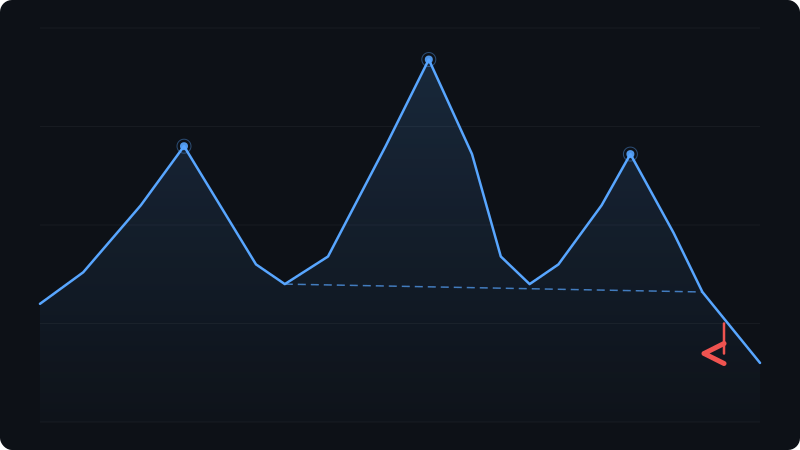
A technical analyst might examine the EUR/USD chart and notice a head and shoulders pattern forming. This pattern is often interpreted as a bearish signal, suggesting that the price may be about to decline. The analyst might also observe that the RSI indicator is approaching overbought levels, further reinforcing the bearish outlook. Based on this analysis, the trader might decide to sell EUR/USD, anticipating a price decline.
Fundamental Analysis Example
A fundamental analyst, on the other hand, might focus on economic news releases from Europe and the United States. If the analyst observes that the Eurozone's GDP growth is slowing while the U.S. economy is expanding, they might conclude that the euro is likely to weaken against the dollar. Furthermore, if the European Central Bank (ECB) is expected to maintain low interest rates while the Federal Reserve (Fed) is expected to raise rates, this would further support the bearish outlook for EUR/USD. Based on this analysis, the trader might also decide to sell EUR/USD.
In this example, both technical and fundamental analysis lead to the same conclusion: a potential decline in EUR/USD. However, the reasoning behind the decision is quite different. The technical analyst focuses on chart patterns and indicators, while the fundamental analyst focuses on economic factors.
Combining Technical and Fundamental Analysis
Many experienced traders combine both technical and fundamental analysis to make more informed trading decisions. This approach allows traders to gain a more comprehensive understanding of the market and to identify high-probability trading opportunities.
For example, a trader might use fundamental analysis to identify currencies that are likely to appreciate or depreciate over the long term. Then, they might use technical analysis to find specific entry and exit points for their trades. This approach can help traders to filter out false signals and to improve their overall trading performance.
Think of it like planning a road trip. Fundamental analysis helps you decide where you want to go (the overall trend), while technical analysis helps you navigate the specific route (entry and exit points).
Common Mistakes and Misconceptions
Relying solely on one type of analysis. It's crucial to consider both technical and fundamental factors for a balanced perspective.
One common mistake that beginners make is relying solely on one type of analysis. Some traders become so focused on technical analysis that they ignore important economic news releases. Others become so engrossed in fundamental analysis that they overlook significant chart patterns. It's important to remember that both technical and fundamental factors can influence currency prices, and a balanced approach is often the most effective.
Another misconception is that technical analysis is only useful for short-term trading, while fundamental analysis is only useful for long-term trading. While it's true that technical analysis is often used for short-term trading, it can also be used for long-term investing. Similarly, fundamental analysis can be used for both short-term and long-term trading.
Practical Tips for Beginners
- Start with a solid understanding of the basics: Before diving into technical or fundamental analysis, make sure you have a good grasp of forex terminology, currency pairs, and trading mechanics.
- Choose an analysis method that aligns with your trading style and goals: If you prefer short-term trading and enjoy analyzing charts, technical analysis may be a good fit for you. If you prefer long-term investing and enjoy following economic news, fundamental analysis may be a better choice.
- Practice with a demo account: Before risking real money, practice your trading skills with a demo account. This will allow you to test different analysis methods and trading strategies without any financial risk.
- Continuously learn and adapt: The forex market is constantly evolving, so it's important to continuously learn and adapt your trading strategies. Stay up-to-date on economic news, technical indicators, and market trends.
Frequently Asked Questions
What is the best analysis method for forex trading?
There is no single "best" analysis method. The most effective approach depends on your trading style, goals, and risk tolerance. Many traders find that combining both technical and fundamental analysis provides the most comprehensive view of the market.
Can I be successful with only technical analysis?
Yes, it's possible to be successful using only technical analysis, especially for short-term trading strategies. However, it's important to be aware of the limitations and to understand that economic events can sometimes override technical patterns.
How much time do I need to spend on fundamental analysis?
The amount of time you spend on fundamental analysis depends on your trading style and goals. If you're a long-term investor, you'll need to dedicate more time to studying economic trends and news events. If you're a short-term trader, you can focus on the most important economic releases.
Where can I learn more about technical and fundamental analysis?
There are many resources available online and in libraries that can help you learn more about technical and fundamental analysis. Look for reputable websites, books, and courses that provide clear and concise explanations of these concepts.
Ultimately, the choice between technical and fundamental analysis is a personal one. There is no right or wrong answer. The best approach is to experiment with both methods and to find the one that works best for you. Remember to always manage your risk and to never trade with more money than you can afford to lose.