
AUD/USD and NZD/USD Face Downside Pressure as US Dollar Strength Persists

The Australian Dollar (AUD) opened Monday's trading session with a modest bearish gap, touching a one-week low during early Asian hours, while the New Zealand Dollar (NZD) also saw selling pressure intensify for a second consecutive day. Both currencies are facing headwinds, with AUD/USD currently trading around the 0.7000 psychological mark, down 0.25% for the day, and NZD/USD retreating closer to the 0.5800 level.
Market Context
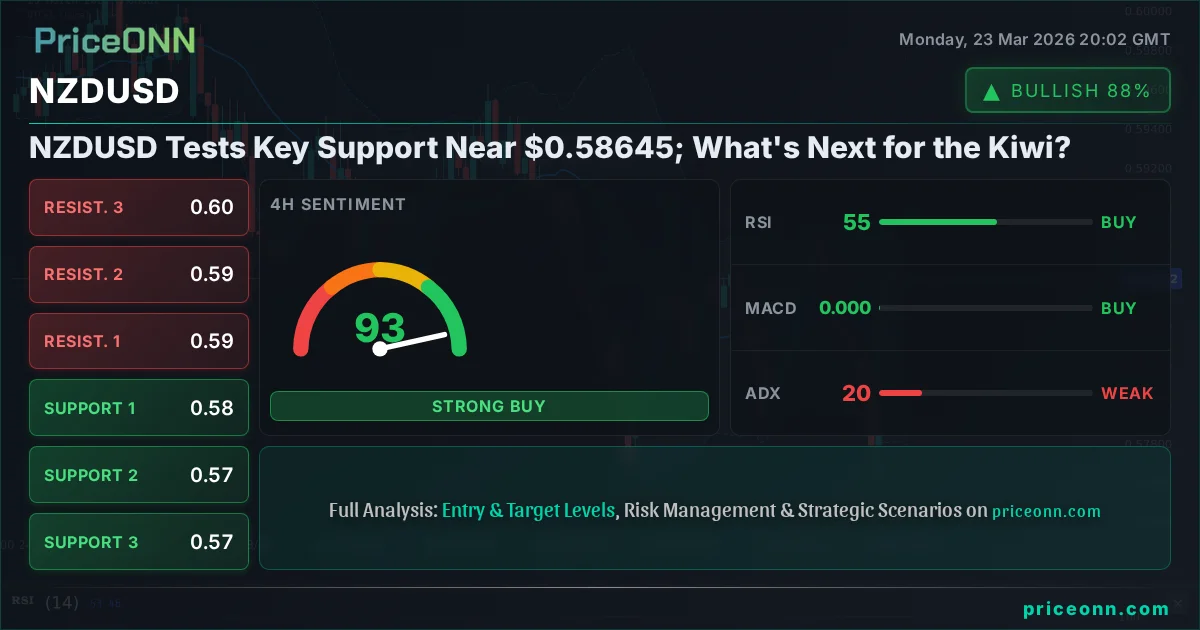
The AUD/USD pair's failure to find significant follow-through buying after its initial dip leaves it consolidating near a critical juncture. The proximity to the 0.7000 support level is particularly noteworthy as the 200-day Exponential Moving Average (EMA) also appears vulnerable. A sustained break below these levels could signal a more significant bearish trend developing for the Aussie. Meanwhile, the NZD/USD pair is struggling to regain ground, having failed to break above the 200-day Simple Moving Average (SMA) barrier, which is situated in the 0.5865-0.5870 zone. Market data indicates that the prevailing sentiment favors further downside for the Kiwi, suggesting that any upward movements may be short-lived opportunities for bearish traders.
Analysis & Drivers
Several interconnected factors are driving the weakness in these antipodean currencies. For the Australian Dollar, the monetary policy stance of the Reserve Bank of Australia (RBA) remains a key determinant. Higher interest rates typically support the AUD, but any hint of dovishness or rate cuts can exert downward pressure. Furthermore, Australia's economic health is heavily influenced by global commodity prices, particularly iron ore, and the economic performance of its largest trading partner, China. Reports indicating a mixed economic picture from China can directly impact demand for Australian exports, weighing on the AUD. In 2021, iron ore exports alone generated approximately $118 billion, highlighting the commodity's significance.
Similarly, the New Zealand Dollar's performance is closely tied to its domestic economic health and the Reserve Bank of New Zealand's (RBNZ) policy. However, like the AUD, the NZD is highly sensitive to the economic vitality of China. Signs of economic slowdown in Beijing can reduce demand for New Zealand's exports, creating challenges for the domestic economy and the Kiwi. The dairy sector, a cornerstone of New Zealand's export economy, also plays a crucial role; fluctuations in global dairy prices directly affect export earnings. The RBNZ aims to maintain inflation within a 1% to 3% target range, with a midpoint of 2%, a mandate that influences its policy decisions and, by extension, the currency's value.
Trader Implications
For traders monitoring AUD/USD, the 0.7000 level is a critical pivot. A decisive close below this mark, especially accompanied by a break of the 200-EMA, could trigger further selling towards potential support zones around 0.6950. Upside resistance is likely to be found near the 0.7050-0.7080 area. Traders should closely watch upcoming RBA commentary and Chinese economic data releases for directional cues.
In the case of NZD/USD, the 0.5865-0.5870 zone (the 200-SMA) represents a significant resistance level. Sellers are likely to remain active below this barrier, with the immediate target being a retest of the 0.5800 psychological level. A break below 0.5800 could open the door for a move towards 0.5750. Conversely, a sustained push above the 200-SMA would be required to alleviate bearish pressure, with eyes then turning towards 0.5900. Investors should remain cautious of any shifts in global risk sentiment, which can disproportionately impact commodity-linked currencies like the NZD.
Outlook
The near-term outlook for both AUD/USD and NZD/USD appears tilted to the downside, contingent on the prevailing strength of the US Dollar and ongoing concerns regarding China's economic trajectory. Any positive surprises from Chinese economic indicators or a shift in global risk appetite could offer temporary respite. However, without significant fundamental catalysts, the path of least resistance for both the Aussie and the Kiwi remains lower, with traders likely to seek opportunities to sell into rallies.
Frequently Asked Questions
What is the immediate support level for AUD/USD?
The immediate support for AUD/USD is the 0.7000 psychological mark. A break below this level could lead to a further decline towards 0.6950.
What is the key resistance for NZD/USD?
The key resistance for NZD/USD is the 200-day SMA located in the 0.5865-0.5870 zone. Sellers are expected to be active below this barrier, with a potential move towards 0.5800.
What external factors are most impacting the AUD and NZD?
The economic performance of China, New Zealand's largest trading partner, and global commodity prices, particularly iron ore for the AUD and dairy for the NZD, are significant external drivers. Additionally, the monetary policy decisions of the RBA and RBNZ play a crucial role.
Track markets in real-time
Empower your investment decisions with AI-powered analysis, technical indicators and real-time price data.
Join Our Telegram Channel
Get breaking market news, AI analysis and trading signals delivered instantly to your Telegram.
Join Channel



PriceONN