
Is AUD/USD Poised for Further Declines as Geopolitical Tensions Escalate?
The AUD/USD has succumbed to a significant sell-off, trading below the critical 0.6900 mark and extending its losing streak to four consecutive days. This sharp depreciation, which has seen the pair drop by over 0.76% in recent sessions, is primarily driven by a dramatic shift in global market sentiment. Heightened fears of a potential escalation in Middle East conflict, coupled with doubts about a ceasefire agreement between the US and Iran, have prompted a strong demand for safe-haven assets, with the US Dollar leading the charge.
Market Context: Risk Aversion Dominates
The narrative in financial markets has pivoted sharply from optimism to palpable anxiety. This shift has pushed the Australian Dollar to two-month lows, with the exchange rate probing levels around 0.6880 during early Asian trading. This move underscores a broader 'risk-off' sentiment gripping investors, leading them to prioritize capital preservation over speculative gains. In such environments, currencies like the AUD, which are heavily influenced by global growth expectations and commodity prices, typically face pressure. Conversely, safe-haven currencies such as the US Dollar, alongside assets like government bonds and gold, tend to appreciate as investors seek perceived stability.
Analysis & Drivers: Geopolitics and Safe Havens
The immediate catalyst for the AUD/USD's decline appears to be geopolitical instability in the Middle East. Uncertainty surrounding diplomatic efforts for a ceasefire between the US and Iran has revived fears of wider regional conflict. This has triggered a classic flight to safety, benefiting the US Dollar. Analysts note that the USD's status as the world's premier reserve currency positions it to attract significant capital inflows during periods of global uncertainty.
Historically, the Australian Dollar's fortunes are closely tied to global economic health and commodity prices, particularly iron ore. As a major commodity exporter, Australia benefits from a 'risk-on' environment where global demand fuels higher commodity prices and boosts the AUD. However, when geopolitical tensions rise and economic outlooks darken, demand for riskier assets, including commodity-linked currencies, diminishes. This dynamic is currently playing out, with the AUD facing headwinds from both geopolitical anxieties and potentially softening global growth prospects.
Meanwhile, gold prices (XAU/USD) have also experienced a significant downturn, falling by approximately 2% to near $4,410. This counterintuitive move, as gold is typically seen as a safe haven, suggests that in the current environment, the US Dollar is acting as the primary beneficiary of capital flows, potentially overshadowing gold's traditional role. Central banks' substantial gold accumulation, with 1,136 tonnes acquired in 2022 alone, highlights its strategic importance, but immediate market reactions can sometimes diverge from long-term trends.
Trader Implications: Key Levels and Risks
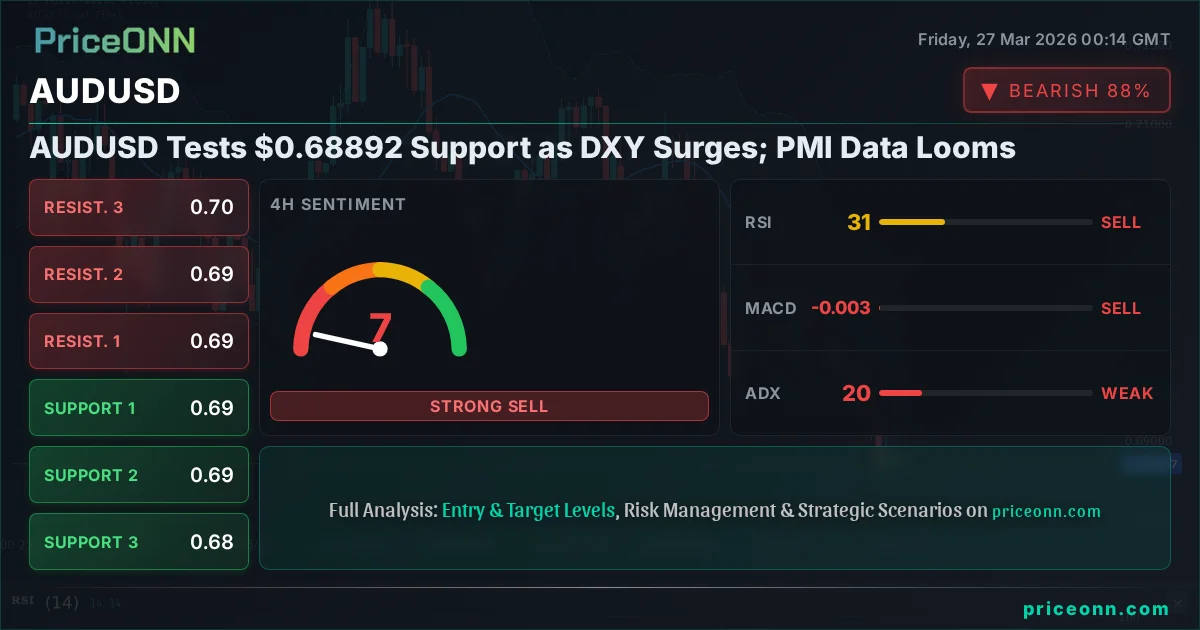
Traders should closely monitor the 0.6850 level as a potential support for AUD/USD. A sustained break below this psychological barrier could signal further downside momentum, potentially targeting the 0.6800 handle. On the upside, resistance is likely to form around the 0.6900-0.6920 region. Any positive developments regarding a Middle East ceasefire or a significant shift in global risk appetite could lead to a short-covering rally.
Key risk factors include any further escalation of tensions in the Middle East, unexpected economic data from major economies that fuels recession fears, or hawkish signals from the Federal Reserve that bolster the USD. Conversely, a de-escalation of geopolitical risks or dovish commentary from the Fed could provide relief for the AUD/USD.
Outlook
The immediate outlook for AUD/USD remains subdued as long as geopolitical uncertainties persist and the US Dollar maintains its safe-haven appeal. Market participants will be keenly watching for any signs of de-escalation in the Middle East. Upcoming economic data releases from Australia and the United States, alongside central bank commentary, will also be crucial in shaping the currency pair's trajectory. A sustained move back above 0.6950 would be needed to suggest a shift in sentiment, but for now, the path of least resistance appears to be to the downside.
Frequently Asked Questions
What is the current support level for AUD/USD?
The AUD/USD is currently testing key support around the 0.6880 level. A break below this could lead to further declines towards 0.6850 and potentially 0.6800.
Why is the Australian Dollar falling?
The Australian Dollar is falling due to a surge in global risk aversion. Fears of escalating Middle East conflict and doubts about a US-Iran ceasefire are driving investors into safe-haven assets like the US Dollar, weakening riskier currencies such as the AUD.
What is the outlook for AUD/USD amid current market conditions?
The outlook for AUD/USD remains cautious. As long as geopolitical tensions persist and the US Dollar remains strong, further downside is possible. Traders should watch for developments in the Middle East and key economic data for any potential shifts.
Track markets in real-time
Empower your investment decisions with AI-powered analysis, technical indicators and real-time price data.
Join Our Telegram Channel
Get breaking market news, AI analysis and trading signals delivered instantly to your Telegram.
Join Channel
PriceONN