Australian Dollar falls to two-month lows on US–Iran peace uncertainty
Global Sentiment Shifts to Risk Aversion
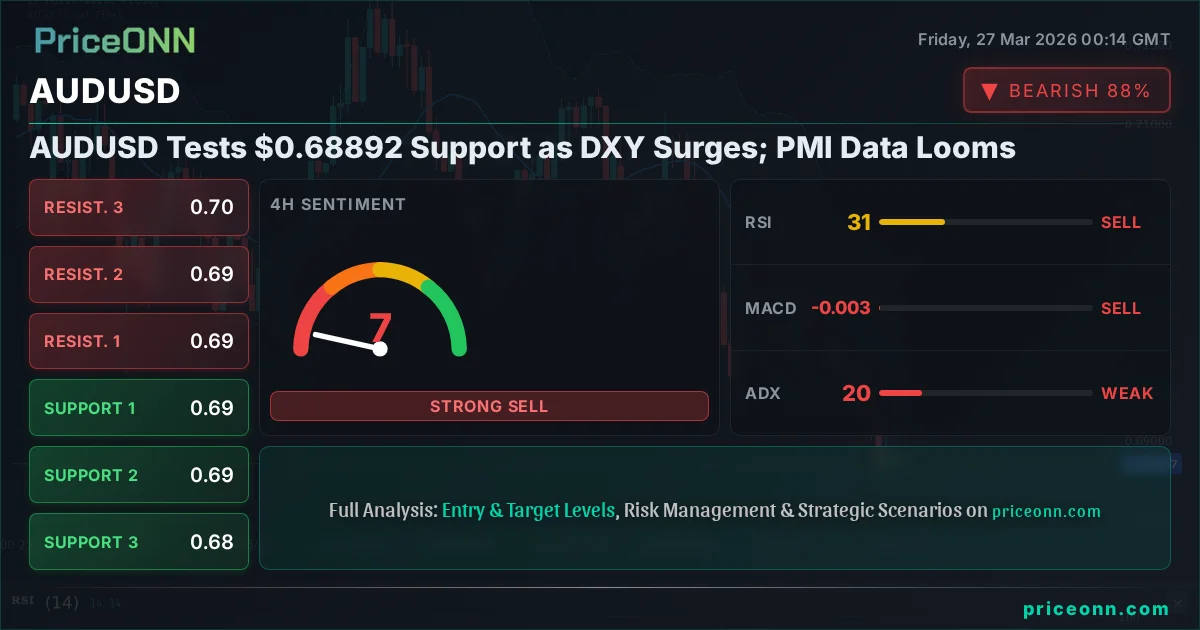
Investor appetite for risk has demonstrably cooled, pushing the Australian Dollar to its lowest point in two months against its US counterpart. The AUD/USD exchange rate is now probing levels around 0.6880, marking the fourth straight day of declines. This downturn reflects a palpable shift in global market sentiment, moving away from optimism towards caution.
The financial world often categorizes market behavior into two broad phases: 'risk-on' and 'risk-off'. During 'risk-on' periods, optimism prevails. Investors feel confident enough to embrace higher-risk assets, anticipating robust returns. This typically fuels rallies in equity markets, boosts most commodities (with gold often being an exception), and strengthens the currencies of commodity-exporting nations. Cryptocurrencies also tend to follow this upward trend.
Conversely, a 'risk-off' environment signals investor anxiety about the future. In such times, the focus shifts to capital preservation. This leads to a retreat from speculative assets and a move towards safer havens. Traditionally, this means a surge in demand for government bonds, particularly those issued by major economies, and a noticeable uptick in the price of gold. Safe-haven currencies like the Japanese Yen, the Swiss Franc, and the US Dollar tend to appreciate as investors seek perceived stability.
Commodity Currencies Face Pressure
The Australian Dollar, alongside its peers such as the Canadian Dollar and the New Zealand Dollar, typically thrives in a 'risk-on' environment. Their economies are heavily reliant on the export of raw materials. When global economic activity is expected to accelerate, demand for these commodities rises, driving up their prices and, consequently, the value of these currencies. Currencies like the Russian Ruble and the South African Rand also exhibit similar sensitivities to global growth expectations.
However, the current geopolitical climate, marked by uncertainty surrounding potential US-Iran escalations, is creating ripples across markets. This uncertainty is amplifying demand for the US Dollar, the Japanese Yen, and the Swiss Franc. The USD's strength stems from its status as the world's primary reserve currency and the perceived safety of US Treasury debt. Investors flock to these assets, viewing them as secure even amidst global turmoil, given the sheer size and resilience of the US economy.
The Yen benefits from strong domestic demand for Japanese government bonds, as a significant portion is held by local investors who are less likely to divest during a crisis. The Swiss Franc's appeal is bolstered by Switzerland's stringent banking secrecy laws and its reputation for financial stability, offering investors a perceived sanctuary for their capital.
The Bigger Picture
The current market dynamic is a clear illustration of how geopolitical tensions can override underlying economic fundamentals. While Australia's economic outlook might otherwise support its currency, the immediate fear factor associated with potential international conflict is proving a more dominant force. This dynamic highlights the sensitivity of commodity exporters' currencies to global stability.
The extended decline in the AUD/USD suggests that traders are pricing in a heightened risk premium. This could persist as long as geopolitical uncertainty remains elevated. The pair's ability to hold above the key 0.6850 support level will be a critical gauge of market sentiment in the near term. A sustained break below this level could signal further downside potential.
The implications extend beyond just the currency markets. A weaker Australian Dollar can make imports more expensive for Australian consumers and businesses, potentially contributing to inflationary pressures. Conversely, it could boost the competitiveness of Australian exports in other markets, though this benefit may be tempered by a global slowdown if risk aversion persists.
Market Ripple Effects
This shift towards a 'risk-off' sentiment has several knock-on effects across financial markets. The immediate impact is seen in the AUD/USD pair's depreciation. As investors seek safety, we can also anticipate a strengthening trend in the US Dollar Index (DXY), which measures the greenback's performance against a basket of major currencies.
Furthermore, the elevated geopolitical risk could lead to a muted performance in global equity markets, particularly in sectors sensitive to economic growth. Conversely, assets typically considered safe havens, such as Gold, may see renewed buying interest. The interplay between commodity prices and currency strength is also crucial; a sustained risk-off mood could pressure industrial metals, impacting currencies like the Canadian Dollar.
Traders should monitor developments closely. The narrative of US-Iran relations will be a primary driver, but underlying economic data from major economies will also play a role in shaping the broader risk sentiment. Key levels to watch for AUD/USD include the immediate support around 0.6850 and resistance levels near 0.6900 and 0.6950.
Track markets in real-time
Empower your investment decisions with AI-powered analysis, technical indicators and real-time price data.
Join Our Telegram Channel
Get breaking market news, AI analysis and trading signals delivered instantly to your Telegram.
Join Channel