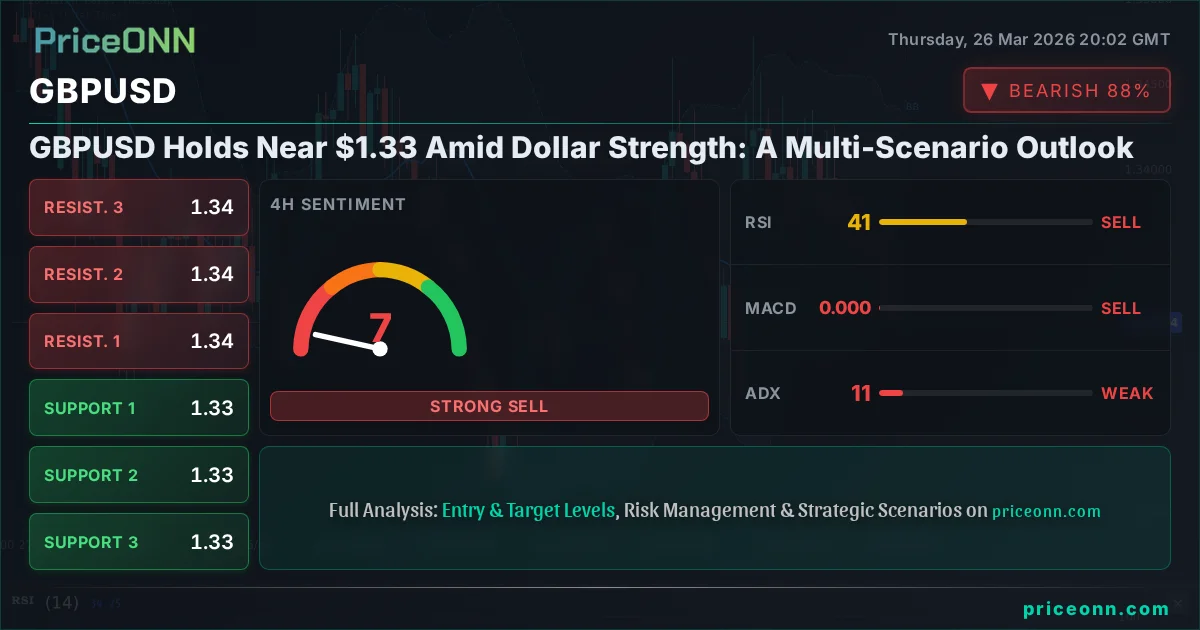
GBP/USD drifts lower as Iran oil shock clouds the BoE rate outlook
Sterling's Global Standing
The British Pound, a currency with roots tracing back to 886 AD, stands as the United Kingdom's official tender. Globally, it commands significant attention in the foreign exchange market, holding the position of the fourth most actively traded currency. Recent data from 2022 indicates it accounts for approximately 12% of all FX transactions, with daily volumes averaging a staggering $630 billion.
Its most prominent trading partners are the US Dollar, in a pairing colloquially known as 'Cable', which represents 11% of overall FX activity. Other key pairs include the Japanese Yen, referred to by traders as the 'Dragon' and comprising 3% of trades, and the Euro, making up 2% of the market.
Monetary Policy and Economic Drivers
The Bank of England (BoE) is the sole issuer of Sterling, and its monetary policy decisions are the paramount influence on the currency's valuation. The central bank's mandate centers on achieving 'price stability', defined as maintaining inflation at roughly 2%. To manage inflation, the BoE primarily adjusts its benchmark interest rates.
When inflationary pressures mount, the BoE typically raises interest rates. This move increases the cost of borrowing for individuals and businesses, acting as a brake on economic activity. Conversely, higher interest rates can make the UK an attractive destination for international capital seeking better returns, thereby bolstering the Pound.
Should inflation dip below the target, it often signals a slowdown in economic expansion. In such circumstances, the BoE might consider lowering interest rates to stimulate borrowing and investment, aiming to spur economic growth. Economic indicators provide crucial insights into the health of the UK economy and, consequently, can sway the Sterling's trajectory.
Key economic data points such as Gross Domestic Product (GDP) figures, Purchasing Managers' Indexes (PMIs) for both manufacturing and services sectors, and employment statistics all play a role in shaping market sentiment towards the Pound. A robust economy typically supports Sterling, not only by attracting foreign investment but also by potentially prompting the BoE to adopt a more hawkish stance on interest rates. Weak economic data, however, often leads to downward pressure on the currency.
Another critical metric influencing Sterling is the Trade Balance, which quantifies the difference between a nation's export earnings and its import expenditures over a specific period. A strong performance in exports, particularly for goods in high global demand, can create significant demand for the Sterling as foreign buyers acquire the currency to purchase these products. A positive net trade balance generally strengthens a currency, while a negative balance can weaken it.
Market Ripple Effects
The recent geopolitical developments in the Middle East, particularly concerning oil supply disruptions, have injected a fresh layer of complexity into the global economic outlook. This heightened uncertainty can indirectly impact the Bank of England's policy considerations. If energy price shocks lead to a sustained increase in inflation, it could force the BoE into a difficult position: tighten policy to combat inflation, potentially stifling growth, or maintain a looser stance to support the economy, risking higher price pressures.
This delicate balancing act creates volatility not just for the GBP/USD pair, but also influences other key markets. The US Dollar Index (DXY), for instance, often reacts to shifts in global risk sentiment; a flight to safety could see the dollar strengthen, putting further pressure on Cable. Furthermore, commodity prices, especially crude oil, will remain under scrutiny. Any sustained rally in oil prices due to supply concerns could feed into broader inflation expectations, affecting central bank policies worldwide and impacting global equity markets as corporate input costs rise.
Traders will be closely watching how the BoE navigates this environment. A more cautious or dovish tone from the Bank, in response to growth fears exacerbated by energy price shocks, could signal a pause or even a reversal in rate hikes, presenting headwinds for Sterling. Conversely, if inflation proves persistent and forces the BoE to remain hawkish, it could offer some support to the Pound, but only if the UK economy does not falter significantly under the strain.
Track markets in real-time
Empower your investment decisions with AI-powered analysis, technical indicators and real-time price data.
Join Our Telegram Channel
Get breaking market news, AI analysis and trading signals delivered instantly to your Telegram.
Join Channel