Aussie drops over 1% as Powell flags stubborn inflation
Dollar Strength Reasserts as Inflation Woes Return
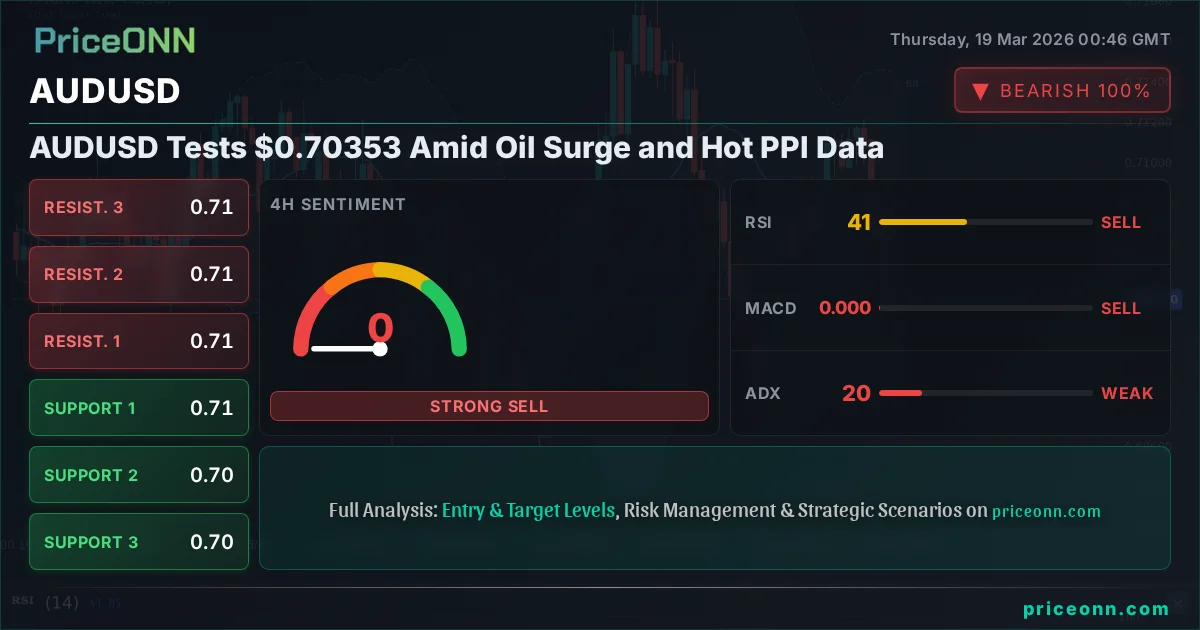
The Australian Dollar faced considerable selling pressure yesterday, plummeting by approximately 1.15% against its US counterpart. A key rejection point at the 0.7100 mark proved insurmountable, sending the AUD/USD pair to settle near 0.7025. Earlier in the session, the currency pair had briefly tested levels above 0.7120, but this upward momentum proved fleeting as sellers aggressively stepped in. This move extended a recent pattern of failed attempts to breach the year-to-date high, which hovers close to 0.7190.
The catalyst for this sharp reversal appears to be a renewed focus on the inflation outlook in the United States. Comments from Federal Reserve officials, particularly Chair Jerome Powell, signaled a more hawkish stance, emphasizing the central bank's commitment to combating sticky price pressures. This has bolstered the US Dollar across the board as markets recalibrate expectations for future interest rate policy.
Underlying Drivers of the Aussie Dollar
Several fundamental factors typically influence the trajectory of the Australian Dollar. Foremost among these is the monetary policy stance of the Reserve Bank of Australia (RBA). The RBA's decisions on interest rates directly impact borrowing costs and, consequently, the attractiveness of AUD denominated assets. Historically, higher Australian interest rates relative to other major economies tend to support the currency, while lower rates can exert downward pressure.
Beyond domestic monetary policy, Australia's status as a major commodity exporter places significant importance on global resource prices. The price of Iron Ore, a cornerstone of Australia's export revenue, often moves in tandem with the AUD. A surge in iron ore prices typically bolsters demand for the Australian Dollar, reflecting increased export earnings and a stronger trade balance outlook.
The economic health of China, Australia's largest trading partner, also plays a critical role. Robust Chinese demand for Australian goods and services, particularly raw materials, directly translates into higher demand for the AUD. Conversely, signs of economic slowdown or distress in China can weigh heavily on the currency's value. Surprises in Chinese economic data, whether positive or negative, frequently lead to noticeable movements in AUD pairs.
Furthermore, Australia's Trade Balance, the net difference between its export earnings and import expenditures, serves as another key indicator. A persistent surplus, driven by strong export performance, generally strengthens the AUD. Conversely, a widening deficit can signal underlying economic weakness and put downward pressure on the currency.
Finally, global market sentiment, often described as risk appetite, is a crucial determinant for the Australian Dollar. During periods of 'risk-on' sentiment, where investors are more willing to embrace riskier assets, the AUD tends to perform well. However, in 'risk-off' environments, characterized by a flight to safety, the AUD often experiences outflows as investors seek more secure havens.
Reading Between the Lines
The recent pullback in the AUD/USD pair underscores the dominant influence of US monetary policy expectations on global currency markets. While domestic factors like commodity prices and RBA policy are important, external forces, particularly those emanating from the US Federal Reserve, can quickly override local influences. The failed attempt to push above 0.7100 signals that the path of least resistance may currently be lower for the Aussie.
Traders will be closely monitoring upcoming inflation data from both the US and Australia for further clues on monetary policy direction. Any signs of persistent inflation in the US could lead to further USD strength, potentially dragging AUD/USD towards the next significant support level around 0.6950. Conversely, a significant cooling of US price pressures could reignite risk appetite and provide a reprieve for the Australian Dollar.
The relationship between the Australian Dollar and commodity prices, particularly Iron Ore, remains a key dynamic. However, the current market narrative appears heavily skewed towards inflation and interest rate differentials. This means that even if commodity prices remain firm, the AUD may struggle for upside traction if US yields continue to climb. Investors should also keep an eye on developments in the Chinese economy, as any unexpected shifts there could add another layer of volatility to the AUD.
Track markets in real-time
Empower your investment decisions with AI-powered analysis, technical indicators and real-time price data.
Join Our Telegram Channel
Get breaking market news, AI analysis and trading signals delivered instantly to your Telegram.
Join Channel