
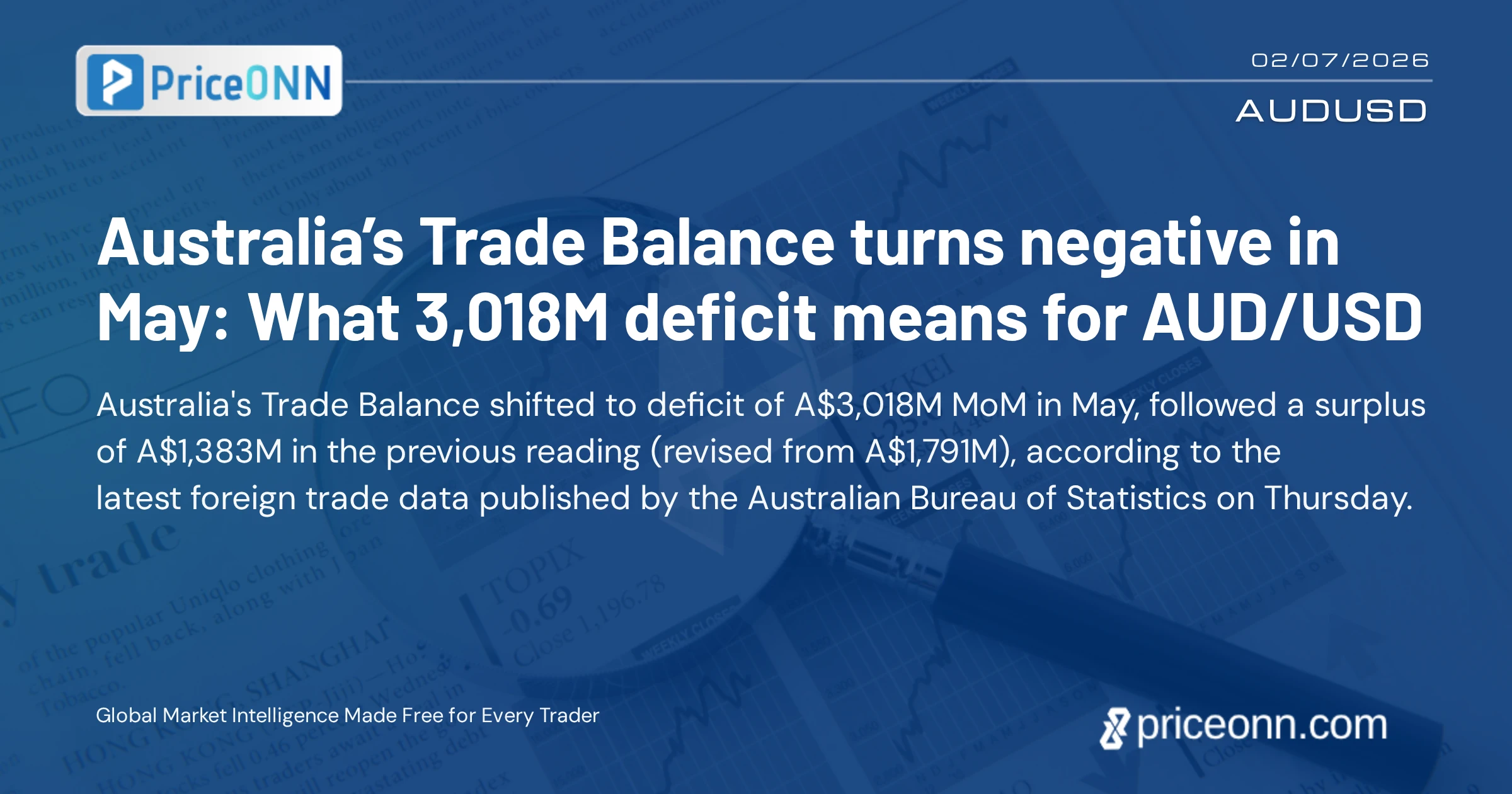
Australia’s Trade Balance turns negative in May: What 3,018M deficit means for AUD/USD
 PriceONN Editorial Desk
Multi-source verification
PriceONN Editorial Desk
Multi-source verification
May's Trade Numbers Reveal Unexpected Deficit
The economic landscape of Australia has taken a notable turn as official figures from the Australian Bureau of Statistics reveal a stark swing in the nation's trade balance. For May, the country registered a deficit of A$3,018 million, a dramatic reversal from the A$1,383 million surplus recorded in the preceding month. This unexpected deficit signals a potential shift in the dynamics of international trade for the resource-rich continent.
This foreign trade data, released on Thursday, provides a crucial snapshot of the country's economic health. The trade balance, fundamentally the difference between the value of goods Australia exports and the value of goods it imports, offers vital clues about economic momentum. Robust export performance typically fuels national growth, while a healthy level of imports can indicate strong domestic demand. A consistent surplus has historically been a tailwind for the Australian Dollar.
Factors Influencing the Aussie Dollar
Several key elements shape the trajectory of the AUD. At the forefront is the monetary policy stance of the Reserve Bank of Australia (RBA). Interest rate decisions by the RBA directly influence borrowing costs and economic activity, impacting the currency's attractiveness to global investors. When Australian rates are comparatively high against those of other major economies, the AUD tends to find support; conversely, lower rates can exert downward pressure.
Furthermore, Australia's position as a major supplier of raw materials places significant emphasis on commodity prices. The value of Iron Ore, a cornerstone of Australia's export revenue, has a particularly pronounced effect. Data from 2021 indicates that Iron Ore exports alone generated $118 billion, with China being the primary destination. Consequently, fluctuations in Iron Ore prices often correlate with movements in the AUD. An upward trend in Iron Ore prices generally boosts the currency, and this is often accompanied by an improved trade balance.
The economic vitality of China, Australia's largest trading partner, also plays a critical role. A thriving Chinese economy translates to increased demand for Australian commodities, goods, and services, thereby bolstering the AUD. Conversely, any slowdown in China's growth can dampen demand for Australian exports and negatively impact the currency's value. Surprises in Chinese economic data therefore frequently create ripples in the AUD market.
Market sentiment, categorized as risk-on (investor appetite for riskier assets) or risk-off (a move towards safer investments), is another layer of influence. Generally, a risk-on environment is favorable for the AUD, reflecting increased global optimism and demand for growth-oriented economies.
Reading Between the Lines
The transition to a trade deficit in May is more than just a headline number. It suggests a potential weakening in export revenues or a strengthening of import demand, or a combination of both. For traders watching the AUD/USD pair, this development warrants close attention. Historically, a consistent trade surplus has been a supportive factor for the Australian Dollar, indicating strong foreign demand for its products. The emergence of a deficit, therefore, could signal headwinds for the currency.
Specifically, market participants will be dissecting the components of this deficit. Was it driven by lower commodity prices, reduced export volumes, or a surge in import spending? The former points to external pressures, potentially linked to global demand or commodity market dynamics, while the latter could suggest strong domestic consumption but at a cost to the net trade position. The health of global manufacturing, often a proxy for commodity demand, and inflation figures within Australia itself will be key indicators to monitor.
The Reserve Bank of Australia's response to evolving economic conditions, including inflation targets of 2-3%, will also be critical. Any indication that this trade deficit might impact inflation or growth could influence RBA's future policy decisions, potentially affecting interest rate differentials and, consequently, the AUD.
Track markets in real-time
Empower your investment decisions with AI-powered analysis, technical indicators and real-time price data.
Join Our Telegram Channel
Get breaking market news, AI analysis and trading signals delivered instantly to your Telegram.
Join Channel PriceONN News
The short‑term Elliott Wave outlook in Gold (XAUUSD) indicates that the rally to $4204 marked the completion of wave ((B)), after which the metal turned lower in wave ((C)). The internal subdivision of wave ((C)) is unfolding as a five‑wave structure. Within this sequence, wave (1) ended at $3983.2. The subsequent rally in wave (2) […] The post Elliott Wave Outlook: Gold (Xauusd) Rally Rejected, Downside Potential Remains appeared first on ActionForex.
PriceONN News
Another month of recovery is in the cards for Canada’s economy next Friday where we expect to see a 0.2% increase in GDP data for May (more details below), but the outlook is once again clouded by the latest bout of U.S. tariff threats that suggest the path ahead could be bumpier. Just how bumpy […] The post Six Takeaways for Canada from Latest U.S. Tariff Threats; GDP Likely Rose Again in May appeared first on ActionForex.
PriceONN News
US business activity accelerated at the start of the third quarter, with S&P Global’s Flash Composite PMI Output Index rising from 51.9 to 53.6 in July, its highest level in eight months. The improvement was driven by the services sector, where the Business Activity Index climbed from 51.2 to 53.6, also an eight-month high. Manufacturing, […] The post US PMI Hits Eight-Month High,Yet Rising Costs and Supply Delays Raise Caution appeared first on ActionForex.
PriceONN News
The Brent crude rally is a bigger ‘bearish’ factor for EURUSD than the ECB. The Fed may spring a surprise as early as July. The US dollar paid no heed to the ECB’s hawkish rhetoric and continued its advance against major global currencies, including the euro. The European Central Bank left its deposit rate at […] The post Dollar: Oil Leaves the Fed with No Choice appeared first on ActionForex.
PriceONN News
USD/JPY soared to 163.81 on Friday, marking a new 40-year high. Repeated warnings of possible currency intervention have so far failed to halt the yen’s decline amid a broad strengthening of the US dollar. The market paid little attention to the Japanese Finance Minister’s statement that authorities are ready to take decisive action. Reports that […] The post USD/JPY Breaks Records: Nothing Slows the Yen’s Decline appeared first on ActionForex.
PriceONN News
UK retail sales volumes jumped 1.0% mom in June, far exceeding expectations for a -0.3% mom decline, following an unrevised 1.2% mom increase in May. The stronger-than-expected performance points to resilient consumer demand despite elevated borrowing costs and persistent cost-of-living pressures. Retailers credited sales promotions and warm weather for boosting spending, particularly at online and […] The post UK Retail Sales Surge 1.0% mom as Online Spending Leads Broad-Based June Rebound...
PriceONN News
Germany’s GfK Consumer Climate edged down from -29.3 to -29.6 for August, highlighting that household confidence remains deeply depressed despite modest improvement in some underlying indicators. The slight deterioration was driven by weaker income expectations and a renewed rise in precautionary saving, offsetting gains in willingness to buy and economic expectations. Income expectations fell from […] The post Germany’s GfK Consumer Climate Slips to -29.6 as Income Outlook Weakens and Saving...
PriceONN News
TL;DR: Gold and Silver tumbled as markets returned to the oil-rates relationship that governed Q2, with Brent above $100 and 10-year Treasury yields above 4.7% restoring pressure on the metals - leaving their next move hostage to Trump’s binary decision on Iran. Why This Matters Gold and Silver tumbled as markets returned to trading precious […] The post Gold and Silver Tumble as Oil Link Returns; Trump’s Looming Decision on Iran Adds Binary Risk appeared first on ActionForex.
PriceONN News
Japan’s core consumer inflation accelerated in June, with the CPI excluding fresh food rising from 1.4% yoy to 1.6% yoy, matched expectations. Headline inflation also picked up from 1.5% yoy to 1.7% yoy. The figures point to firmer price pressures ahead of next week’s Bank of Japan policy meeting, though both measures remained below the […] The post Japan Core CPI Picks Up to 1.6% in June, but Underlying Inflation Remains Contained appeared first on ActionForex.
PriceONN News
Australia’s private sector gained momentum in July, with the S&P Global Flash Composite PMI rising from 50.4 to 52.6, its highest reading since the start of the year. The improvement was driven primarily by the services sector, where the Services PMI Business Activity Index climbed from 50.5 to 53.0, while Manufacturing PMI edged up from […] The post Australia PMI Composite Hits 2026 High at 52.6 as Domestic Demand Rebounds appeared first on ActionForex.
PriceONN News
Key insights from the week that was. The June Labour Force Survey offered both noise and signal. Employment surprised materially to the upside, rising 76.3k in the month. However, the gain was matched by a sizeable lift in labour supply, the participation rate bouncing 0.3ppts to 67.0%, a 13-month high. The ABS noted in the […] The post Cliff Notes: Markets on Edge appeared first on ActionForex.
PriceONN News
The ECB kept policy rates unchanged at the July meeting, with the deposit rate at 2.25%, in line with consensus and market pricing. Lagarde kept full optionality on the future policy rate path, without pre-committing. There was no market reaction to the meeting. We expect a final 25bp hike in September, bringing the deposit rate […] The post ECB Review – Back to the Baseline appeared first on ActionForex.