
Australian Dollar steadies following Chinese CPI data
 PriceONN Editorial Desk
Multi-source verification
PriceONN Editorial Desk
Multi-source verification

Market Pulse: Australian Dollar Finds Footing
The Australian Dollar experienced a modest recovery in Thursday's Asian trading, nudging towards the 0.6930 level against the US Dollar. This movement followed a period of stagnation and came as traders digested fresh inflation data from China, the nation's primary economic engine and key trading partner.
While the immediate price action shows a slight gain for the AUD, the underlying drivers that influence its value remain a complex interplay of global and domestic forces. Understanding these dynamics is critical for any market participant tracking this commodity-linked currency.
Unpacking the Aussie Dollar's Core Influences
At its heart, the AUD's trajectory is significantly shaped by monetary policy decisions from the Reserve Bank of Australia (RBA). The central bank's benchmark interest rate, which dictates interbank lending costs, has a ripple effect throughout the Australian economy. The RBA's primary mandate is to maintain price stability, targeting an inflation rate between 2% and 3%. When the RBA's policy rate is perceived as relatively high compared to those of other major economies, it typically bolsters the Australian Dollar. Conversely, a lower interest rate environment tends to weaken it.
Beyond domestic interest rates, Australia's status as a resource-rich nation places immense importance on global commodity prices, particularly Iron Ore. This vital export, with China being the principal buyer, generated approximately $118 billion in revenue in 2021. Fluctuations in Iron Ore prices directly impact the demand for the Australian Dollar; a rise in ore prices generally correlates with an appreciation of the AUD, as increased export earnings boost the currency's aggregate demand. Conversely, falling ore prices often drag the AUD lower.
The economic vitality of China, Australia’s largest trading partner, is another cornerstone influence. Robust Chinese economic activity translates into greater demand for Australian raw materials, goods, and services, thereby lifting the AUD. Any signs of economic deceleration in China, however, can dampen demand for Australian exports and consequently exert downward pressure on the currency. Surprises in Chinese growth statistics, whether positive or negative, frequently translate into immediate market reactions for the Australian Dollar and its associated currency pairs.
Furthermore, Australia's Trade Balance – the net difference between its export earnings and import expenditures – plays a crucial role. A healthy surplus, where export revenue outstrips import costs, signifies strong international demand for Australian products. This scenario inherently strengthens the AUD as foreign entities require more of the currency to purchase these sought-after exports. A negative trade balance, indicating a deficit, typically exerts downward pressure on the currency.
Finally, broader market sentiment, often categorized as 'risk-on' (investor appetite for riskier assets) or 'risk-off' (a flight to safety), also affects the AUD. Periods of elevated risk appetite generally favor the Australian Dollar, while risk-off environments tend to see it underperform as investors retreat to perceived safe-haven assets.
Reading Between the Lines
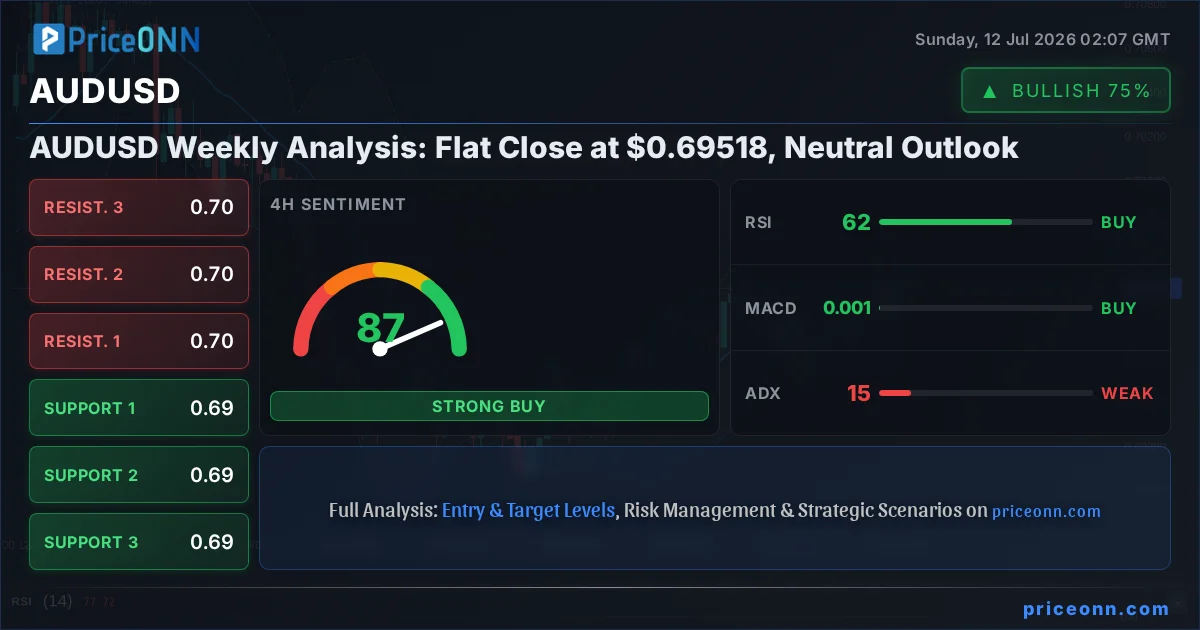
Today's modest upward movement in the AUD/USD pair, trading around the 0.6930 mark, appears to be a cautious response to China's latest inflation figures. While the data itself might not have been a dramatic shock, it provided enough stability to allow the Australian Dollar to reclaim some ground after a flat preceding session. The ongoing narrative for the AUD remains heavily tethered to the RBA's interest rate path, commodity price action, and the economic pulse of its largest customer, China.
Traders will be closely watching how these factors evolve. For instance, any unexpected shifts in the RBA's forward guidance regarding interest rates could quickly alter the AUD's short-term prospects. Similarly, significant movements in Iron Ore prices or any further economic data from China that deviates from expectations will likely trigger noticeable price reactions.
The interplay between these elements creates opportunities and risks. A strengthening commodity price environment coupled with a stable or dovish RBA stance could present a bullish case for the AUD. Conversely, signs of a Chinese economic slowdown combined with a hawkish RBA policy could lead to increased volatility and potential downside for the currency.
Market participants are also attuned to the broader global economic backdrop. If global growth concerns intensify, leading to a widespread 'risk-off' sentiment, the Australian Dollar, despite its commodity backing, could face headwinds as investors seek safer havens. This highlights the need for a holistic view, considering not just the direct drivers but also the prevailing global market mood.
Track markets in real-time
Empower your investment decisions with AI-powered analysis, technical indicators and real-time price data.
Join Our Telegram Channel
Get breaking market news, AI analysis and trading signals delivered instantly to your Telegram.
Join Channel PriceONN News
The Brent crude rally is a bigger ‘bearish’ factor for EURUSD than the ECB. The Fed may spring a surprise as early as July. The US dollar paid no heed to the ECB’s hawkish rhetoric and continued its advance against major global currencies, including the euro. The European Central Bank left its deposit rate at […] The post Dollar: Oil Leaves the Fed with No Choice appeared first on ActionForex.
PriceONN News
USD/JPY soared to 163.81 on Friday, marking a new 40-year high. Repeated warnings of possible currency intervention have so far failed to halt the yen’s decline amid a broad strengthening of the US dollar. The market paid little attention to the Japanese Finance Minister’s statement that authorities are ready to take decisive action. Reports that […] The post USD/JPY Breaks Records: Nothing Slows the Yen’s Decline appeared first on ActionForex.
PriceONN News
The short‑term Elliott Wave outlook in Gold (XAUUSD) indicates that the rally to $4204 marked the completion of wave ((B)), after which the metal turned lower in wave ((C)). The internal subdivision of wave ((C)) is unfolding as a five‑wave structure. Within this sequence, wave (1) ended at $3983.2. The subsequent rally in wave (2) […] The post Elliott Wave Outlook: Gold (Xauusd) Rally Rejected, Downside Potential Remains appeared first on ActionForex.
PriceONN News
EUR/USD rose to 1.1429 on Thursday, with the US dollar continuing its moderate decline from the previous session. The market is assessing rising inflation risks driven by elevated energy prices against a backdrop of weakening economic data, while seeking further signals on Federal Reserve policy. At next week’s meeting, the regulator is expected to keep […] The post EUR/USD Recovers as Dollar Weakens appeared first on ActionForex.
PriceONN News
EUR/CHF may already be telling investors what to expect from today’s European Central Bank meeting. The cross broke decisively above 0.9278 this week, extending its recent rally as surging oil prices revived inflation concerns across Europe. The move suggests markets have begun positioning for a relatively more hawkish ECB even though policymakers are almost universally […] The post EUR/CHF Rally Points to Hawkish ECB Hold as Oil Reignites Inflation Risks appeared first on ActionForex.
PriceONN News
Another month of recovery is in the cards for Canada’s economy next Friday where we expect to see a 0.2% increase in GDP data for May (more details below), but the outlook is once again clouded by the latest bout of U.S. tariff threats that suggest the path ahead could be bumpier. Just how bumpy […] The post Six Takeaways for Canada from Latest U.S. Tariff Threats; GDP Likely Rose Again in May appeared first on ActionForex.
PriceONN News
US business activity accelerated at the start of the third quarter, with S&P Global’s Flash Composite PMI Output Index rising from 51.9 to 53.6 in July, its highest level in eight months. The improvement was driven by the services sector, where the Business Activity Index climbed from 51.2 to 53.6, also an eight-month high. Manufacturing, […] The post US PMI Hits Eight-Month High,Yet Rising Costs and Supply Delays Raise Caution appeared first on ActionForex.
PriceONN News
UK retail sales volumes jumped 1.0% mom in June, far exceeding expectations for a -0.3% mom decline, following an unrevised 1.2% mom increase in May. The stronger-than-expected performance points to resilient consumer demand despite elevated borrowing costs and persistent cost-of-living pressures. Retailers credited sales promotions and warm weather for boosting spending, particularly at online and […] The post UK Retail Sales Surge 1.0% mom as Online Spending Leads Broad-Based June Rebound...
PriceONN News
Germany’s GfK Consumer Climate edged down from -29.3 to -29.6 for August, highlighting that household confidence remains deeply depressed despite modest improvement in some underlying indicators. The slight deterioration was driven by weaker income expectations and a renewed rise in precautionary saving, offsetting gains in willingness to buy and economic expectations. Income expectations fell from […] The post Germany’s GfK Consumer Climate Slips to -29.6 as Income Outlook Weakens and Saving...
PriceONN News
TL;DR: Gold and Silver tumbled as markets returned to the oil-rates relationship that governed Q2, with Brent above $100 and 10-year Treasury yields above 4.7% restoring pressure on the metals - leaving their next move hostage to Trump’s binary decision on Iran. Why This Matters Gold and Silver tumbled as markets returned to trading precious […] The post Gold and Silver Tumble as Oil Link Returns; Trump’s Looming Decision on Iran Adds Binary Risk appeared first on ActionForex.
PriceONN News
Japan’s core consumer inflation accelerated in June, with the CPI excluding fresh food rising from 1.4% yoy to 1.6% yoy, matched expectations. Headline inflation also picked up from 1.5% yoy to 1.7% yoy. The figures point to firmer price pressures ahead of next week’s Bank of Japan policy meeting, though both measures remained below the […] The post Japan Core CPI Picks Up to 1.6% in June, but Underlying Inflation Remains Contained appeared first on ActionForex.
PriceONN News
Australia’s private sector gained momentum in July, with the S&P Global Flash Composite PMI rising from 50.4 to 52.6, its highest reading since the start of the year. The improvement was driven primarily by the services sector, where the Services PMI Business Activity Index climbed from 50.5 to 53.0, while Manufacturing PMI edged up from […] The post Australia PMI Composite Hits 2026 High at 52.6 as Domestic Demand Rebounds appeared first on ActionForex.