Australian Dollar weakens as Australian Unemployment Rate rises, PBOC holds rates steady
Unemployment Figures Cast Shadow Over Aussie Dollar
The Australian Dollar (AUD) found itself on the defensive during early Asian trading Friday, dipping near the 0.7080 mark against the US Dollar (USD). This downturn followed the release of key employment data revealing an uptick in Australia's jobless rate for February. The surprise increase suggests potential cooling in the domestic labor market, a development that often weighs on currency valuations.
Several pillars underpin the value of the Australian Dollar. Chief among these is the monetary policy stance of the Reserve Bank of Australia (RBA), particularly its benchmark interest rates. Given Australia's significant role as a global resource provider, the price fluctuations of its primary export, iron ore, also exert considerable influence. Furthermore, the economic vitality of its largest trading partner, China, alongside domestic inflation trends, economic growth trajectories, and the nation's trade balance, are critical determinants of AUD's strength.
Market sentiment plays a crucial, albeit sometimes volatile, role. A prevailing 'risk-on' environment, where investors embrace riskier assets, typically bolsters the AUD. Conversely, a 'risk-off' mood, characterized by a flight to safety, tends to diminish its appeal. The RBA orchestrates its influence through interest rate adjustments, impacting interbank lending rates and, by extension, the broader economy. Its primary mandate is to keep inflation within the 2% to 3% target band. Consequently, interest rates that are relatively high compared to those offered by other major central banks tend to support the AUD, while lower rates have the opposite effect. The RBA also possesses tools like quantitative easing and tightening, which can influence credit conditions, with easing generally being AUD-negative and tightening AUD-positive.
China's Economic Pulse and Commodity Prices
The intricate relationship between Australia and China, its foremost trading partner, cannot be overstated. A robust Chinese economy translates into heightened demand for Australian goods and services, particularly raw materials, which directly lifts the AUD. When China's growth falters or decelerates unexpectedly, this demand slackens, often leading to a depreciation of the Australian currency. Consequently, any significant deviations from expected growth figures in China frequently trigger immediate reactions in the AUD and its associated currency pairs.
Iron ore stands as Australia's single largest export commodity, generating an estimated $118 billion annually as of 2021, with China being the principal buyer. The ebb and flow of iron ore prices, therefore, act as a significant catalyst for the Australian Dollar. A general upward trend in iron ore prices typically correlates with an appreciation of the AUD, driven by increased aggregate demand for the currency. The inverse holds true when iron ore prices decline. Moreover, elevated iron ore prices often correlate with an improved Trade Balance for Australia, providing another tailwind for the AUD.
The Trade Balance itself, representing the disparity between a nation's export earnings and its import expenditures, is a fundamental economic indicator affecting the AUD. When Australia successfully exports high-demand commodities and goods, its currency can appreciate simply due to the surplus demand from foreign entities seeking to acquire these exports over what Australia spends on imports. A positive net Trade Balance thus acts as a strengthening force for the AUD, whereas a negative balance exerts downward pressure.
Why This Matters Now
The recent uptick in Australia's unemployment rate, coupled with the People's Bank of China's (PBOC) decision to maintain its benchmark lending rates steady, creates a complex crosscurrent for the AUD/USD pair. The unexpected rise in joblessness suggests that inflationary pressures might be easing more rapidly than anticipated in Australia, potentially giving the RBA room to pause or even consider rate cuts sooner than markets have priced in. This divergence in potential monetary policy paths, with the US Federal Reserve still signaling a data dependent approach that could lean towards higher rates for longer, puts the AUD under renewed pressure.
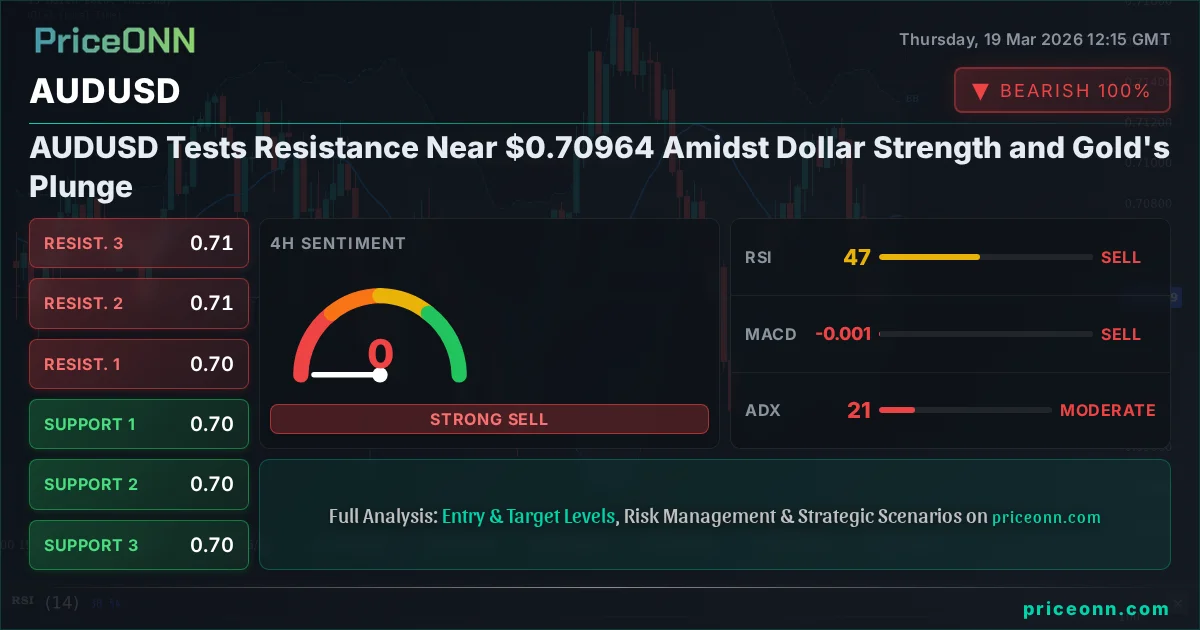
Traders will be closely monitoring upcoming RBA commentary for any hints about future policy direction. Key levels to watch for AUD/USD include immediate resistance around the 0.7100 psychological mark, with a break above potentially signaling a short-term relief rally. Conversely, a sustained move below the 0.7050 support level could accelerate further downside momentum, targeting the 0.7000 handle. The broader market sentiment and the trajectory of iron ore prices will also be critical factors influencing the pair's direction in the coming sessions. The stability in Chinese rates, while not providing immediate stimulus, at least removes one layer of uncertainty for commodity demand.
Track markets in real-time
Empower your investment decisions with AI-powered analysis, technical indicators and real-time price data.
Join Our Telegram Channel
Get breaking market news, AI analysis and trading signals delivered instantly to your Telegram.
Join Channel