
Bitcoin's Next Move: Navigating Regulatory Headwinds and Institutional Currents

Bitcoin prices saw significant movement this week, a clear signal of the cryptocurrency market's sensitivity to evolving regulatory landscapes and persistent institutional interest. While regulatory uncertainty, particularly concerning stablecoins, caused jitters, underlying institutional momentum continues to build, creating a complex environment for traders.
Market Context
The cryptocurrency market has been under scrutiny, with recent events highlighting the delicate balance between innovation and regulation. Shares of Circle, a prominent stablecoin issuer, experienced a sharp decline of approximately 20% earlier this week. This sell-off was reportedly triggered by news of a draft legislative proposal, the CLARITY Act, which could potentially restrict yields on stablecoin holdings. However, market data shows that analysts at Bernstein believe this reaction may be overstated, differentiating between the entities that earn yield and those that distribute it. Their analysis suggests the legislation primarily targets platforms passing yield to users, while Circle's core revenue stems from its reserves backing USDC. This distinction is crucial, as the proposed rules appear to permit incentive structures tied to user activity, such as trading, without fundamentally disrupting issuer economics.
Analysis & Drivers
The primary driver behind the recent market volatility appears to be regulatory apprehension. The CLARITY Act draft, if enacted, could reshape how stablecoins function and how users interact with them, creating uncertainty that ripples through the broader crypto market, including Bitcoin. Despite these headwinds, there are counter-trends indicating strong institutional engagement. Reports from Canada suggest that traditional financial institutions are actively preparing for stablecoin integration, signaling a growing acceptance and strategic positioning within the established financial system. This dual narrative-regulatory caution on one side and institutional adoption on the other-creates a dynamic that traders must carefully monitor. Furthermore, the evolving role of AI agents in reshaping micropayment economics and the increasing regulatory focus on prediction markets also contribute to the complex tapestry of factors influencing digital asset prices.
Trader Implications
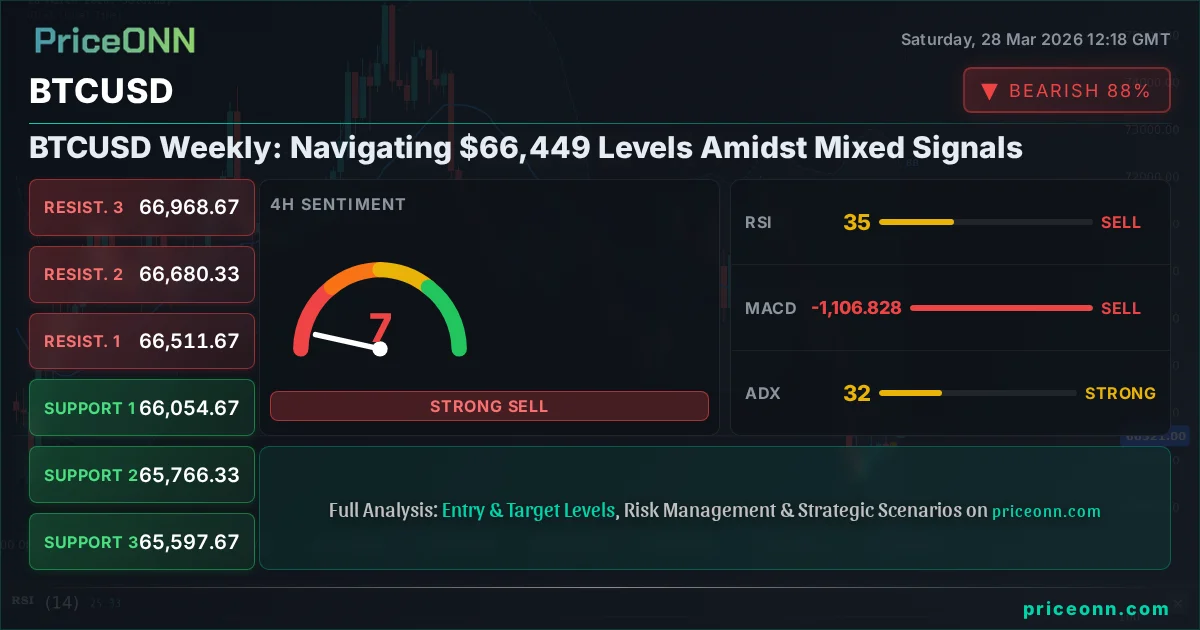
For traders, the current environment demands a nuanced approach. Key price levels to watch for Bitcoin include the $65,000 support zone, which has shown resilience, and the $70,000 resistance level that has been tested multiple times. A decisive break above the latter could signal renewed bullish momentum, while a fall below the former might indicate a deeper correction. The market sentiment remains cautious, with any further negative regulatory news likely to exert downward pressure. Conversely, positive developments regarding stablecoin clarity or significant institutional inflows could catalyze a strong upward move. Traders should prioritize risk management, utilizing stop-loss orders and considering position sizing carefully amidst this uncertainty. Monitoring on-chain data for signs of accumulation by large holders could provide further clues about institutional sentiment.
The path forward for Bitcoin and the broader cryptocurrency market hinges on the resolution of regulatory ambiguities and the sustained commitment of institutional players. Upcoming legislative sessions and any official statements from regulatory bodies will be critical in shaping market direction. While short-term fluctuations are expected, the long-term trend may continue to be influenced by the growing integration of digital assets into mainstream finance and the ongoing technological advancements within the crypto space.
Frequently Asked Questions
What is the immediate impact of the CLARITY Act on Bitcoin?
The CLARITY Act primarily targets stablecoin yield distribution, not Bitcoin directly. However, increased regulatory scrutiny on stablecoins can create broader market uncertainty, potentially leading to short-term price dips for Bitcoin as investors become more risk-averse. Market data suggests Bitcoin's correlation with stablecoin stability is indirect but present.
What are the key price levels for Bitcoin traders to monitor?
Traders should closely watch the $65,000 level as a critical support zone. A breach below this could trigger further selling pressure. On the upside, the $70,000 mark represents a significant resistance. A sustained move above $70,000 could signal a resumption of the bullish trend.
What is the outlook for institutional adoption of cryptocurrencies?
Despite regulatory challenges, institutional adoption appears to be on a steady upward trajectory. Reports indicate traditional finance firms are preparing for stablecoin integration, suggesting a long-term commitment to the digital asset space. This institutional momentum is seen as a key supportive factor for cryptocurrency prices.
Track markets in real-time
Empower your investment decisions with AI-powered analysis, technical indicators and real-time price data.
Join Our Telegram Channel
Get breaking market news, AI analysis and trading signals delivered instantly to your Telegram.
Join Channel

PriceONN