
Is Bitcoin Set for a Deeper Correction as Global Risk Aversion Mounts?

The cryptocurrency market is facing a challenging period as global risk aversion intensifies, pulling down assets that had previously shown resilience. What appeared to be a potential decoupling from traditional market anxieties has quickly reversed, highlighting the interconnectedness of financial markets, particularly during times of heightened uncertainty.
Market Context
A pervasive bearish sentiment has gripped global financial markets, driven by persistent inflationary concerns and the resulting strengthening of the US Dollar. This environment is proving difficult for most risk assets, and cryptocurrencies are no exception. Even assets typically considered safe havens have experienced pressure, underscoring the broad-based nature of the current downturn.
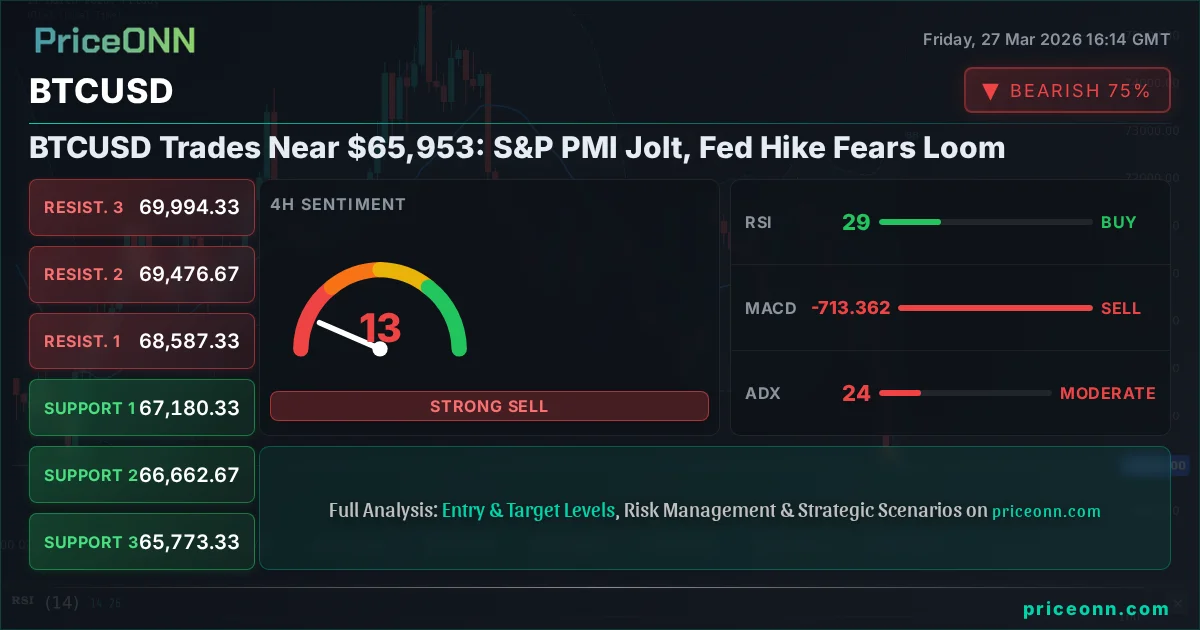
Bitcoin, after reaching a recent milestone with the issuance of the 20 millionth BTC, attempted to push past the significant psychological level of $75,000. However, this upward momentum proved unsustainable, failing to hold and subsequently dragging the broader digital asset market lower. This price action illustrates the market's sensitivity to prevailing risk sentiment, where even positive supply-side events can be overshadowed by macroeconomic headwinds.
Analysis & Drivers
The primary driver behind the current market pressure appears to be a global shift towards risk-off sentiment. This is largely fueled by ongoing inflationary concerns, which have led central banks to maintain a hawkish stance or signal a slower path to rate cuts. The strengthening US Dollar is a significant factor, as it typically correlates with a decline in the value of other risk assets, including digital currencies.
Adding to the complexity are rising energy prices, which are placing additional strain on the global economy. This dynamic makes it challenging to find effective hedges against broader market declines, and cryptocurrencies, despite their perceived diversification benefits, are proving to be highly sensitive to this risk aversion. Industry reports indicate that higher-beta assets, those with greater volatility, are being disproportionately affected, with some altcoins experiencing declines of as much as 2% in recent trading sessions. This suggests that while Bitcoin and Ethereum are the market leaders, their ability to resist the broader sell-off is limited in the current climate.
Trader Implications
Traders should be cautious of the prevailing risk-off environment. The recent failure of Bitcoin to hold above $75,000 suggests that immediate upside potential may be capped, and downside risk has increased. Key support levels for Bitcoin will be critical to monitor; a decisive break below $65,000 could signal further capitulation.
For altcoins, the situation is even more precarious. The observed 2% declines indicate a lack of independent buying interest, with most altcoin price action being derivative of Bitcoin's movements and overall market sentiment. Traders looking for opportunities might consider focusing on assets that demonstrate strong on-chain metrics or utility, as these could prove more resilient. However, the immediate outlook suggests that any short-term bounces may be short-lived "pump-fakes" rather than sustained rallies. Risk management is paramount, with tight stop-losses and a focus on capital preservation being advisable until a clearer bullish trend emerges.
Outlook
The near-term outlook for cryptocurrencies remains subdued, heavily influenced by macroeconomic factors and global risk sentiment. Until there is a significant shift in inflation data, central bank policy, or a de-escalation of geopolitical tensions, digital assets are likely to remain under pressure. Traders will be closely watching the US Dollar index (DXY) and energy price movements for further clues. A sustained period of dollar weakness or a stabilization in energy costs could provide a much-needed catalyst for a crypto recovery, but for now, the path of least resistance appears to be downwards, potentially extending the current sell-off through the upcoming week.
Frequently Asked Questions
What is the current support level for Bitcoin after its recent price action?
Following its failure to hold above $75,000, traders are watching the $65,000 level closely. A break below this key support could indicate further downside momentum for Bitcoin.
Why are altcoins experiencing significant drops?
Altcoins are highly sensitive to overall market sentiment and Bitcoin's price action. Declines of up to 2% are occurring because the prevailing risk-off environment and US Dollar strength are reducing investor appetite for higher-risk, volatile assets.
What factors could lead to a cryptocurrency market recovery?
A recovery would likely require a shift in macroeconomic conditions, such as sustained US Dollar weakness, a cooling of inflation figures, or a more dovish stance from major central banks. Stabilization in global energy prices would also be a positive catalyst.
Track markets in real-time
Empower your investment decisions with AI-powered analysis, technical indicators and real-time price data.
Join Our Telegram Channel
Get breaking market news, AI analysis and trading signals delivered instantly to your Telegram.
Join Channel

PriceONN