Breaking: Australia’s Unemployment Rate climb to 4.3% in February vs. 4.1% expected
February Jobs Data Shows Economic Softening
The Australian labor market delivered a surprise on Thursday, revealing a higher-than-anticipated unemployment rate for February. Official figures from the Australian Bureau of Statistics (ABS) indicated the jobless rate ticked up to 4.3%, a notable increase from the 4.1% recorded in January. This figure also surpassed the consensus forecast among economists, which had predicted the rate to hold steady at 4.1%.
This uptick suggests a cooling in the domestic job market, a development that could influence future monetary policy decisions by the Reserve Bank of Australia (RBA). While the increase may seem modest, its deviation from expectations warrants close attention from market participants.
Understanding the Drivers of the Australian Dollar
The value of the Australian Dollar (AUD) is a complex interplay of several key economic factors. At the forefront is the monetary policy stance of the Reserve Bank of Australia (RBA). The central bank's decisions on interest rates, aimed at maintaining inflation between 2% and 3%, directly impact the attractiveness of holding AUD.
When the RBA maintains relatively high interest rates compared to other major economies, it generally supports the currency. Conversely, lower rates can put downward pressure on the AUD. Beyond interest rates, the RBA also employs tools like quantitative easing and tightening, which further influence credit conditions and, consequently, the currency's valuation. Historically, easing measures tend to be AUD-negative, while tightening is viewed positively.
Australia's status as a resource-rich nation also means global commodity prices play a critical role. Iron ore, the country's largest export, is a significant driver. When iron ore prices surge, it typically boosts demand for the Australian Dollar, reflecting increased export earnings and potentially a stronger trade balance. The inverse is also true, with falling ore prices often correlating with a weaker AUD.
Furthermore, the economic health of China, Australia's primary trading partner, exerts substantial influence. Robust growth in China translates to higher demand for Australian goods and services, providing a tailwind for the AUD. A slowdown in the Chinese economy, however, can dampen this demand and weigh on the currency. Surprises in Chinese economic data, whether positive or negative, frequently create ripples across AUD currency pairs.
The nation's Trade Balance, the difference between export earnings and import costs, is another crucial determinant. A healthy surplus, driven by strong export performance, bolsters the AUD. A persistent deficit can signal underlying economic weaknesses and exert downward pressure on the currency.
Market Ripple Effects
The unexpected rise in Australia's unemployment rate to 4.3% injects a dose of caution into the market's outlook for the Australian economy. This data point could signal that the RBA's previous rate hikes are having a more pronounced effect on the labor market than anticipated.
For traders, this development presents several key considerations. Firstly, it might temper expectations for immediate interest rate cuts by the RBA, but more significantly, it could increase the probability of future rate cuts if the trend continues. This scenario would likely weaken the Australian Dollar against its major counterparts, particularly those with more hawkish central banks.
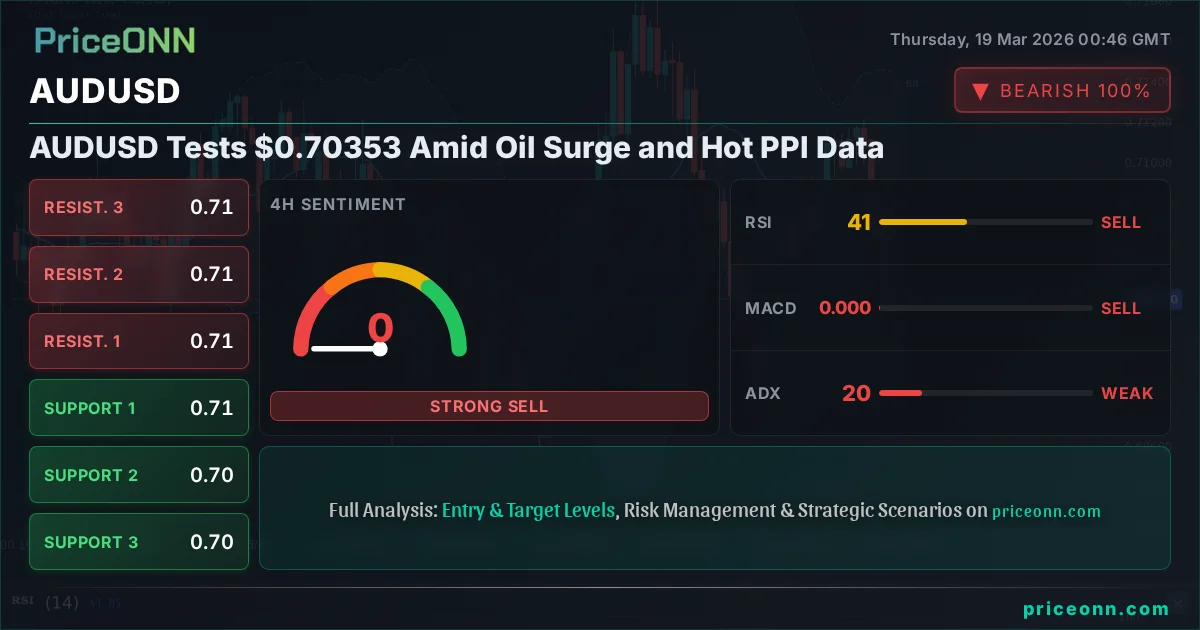
The immediate impact could be seen in the AUD/USD and AUD/JPY currency pairs. A weaker AUD would suggest potential downside for these crosses. Additionally, investors might re-evaluate their exposure to Australian equities, particularly sectors sensitive to domestic demand. The outlook for iron ore prices also becomes more critical; if demand falters alongside domestic employment, it could compound downward pressure on the AUD.
Traders should monitor upcoming RBA statements and inflation data closely for further clues on the central bank's reaction function. Key levels to watch on the AUD/USD include the recent lows, as a break below could signal a more significant downtrend. The broader market sentiment, whether risk-on or risk-off, will also play a role. A shift towards risk aversion could further exacerbate AUD weakness.
Track markets in real-time
Empower your investment decisions with AI-powered analysis, technical indicators and real-time price data.
Join Our Telegram Channel
Get breaking market news, AI analysis and trading signals delivered instantly to your Telegram.
Join Channel