
Brent Crude Eyes $120 as Supply Shock Grips Global Markets

Brent crude is trading above $100 per barrel, fueled by escalating tensions in the Middle East and fears of a major supply disruption. The ongoing conflict has prompted investment banks to revise their oil price forecasts sharply upwards, with some analysts suggesting a potential surge to $150 per barrel if the Strait of Hormuz remains blocked.
Market Context
The energy market is grappling with what the International Energy Agency (IEA) describes as the "largest disruption" in its history. The Middle East war has crippled supply from a crucial oil-producing region, triggering widespread concerns about availability and pricing. On Thursday, Brent Crude once again surpassed the $100 mark, driven by news of attacks on oil tankers and increasingly aggressive rhetoric from Iran. WTI Crude is also feeling the upward pressure trading above $95 a barrel.
The IEA's intervention, involving the release of 400 million barrels from strategic reserves, has had limited impact on prices. This suggests that the market views the current crisis as more than a short-term blip, implying that the supply disruption may be prolonged and severe.
Analysis & Drivers
Several factors are contributing to the current surge in oil prices:
- Geopolitical Risk: The war in the Middle East is the primary driver, threatening to disrupt oil flows through the Strait of Hormuz, a vital chokepoint for global oil supply.
- Supply Disruption: Attacks on oil tankers and infrastructure are directly impacting the availability of crude oil.
- Revised Forecasts: Major investment banks, including Goldman Sachs and UBS, have significantly raised their oil price forecasts, reflecting expectations of continued supply constraints.
- IEA Assessment: The IEA's warning about the "largest disruption" underscores the severity of the situation and the potential for further price increases.
Goldman Sachs now projects Brent Crude to average over $100 per barrel this month. They also anticipate an average of $85 per barrel in April. However, the bank acknowledges that these figures could be conservative if the Strait of Hormuz remains significantly impacted. In such a scenario, Brent Crude could reach $93 per barrel in the fourth quarter, with potential spikes above $100 in the near term.
UBS also anticipates prices exceeding $100 per barrel and potentially entering a demand destruction territory of $120 per barrel if the Strait of Hormuz remains blocked.
Trader Implications
For traders, the current market environment presents both opportunities and risks. Here are some key considerations:
- Monitor Geopolitical Developments: The situation in the Middle East is highly fluid. Traders should closely monitor news and developments that could impact oil supply.
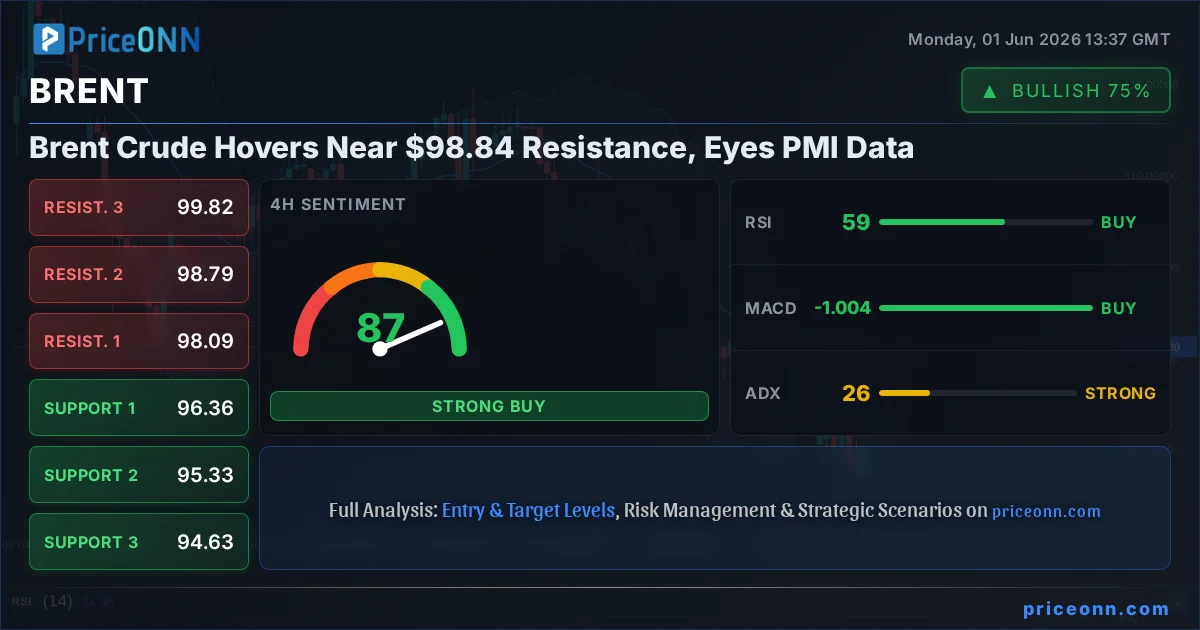
- Watch Key Price Levels: Brent Crude's resistance levels are around $102 and $105. Support lies near $98 and $95.
- Consider Long Positions: Given the upward momentum, traders may consider taking long positions in oil futures or related ETFs. However, risk management is crucial.
- Hedge Against Inflation: Rising oil prices can contribute to inflation. Investors may want to consider hedging their portfolios with energy stocks or commodity-linked assets.
- Be Aware of Volatility: Expect increased volatility in the oil market. Use stop-loss orders to protect against unexpected price swings.
The IEA released 400 million barrels from strategic reserves, but this has done little to slow the price surge, suggesting a deeper problem. A prolonged blockage of the Strait of Hormuz could have severe economic consequences, potentially pushing major economies into recession.
The market's reaction to the IEA's intervention underscores the severity of the situation. The failure of the reserve release to curb rising prices suggests that the market views the current crisis as more than a short-term disruption.
Traders should also pay attention to statements from key figures, such as Iran's new Supreme Leader, who has vowed to continue blocking the Strait of Hormuz. Such statements can significantly impact market sentiment and prices.
The ongoing conflict in the Middle East is affecting oil ports in Oman and the UAE, raising risk levels for tankers operating in the area. This further exacerbates supply concerns and contributes to upward price pressure.
The prospect of a prolonged oil crisis raises concerns about its potential impact on major economies. Analysts have warned that a sustained disruption could tilt economies into recession.
The situation is evolving rapidly, and traders must remain vigilant and adapt their strategies accordingly.
Outlook
The outlook for oil prices remains bullish in the near term. The ongoing conflict in the Middle East, coupled with supply disruptions and rising demand, suggests that prices will continue to climb. Traders should closely monitor geopolitical developments and key price levels to capitalize on potential opportunities. The market's focus will remain on the Strait of Hormuz and any signs of de-escalation. However, until a resolution is reached, the risk of further price spikes remains high.
Track markets in real-time
Empower your investment decisions with AI-powered analysis, technical indicators and real-time price data.
Join Our Telegram Channel
Get breaking market news, AI analysis and trading signals delivered instantly to your Telegram.
Join Channel PriceONN News
Brent crude prices surged towards the mid-$90s amid fears of supply disruptions from Middle East tensions, only to pare gains later as whispers of a potential US-Iran diplomatic understanding emerged.
PriceONN News
Crude oil futures experienced a dramatic reversal, soaring overnight to $92.52 before plummeting nearly 6% to $89 a barrel. This volatility was driven by escalating US-Iran tensions followed by reports of a potential preliminary diplomatic understanding.
PriceONN News
The possibility of Iran developing a nuclear weapon is now higher than it was before the United States and Israel first attacked the country in February, the International Atomic Energy Agency has concluded in a report. The conclusion suggests the war has so far resulted in the opposite of what President Trump set out to do, namely, prevent Iran from developing a nuclear weapon. Bloomberg cited the report, which has restricted access, saying that in it, the IAEA had warned its member states...
PriceONN News
Brazil is undertaking a major biofuels experiment that could be majorly disruptive for the global energy landscape if it proves effective. The South American country is filthy rich in biomass, and is seeking to use ethanol in novel applications – in this case, to power the energy grid. A new ethanol-powered engine designed specifically to provide electricity to the grid was just launched at the Suape II power plant in Pernambuco, in a world first. Brazilian energy company Suape Energia has...
PriceONN News
Iran's oil exports fell to their lowest level in at least six years in May as the U.S. naval blockade continued to choke off crude shipments and leave tens of millions of barrels stranded at sea. According to shipping data from Vortexa, Iran exported just 209,000 barrels per day (bpd) of crude oil and condensate in May, down from 1.34 million bpd in April and nearly 1.9 million bpd in March. Kpler had estimated May exports slightly higher at 260,000 bpd, but still the lowest level since the...
PriceONN News
Crude oil prices experienced a significant drop, with WTI futures falling over 1.8% to $87.25, as optimism grew for a U.S.-Iran deal potentially reopening the Strait of Hormuz.
PriceONN News
(RTTNews) - Crude oil prices have tumbled on Friday as expectations of the U.S. and Iran signing a Memorandum of Understanding run high. The MoU would allow for immediate reopening of the Strait of Hormuz and pave the way for the resumption of oil and energy trade.
PriceONN News
Crude oil futures experienced a dramatic intraday reversal on Thursday, soaring overnight on geopolitical fears only to pull back significantly as reports of a potential diplomatic understanding between the U.S. and Iran emerged.
PriceONN News
Crude oil futures experienced a dramatic intraday reversal, soaring to $92.52 before pulling back significantly on Thursday. The volatile session was driven by shifting geopolitical narratives and U.S. inventory data.
PriceONN News
(RTTNews) - Crude oil futures skyrocketed overnight but have shown a significant pullback over the course of the trading day on Thursday.
PriceONN News
South America has raised its oil exports more than the U.S. has done so far this year as key producers in the region boosted production and shipments to a world scrambling for crude that’s not dependent on the Strait of Hormuz. Over the past five years, South America’s biggest producer and exporter, Brazil, has started production at several new offshore platforms in the Santos pre-salt fields. Guyana has continuously increased overseas shipments as the Exxon-led consortium starts up...
PriceONN News
Africa's biggest refinery is getting bigger. Nigeria's Dangote refinery has started work on a second crude processing unit that will add another 700,000 barrels per day (bpd) of capacity, putting the complex on track to rival the world's largest refining site and giving billionaire owner Aliko Dangote a much larger role in global fuel markets. According to Dangote Petroleum Refinery CEO David Bird, construction is already underway at the Lekki site outside Lagos. The new refinery is expected to...