
Can EUR/USD Break Its Bearish Streak Amidst Geopolitical Tensions?


The EUR/USD currency pair is showing tentative signs of recovery, attempting to claw back ground from recent lows that touched levels not seen since July of the previous year. The pair found support around the 1.1450 mark, halting a sharp four-session pullback that saw it test the 1.1410 region. Despite this minor reprieve, the overall market sentiment remains defensive, with key technical indicators and broader geopolitical concerns suggesting that any upside momentum may be short-lived.
Market Context: A Bounce from Multi-Month Lows
Following a significant decline that pushed EUR/USD towards the 1.1450 seven-and-a-half-month low, the pair is now engaged in a modest recovery effort. This pullback originated from a cluster of converging moving averages and a short-term uptrend line that had previously supported the pair. The recent dip saw the Euro briefly fall below 1.1700 before testing the psychological 1.1500 level, with a low registered at 1.1507. A subsequent technical breach above a descending trend line around 1.1580 offered a glimmer of hope for buyers, surpassing the 38.2% Fibonacci retracement of the recent decline from 1.1826 to 1.1507.
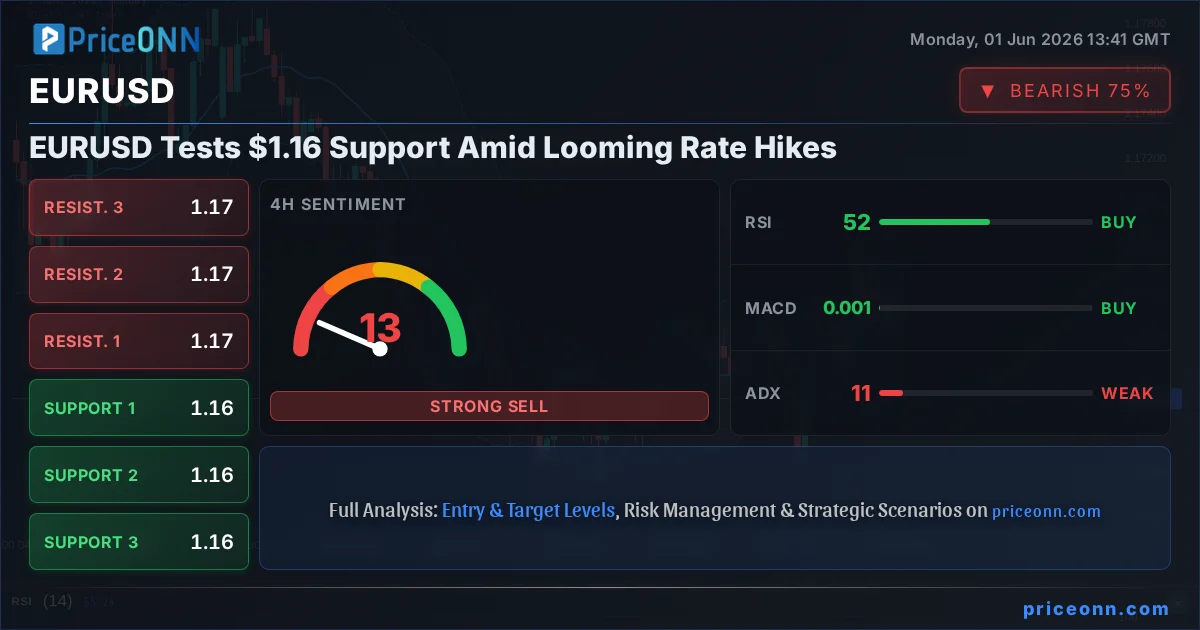
However, the recovery is being met with caution. Both the MACD and RSI indicators are flashing bearish signals, with the MACD deeply entrenched below zero and its signal line, while the RSI hovers near oversold territory. Compounding the bearish technical outlook is a recent 'death cross' formation between the 20-day and 200-day Simple Moving Averages, a pattern historically associated with sustained downward pressure.
Analysis & Drivers: Geopolitics and Central Bank Watch
The recent price action in EUR/USD is heavily influenced by a confluence of factors, chief among them being heightened geopolitical concerns, particularly in the Middle East. These global uncertainties are fostering a risk-averse environment, which typically benefits safe-haven assets and weighs on riskier currencies or those tied to global trade sentiment.
Furthermore, upcoming monetary policy meetings from both the Federal Reserve (Fed) and the European Central Bank (ECB) this week are keeping traders on edge. Market participants are looking for any signals regarding future interest rate trajectories. Any indication of a more hawkish stance from the Fed could further strengthen the US Dollar, while a dovish tone from the ECB might exacerbate weakness in the Euro. The interplay between these central bank expectations and the prevailing geopolitical risks is creating a complex trading environment.
Technically, a contracting triangle pattern is forming on shorter-term charts for USD/JPY, with the upper boundary around 158.30 acting as a critical resistance. Should USD/JPY remain below this level, analysts suggest potential for further declines against the Yen, though the immediate focus for EUR/USD traders remains on its own support and resistance levels.
Trader Implications: Key Levels to Watch
For traders monitoring EUR/USD, the immediate resistance is situated above the March 9 trough of 1.1506. A more significant resistance zone lies at 1.1667, which aligns with the aforementioned SMA death cross and the short-term ascending trendline. Breaking decisively above this level would be required to challenge the bearish bias.
On the downside, support below the recent closing low of 1.1410 is observed at the June 10, 2025 swing low of 1.1370. Further support can be found within the broader band of 1.1310-1.1250, representing the May lows. Given the prevailing bearish technical signals and the uncertain geopolitical backdrop, traders should exercise caution. Any relief rallies are likely to encounter renewed selling interest as long as the pair remains below the short-term uptrend line, keeping the focus on these lower support levels.
Outlook
The modest bounce in EUR/USD is currently overshadowed by persistent bearish technical indicators and significant geopolitical uncertainties. While the pair has momentarily halted its sharp decline, the underlying structure suggests that upside potential is limited in the near term. Traders will be closely watching the upcoming Fed and ECB policy statements for directional cues, but the immediate focus remains on whether EUR/USD can hold above the 1.1400 psychological level or if it will succumb to further selling pressure and retest the multi-month lows.
Frequently Asked Questions
What is the current short-term outlook for EUR/USD?
The short-term outlook for EUR/USD remains cautious, with a modest bounce from 1.1450 currently in play. However, bearish technical signals like the MACD and RSI, along with a recent 'death cross' formation, suggest limited upside potential. Traders are watching the 1.1506 and 1.1667 levels as key resistance zones.
What are the main drivers affecting EUR/USD at the moment?
The primary drivers are heightened geopolitical tensions, particularly in the Middle East, which are fostering risk aversion. Additionally, anticipation of upcoming monetary policy decisions from the US Federal Reserve and the European Central Bank is creating uncertainty and influencing currency movements.
What are the key support levels traders should watch for EUR/USD?
Key support levels to monitor include the recent low near 1.1410, followed by the June 2025 swing low at 1.1370. A more significant support area can be found between 1.1310 and 1.1250, corresponding to the May lows of the previous year.
Track markets in real-time
Empower your investment decisions with AI-powered analysis, technical indicators and real-time price data.
Join Our Telegram Channel
Get breaking market news, AI analysis and trading signals delivered instantly to your Telegram.
Join Channel PriceONN News
EUR/USD stalled below 1.1660 as the US Dollar defied expectations, refusing to weaken despite reports of a US-Iran ceasefire extension. Market participants remain cautious, awaiting concrete confirmation and assessing lingering inflationary pressures.
PriceONN News
EUR/USD closed at 1.1640, showing resilience amid mixed signals. Easing US-Iran tensions initially pressured the dollar, but persistent inflation concerns and political ratification hurdles are keeping the greenback surprisingly steady.
PriceONN News
The EUR/USD faces headwinds as core US PCE inflation unexpectedly rose to 3.3% year-over-year, reinforcing a 'higher for longer' interest rate narrative. Meanwhile, a US-Iran ceasefire extension boosted global risk appetite, potentially drawing capital away from safe-haven currencies.
PriceONN News
EUR/USD stabilized around 1.1640 as reports of a US-Iran ceasefire extension and potential Strait of Hormuz reopening eased inflation fears. However, the US Dollar's resilience suggests lingering caution among forex traders.
PriceONN News
Oil markets have stabilised lower for now and global equity markets have rallied this week on the back of renewed optimism around a deal in the Middle East. On Thursday afternoon, media reports emerged that the US and Iranian negotiators had settled on a Memorandum of Understanding (MOU) that would extend the ceasefire by 60 […] The post Weekly Focus – Optimism Around Iran Deal Lifts Market Sentiment appeared first on ActionForex.
PriceONN News
USDJPY has returned to the area of previous interventions. The ECB is moving towards a rate hike in June. The US dollar retreated on Friday amid new record highs for stock indices and rumours of amendments to the US-Iran agreement. However, tit-for-tat exchanges between the adversaries pushed the dollar index back into the support zone […] The post Yen Braces for a New Storm appeared first on ActionForex.
PriceONN News
Markets are pricing in a potential de-escalation in the US-Iran conflict, leading to a significant drop in crude oil prices and a weakening US Dollar as diplomatic efforts appear to be gaining traction.
PriceONN News
AUD/USD’s late break of 0.7183 resistance suggests that pullback from 0.7277 has already completed at 0.7076, after defending 55 D EMA. Initial bias is back on the upside this week for retesting 0.7277 high first. Firm break there will resume larger up trend. For now, risk will stay on the upside as long as 0.7076 […] The post AUD/USD Weekly Report appeared first on ActionForex.
PriceONN News
The USD/JPY pair is flirting with the 160 level as stalled US-Iran negotiations and hawkish Federal Reserve rhetoric fuel inflation concerns. Traders are closely watching upcoming US Non-Farm Payrolls and Eurozone CPI data.
PriceONN News
The USD/JPY pair is showing signs of upside exhaustion, struggling to overcome the 159.65 resistance level and trading below a key bullish trend line. This technical setup raises concerns about a potential pullback in the near term.
PriceONN News
The US Dollar experienced a notable decline last week as markets priced in a potential diplomatic resolution to the US-Iran conflict, leading to a drop in oil prices and Treasury yields. This shift in sentiment suggests a move away from stagflation fears towards a more stable economic outlook.
PriceONN News
USD/CAD faces pressure as Canada's economy shows signs of stalling, with Q1 GDP contracting 0.1% and domestic demand weakening. This comes as trade negotiations and geopolitical shifts add layers of uncertainty.