
Can the US Dollar Hold its Ground Amidst Middle East Tensions and Fed Uncertainty?
The US Dollar experienced a modest pullback, with the Dollar Index (DXY) easing from 99.87 to approximately 99.58, as geopolitical tensions in the Middle East and the impending Federal Reserve policy announcement cast a shadow over market sentiment. This correction saw EUR/USD climb from 1.1505 to 1.1540, while USD/JPY saw a marginal dip. Meanwhile, oil prices hovered around the $100-$105 per barrel mark, suggesting a potential new short-term equilibrium.
Market Context
Overnight developments in the Middle East have dominated headlines, with reports of Iran launching missile strikes on Tel Aviv following the killing of a key Iranian security chief by Israeli forces. The ongoing conflict has raised concerns about global energy markets, with visibility on a resolution remaining scarce. This uncertainty is a significant factor influencing market dynamics, adding a layer of risk to economic outlooks. In parallel, bond markets showed mixed signals, with US yields fluctuating and German yields declining. Despite these complexities, modest equity gains were observed for a second consecutive day, with the S&P 500 rising 0.25% and the Euro Stoxx 50 up 0.53%.
Analysis and Drivers
The primary drivers for the current market environment are twofold: the escalating geopolitical situation in the Middle East and the anticipated Federal Reserve policy decision later today. The conflict's potential to disrupt energy supply chains is a significant concern, with oil prices potentially acting as a near-term anchor. Analysts are closely watching the Fed, with market data suggesting a high probability that the central bank's guidance may lean more hawkish than previously expected. This stance could be influenced by the potential for higher energy prices to push inflation towards the 3.5%+ area. While markets are pricing in one more rate cut later this year, some economists are calling for two. The Bank of Canada's interim meeting today is also on the radar, with expectations for rates to remain unchanged at 2.25%, though the forward guidance will be key.
Trader Implications
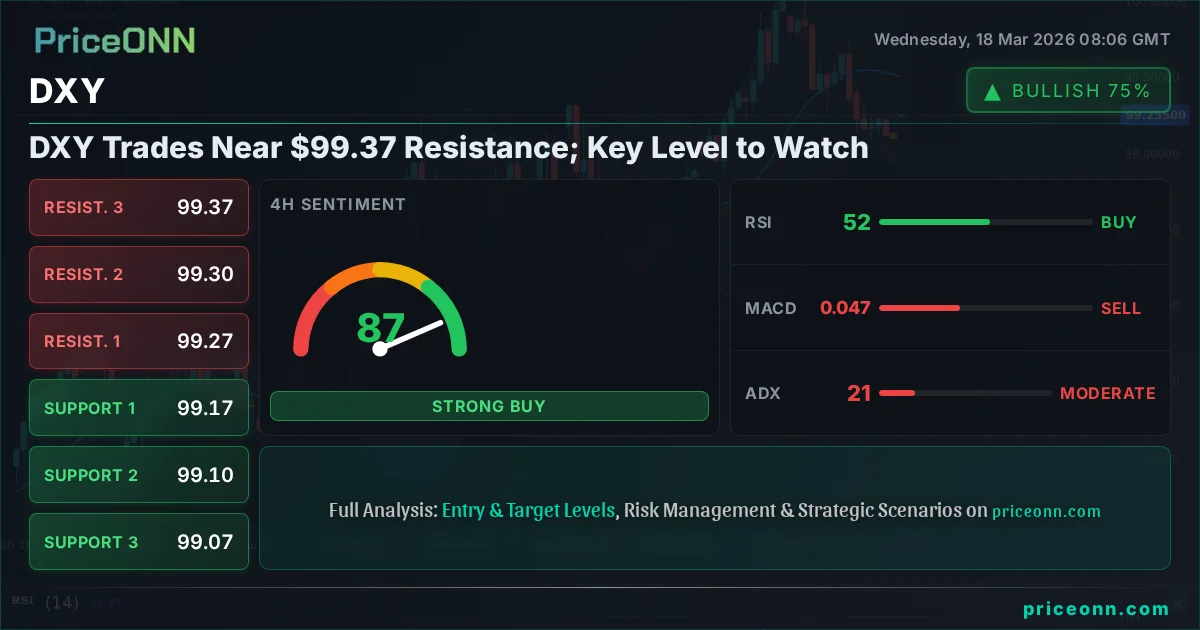
Traders should closely monitor the Federal Reserve's policy statement and Chair Powell's press conference for clues on future monetary policy. Any indication of a more hawkish stance, driven by inflation concerns stemming from energy price shocks, could support the US Dollar. Key levels to watch for the Dollar Index (DXY) include the recent high around 99.87 as potential resistance and the 99.50 area as immediate support. For EUR/USD, the 1.1540 level is a near-term point of interest, with a sustained break above potentially opening doors for further upside. For USD/JPY, levels around 158.75 are being tested. The ongoing Middle East developments remain a critical wildcard, capable of shifting market sentiment rapidly and impacting risk appetite. Traders should remain vigilant for any new escalations or de-escalations in the region.
Outlook
The immediate future for currency markets hinges on the Federal Reserve's policy communication and any significant developments from the Middle East conflict. If the Fed adopts a more cautious or hawkish tone, it could provide renewed strength to the US Dollar, potentially reversing recent gains in pairs like EUR/USD. Conversely, a sudden escalation in the Middle East could trigger a flight to safety, which might also benefit the dollar, although the direct impact on energy prices remains a primary concern. The Bank of Canada's meeting, while expected to be a non-event for rates, could offer directional cues through its commentary. Ultimately, market participants will be seeking clarity amidst a complex interplay of geopolitical risks and monetary policy expectations.
Frequently Asked Questions
What is the immediate outlook for the US Dollar (DXY)?
The US Dollar Index (DXY) has seen a slight correction and is currently trading around 99.50. While geopolitical risks could offer some support, a hawkish tone from the Federal Reserve would be a key driver for further strength, with resistance near 99.87.
How are rising oil prices impacting the Fed's potential policy?
Rising oil prices, potentially pushing inflation towards 3.5%+, could lead the Federal Reserve to adopt a more hawkish stance. This might involve delaying anticipated rate cuts or signaling fewer cuts than previously expected later in the year.
What are the key levels to watch for EUR/USD?
EUR/USD has seen a slight recovery towards 1.1540. A sustained break above this level could indicate further upside potential, while a failure to hold this level, especially if the Fed signals hawkishness, could see a return to lower levels.
Track markets in real-time
Empower your investment decisions with AI-powered analysis, technical indicators and real-time price data.
Join Our Telegram Channel
Get breaking market news, AI analysis and trading signals delivered instantly to your Telegram.
Join Channel
PriceONN