
Consumer prices rose 0.1% in July, as expected, putting the annual rate at 3.4%
 PriceONN Editorial Desk
Multi-source verification
PriceONN Editorial Desk
Multi-source verification

Inflationary Winds Show Signs of Abating
Economic indicators released Wednesday suggest a cooling in price pressures, a development that could significantly alter the Federal Reserve's upcoming monetary policy decisions. The latest Consumer Price Index (CPI) report from the Bureau of Labor Statistics revealed a seasonally adjusted monthly uptick of just 0.1% for July. This figure perfectly matched economists' expectations and offers a stark contrast to the inflationary surges seen earlier in the year.
Digging deeper, the core CPI, which strips out volatile food and energy components, also showed a mild increase of 0.2% for the month. Annually, headline inflation stands at 3.4%, while the core rate clocks in at 2.5%. While these numbers remain above the central bank's preferred 2% target, the consistent moderation over the past couple of months, particularly following a significant energy-driven spike earlier in 2026, signals a potential easing of the most acute inflationary forces. Nevertheless, global geopolitical conditions, especially in the Middle East, continue to cast a shadow of volatility over energy markets.
The market's immediate reaction was palpable. Stock market futures experienced an upward trend following the data release, while Treasury yields across the maturity spectrum dipped into negative territory. This sentiment shift was further reflected in futures markets, where traders pared back the probability of a September interest rate increase. According to CME Group's FedWatch tool, the odds for a rate hike next month have fallen to approximately 42%.
Key Sectors and Price Drivers
Energy prices, a major contributor to earlier inflation concerns, continued their downward trajectory, falling another 1.5% in July after a substantial 5.7% drop in June. Despite this monthly decline, the annual energy inflation figure remains elevated at 14.7%, largely due to significant price jumps in preceding months, including a notable 10.9% surge in March following the initial attacks on Iran.
Food prices experienced a modest 0.1% increase for the month, mirroring the overall CPI trend. Shelter costs, a persistent driver of inflation and a key factor keeping the annual rate above the Fed's target, also saw a similar 0.1% rise. Despite this subdued monthly gain, shelter costs still represented approximately two-thirds of the overall increase in the headline CPI, underscoring its significant influence on household budgets.
In other categories, new vehicle prices edged up by 0.1%, while used car and truck prices saw a slightly larger increase of 0.4%. Medical care costs climbed 0.4%, and airline fares experienced a more significant acceleration, rising by 2.2% during July.
Reading Between the Lines
The Federal Open Market Committee (FOMC), the Fed's policy setting body, has another month of economic data to consider before its September meeting. This latest inflation report, aligning with expectations, reinforces the narrative that further rate hikes may not be immediately necessary. While the situation remains fluid, market participants are increasingly factoring in the possibility of the Fed holding rates steady in the near term.
"In-line inflation will keep the 'no need to hike rates' narrative that took hold after last week's jobs report intact," said Ellen Zentner, chief economic strategist for Morgan Stanley Wealth Management. "There will be another round of inflation data before the September FOMC meeting, so the storyline could still change. But unless those numbers tell a much different story, the Fed will likely still be in a position to leave rates unchanged next month."
Just a short while ago, markets were heavily pricing in a high probability of a rate hike at the upcoming September meeting. However, a confluence of factors, including a weaker-than-expected July jobs report showing a net loss of positions and ongoing volatility in energy prices, has diminished the urgency for immediate tightening. The FOMC's July meeting saw a 9-3 vote to maintain the current interest rate, with the dissenting votes favoring a hike. Current market pricing now indicates a greater likelihood of a rate adjustment occurring in October or December.
Market Ripple Effects
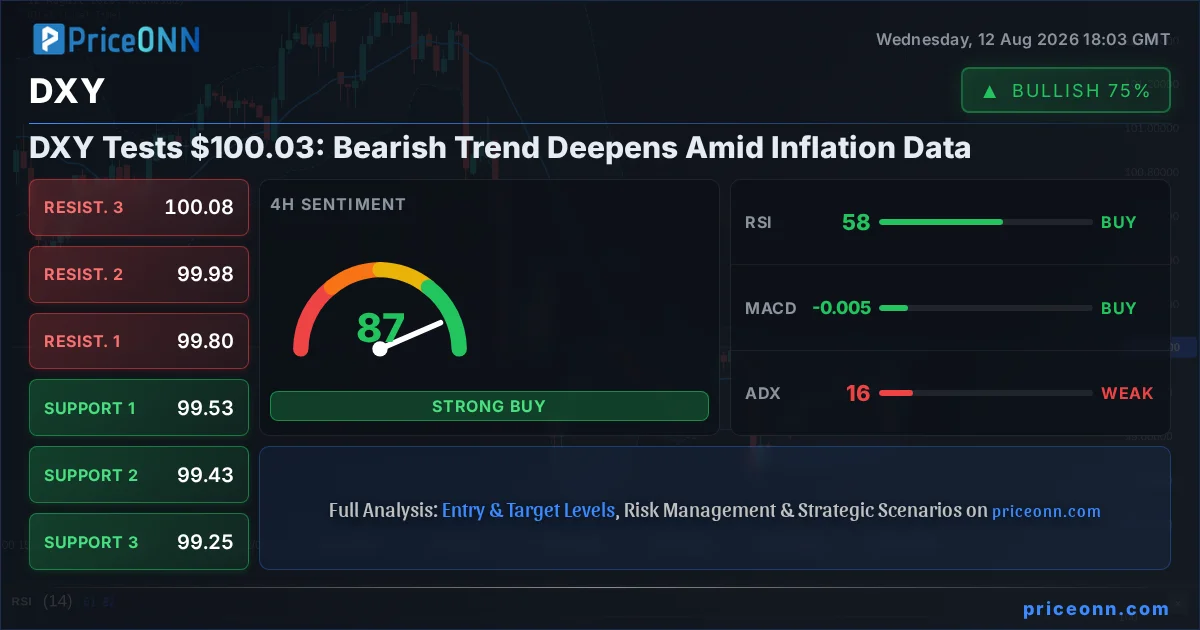
This moderation in inflation figures and the subsequent shift in rate hike expectations have significant implications for various asset classes. The cooling price environment, if sustained, could provide a more stable backdrop for equities, particularly for sectors sensitive to interest rate changes. Conversely, the reduced probability of a hike might temper the strength of the U.S. Dollar Index (DXY) as the interest rate differential with other major economies narrows.
Investors will be closely watching the ongoing developments in energy markets, as their volatility remains a key factor influencing overall inflation and Fed policy. Furthermore, the persistent rise in shelter costs, though currently modest, warrants continued attention as it remains a critical component of the inflation basket. The market's pricing for future rate moves, shifting from September to later in the year, suggests a potential for increased bond market activity and a reevaluation of fixed-income strategies.
Track markets in real-time
Empower your investment decisions with AI-powered analysis, technical indicators and real-time price data.
Join Our Telegram Channel
Get breaking market news, AI analysis and trading signals delivered instantly to your Telegram.
Join Channel PriceONN News
Readings for July on the prices consumers pay for goods and services came in pretty much on target.
PriceONN News
The consumer price index is expected to show only a modest increase for July.
PriceONN News
The consumer price index in June was expected to increase 3.8% from a year ago.
PriceONN News
The commentary pointed to a highly volatile environment in which purchasing managers were struggling to stay ahead
PriceONN News
The June Consumer Price Index (CPI) fell 0.4% on the month against consensus for a 0.1% decline, following May's 0.5% increase, and the annual rate dropped to 3.5% from 4.2%, well under the 3.8% forecast. Core prices were flat MoM and eased to 2.6% YoY versus 2.8% expected.
PriceONN News
Gold pushed toward $4,450 an ounce Tuesday, its best level in about two months, as a stalled U.S.-Iran deal to reopen the Strait of Hormuz kept oil elevated and traders braced for a Wednesday inflation report that could decide whether a September Fed rate hike is really off the table. Silver pushed above $65 for a second straight session, extending its climb to a seven-week high. The rally traces back to Friday's jobs report, which showed the U.S. economy shed 23,000 positions in July. That...
PriceONN News
Nonfarm payrolls were projected to increase by 83,000 in July while the unemployment rate held steady at 4.2%, according to the Dow Jones consensus.
PriceONN News
Nonfarm payrolls are expected to post a gain of just 83,000 with an unchanged unemployment rate at 4.2%.
PriceONN News
This week was mostly about the Federal Reserve rate decision and the artificial intelligence (AI) trade, along with some developments in the Iran conflict and major economic data.
PriceONN News
In five public appearances, Warsh has used the phrase "family fight" 13 times, returning to "first principles" 11 times and "inflation is a choice" for the Fed six times.
PriceONN News
Canada’s inflation has cooled a tad in June, with the Consumer Price Index (CPI) rising 2.8% from a year earlier, coming in below market expectations and down from the 3.2% increase recorded in May. On a monthly basis, prices declined by 0.4%.
PriceONN News
Nonfarm payrolls were expected to rise by 115,000 in June while the unemployment rate held steady at 4.3%.