
An inflation report Wednesday should be a big deal for the Fed. Here's what to expect
 PriceONN Editorial Desk
Multi-source verification
PriceONN Editorial Desk
Multi-source verification
Economic Thermometer Readings Due Wednesday
The impending release of the July Consumer Price Index (CPI) report on Wednesday morning is poised to be a significant data point for Federal Reserve policymakers navigating the complex terrain of inflation control. Expectations, as compiled by Dow Jones, point towards a subdued monthly rise of 0.1% for the headline inflation figure. Even more closely watched, the core CPI, which strips out volatile food and energy components, is projected to tick up by 0.2%.
On an annualized basis, these figures are anticipated to show a slight deceleration, with the overall CPI expected at 3.4% and the core rate at 2.5%. Both are forecast to be 0.1 percentage points lower than June's readings. While these projected numbers still significantly exceed the central bank's long-term 2% inflation target, two consecutive months of modest increases could provide the Federal Open Market Committee (FOMC) with a crucial window to pause its aggressive rate-hiking cycle.
“If the July CPI report aligns with forecasts, a majority of the committee will likely dismiss the supply side fluctuations, allowing the FOMC to maintain current interest rates for the remainder of the year,” stated Joe Brusuelas, chief economist at RSM. He further suggested that such data would offer “a measure of assistance” to Fed Chair Kevin Warsh, who has faced considerable policy headwinds since assuming his role.
Shifting Market Sentiments and Policy Crossroads
The FOMC's July meeting concluded with a narrow 9-3 decision to keep the benchmark interest rate steady within the 3.5%-3.75% range. The three dissenting votes advocated for a quarter percentage point hike, and Governor Lisa Cook has recently signaled her inclination towards further increases if inflation trends fail to cooperate. However, a recent string of less alarming economic indicators, coupled with easing geopolitical tensions in the Middle East, has prompted a recalibration of market expectations regarding future rate moves.
Current market pricing, as reflected by the CME's FedWatch gauge, now suggests only a 50-50 probability of a rate hike at the September meeting. The odds increase for potential rate adjustments in October or December. This recalibration highlights the delicate balance Fed officials are attempting to strike between curbing inflation and avoiding an unnecessary economic slowdown.
Fed officials will have the benefit of reviewing both the July and August inflation data before their next scheduled policy discussion. The central bank observes its customary August hiatus, with attention turning to the Kansas City Fed's annual symposium in Jackson Hole, Wyoming. Brusuelas wryly commented, “If you are not confused, you are not paying attention; that accurately describes our current situation in mid-August.”
The economy has experienced some welcome disinflationary signals following June's economic data. Headline inflation saw a monthly decrease of 0.4%, with the core rate remaining flat, largely attributed to falling energy prices and moderating shelter costs. Concurrently, a separate report indicated a decline of 23,000 nonfarm payrolls in July, although the unemployment rate still managed to dip to 4.1%.
Despite these potential indicators of a cooling labor market, some analysts are bracing for the possibility of an upside surprise in the July inflation figures or, at the very least, evidence that inflation remains too persistent for the Fed to disregard. For instance, Bank of America's economic team maintains its forecast for three additional rate increases in the coming months. They noted in a client communication that the July jobs report “did not alter the broader labor market picture; it remains stable. Crucially, the Fed’s policy response is heavily weighted toward inflation data, as recent commentary suggests.”
Should the Fed’s primary inflation metric average increases of 0.25% over the next two months, Bank of America anticipates that “a Fed rate hike in September becomes virtually certain.” Conversely, an average below 0.2% would push a hike further out, with figures in between making September a tossup. The decision would then hinge on Chair Warsh's stance, specifically whether recent reports indicating his openness to hikes are accurate, or if his earlier dovish remarks better reflect his policy leanings.
In a scenario where inflation data proves hotter than expected, Warsh could confront a committee inclined towards not just one, but multiple rate adjustments. The Federal Reserve historically tends to implement rate changes in increments rather than as isolated events. Cleveland Fed President Beth Hammack, who dissented in June, recently indicated her expectation that “multiple increases will likely be necessary.”
Market Ripple Effects
The upcoming July CPI report carries significant weight for the Federal Reserve's monetary policy trajectory. A mild reading, as anticipated, could bolster arguments for a pause in interest rate hikes, potentially offering relief to sectors sensitive to borrowing costs. Conversely, a hotter-than-expected print could reignite fears of persistent inflation, leading to renewed expectations of further tightening.
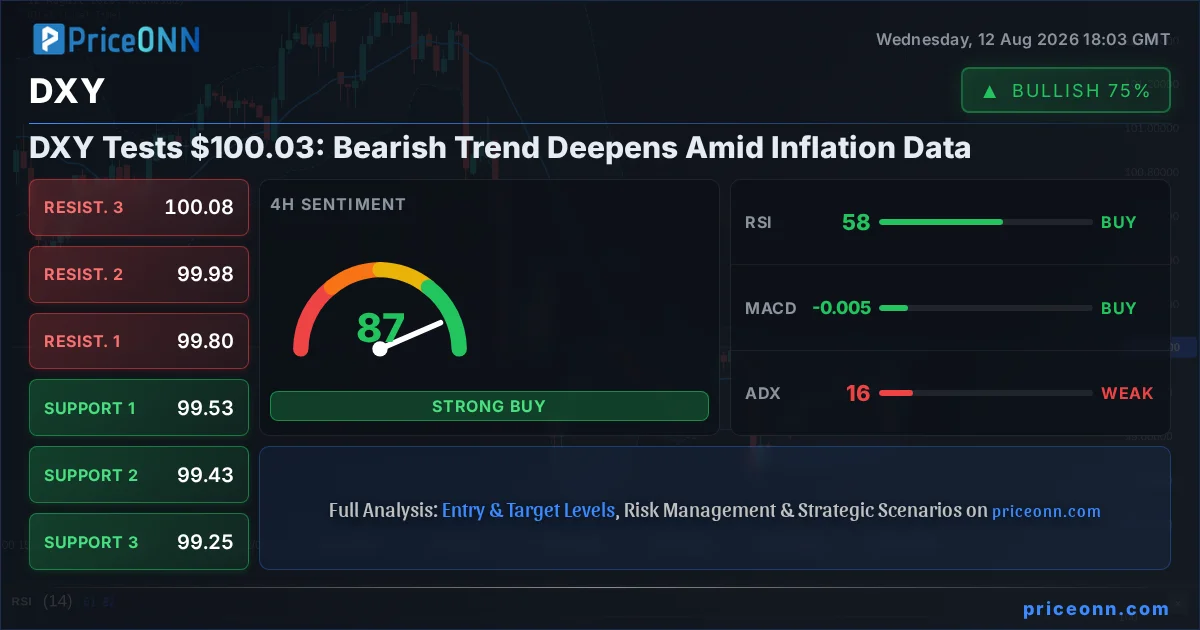
This development is closely watched by several key markets. The US Dollar Index (DXY) could see volatility depending on the Fed's perceived path forward. A dovish surprise might weaken the dollar, while hawkish signals would likely strengthen it. Bond markets, particularly the US 10-Year Treasury yield, are highly sensitive to inflation data and Fed policy expectations; lower inflation could lead to yield compression. Equity markets, especially growth-oriented sectors like technology stocks that benefit from lower interest rates, could react positively to a pause but negatively to renewed tightening fears. Finally, commodities, including Gold, often react inversely to dollar strength and interest rate expectations; a pause might support gold prices, while further hikes could pressure them.
Traders should monitor not only the headline and core CPI figures but also the underlying components for signs of persistent inflation, such as shelter costs. The market's reaction function will also depend on the Fed's communication following the data release. The key risk is a scenario where inflation proves more stubborn than anticipated, forcing the Fed into aggressive action that could spark recessionary concerns. Conversely, a sustained cooling trend could pave the way for a soft landing, benefiting risk assets.
Track markets in real-time
Empower your investment decisions with AI-powered analysis, technical indicators and real-time price data.
Join Our Telegram Channel
Get breaking market news, AI analysis and trading signals delivered instantly to your Telegram.
Join Channel PriceONN News
Readings for July on the prices consumers pay for goods and services came in pretty much on target.
PriceONN News
The consumer price index in June was expected to increase 3.8% from a year ago.
PriceONN News
The consumer price index was expected to increase 0.1% in July, with an annual rate of 3.4%.
PriceONN News
Nonfarm payrolls were projected to increase by 83,000 in July while the unemployment rate held steady at 4.2%, according to the Dow Jones consensus.
PriceONN News
The commentary pointed to a highly volatile environment in which purchasing managers were struggling to stay ahead
PriceONN News
In five public appearances, Warsh has used the phrase "family fight" 13 times, returning to "first principles" 11 times and "inflation is a choice" for the Fed six times.
PriceONN News
The June Consumer Price Index (CPI) fell 0.4% on the month against consensus for a 0.1% decline, following May's 0.5% increase, and the annual rate dropped to 3.5% from 4.2%, well under the 3.8% forecast. Core prices were flat MoM and eased to 2.6% YoY versus 2.8% expected.
PriceONN News
Gold pushed toward $4,450 an ounce Tuesday, its best level in about two months, as a stalled U.S.-Iran deal to reopen the Strait of Hormuz kept oil elevated and traders braced for a Wednesday inflation report that could decide whether a September Fed rate hike is really off the table. Silver pushed above $65 for a second straight session, extending its climb to a seven-week high. The rally traces back to Friday's jobs report, which showed the U.S. economy shed 23,000 positions in July. That...
PriceONN News
Nonfarm payrolls are expected to post a gain of just 83,000 with an unchanged unemployment rate at 4.2%.
PriceONN News
This week was mostly about the Federal Reserve rate decision and the artificial intelligence (AI) trade, along with some developments in the Iran conflict and major economic data.
PriceONN News
Canada’s inflation has cooled a tad in June, with the Consumer Price Index (CPI) rising 2.8% from a year earlier, coming in below market expectations and down from the 3.2% increase recorded in May. On a monthly basis, prices declined by 0.4%.
PriceONN News
According to a report from the US Department of Labour (DOL) released on Thursday, the number of US citizens submitting new applications for unemployment insurance shrank to 215K for the week ending July 4.