
Crude Oil Rebounds to $98 as Gulf War Escalation Trumps Supply Release


Crude oil prices staged a dramatic comeback, rebounding to $98.08 per barrel after initially plummeting to $92.04. The whipsaw price action reflects the market's struggle to reconcile conflicting signals from the ongoing Gulf War and the release of strategic petroleum reserves by multiple governments.
Market Context
The oil market has been highly volatile in recent weeks, whipsawed by geopolitical tensions and supply-side interventions. The current Gulf War, which began on February 28th, has disrupted oil and energy transit through the Strait of Hormuz, a critical chokepoint for global oil supplies. Initially, optimism surrounding potential ceasefire talks led to a sharp sell-off. However, those hopes were dashed by renewed threats and a hardening of positions from both sides, sending prices soaring once again.
Adding to the complexity, governments have released approximately 400 million barrels from their strategic petroleum reserves in a coordinated effort to stabilize prices. This is the largest emergency release ever attempted. The expectation was that this flood of supply would push prices down significantly. However, the impact has been muted, highlighting the severity of the underlying supply concerns.
Analysis & Drivers
The market's muted response to the strategic reserve release suggests that geopolitical risks are currently outweighing supply-side interventions. The closure of the Strait of Hormuz has created a significant bottleneck, and even a substantial release of reserves cannot fully compensate for the disruption of daily shipments. Industry reports indicate that the market is increasingly pricing in the possibility of a prolonged conflict, which would further strain global supply chains.
Conflicting statements from political leaders are also contributing to market volatility. Claims of an imminent surrender were contradicted by confirmations that Iran will continue blocking the Strait of Hormuz. This divergence of opinion has created uncertainty and fueled speculation about the war's duration. The market is now focused on assessing the credibility of each side's claims and anticipating the next escalation.
Analysts note that the long-held assumption of an oil glut has been challenged by the current crisis. The belief that abundant supply from US shale, Russian exports, and Iranian barrels would keep prices low has proven to be a fallacy. The market has been reminded of the fragility of global supply chains and the importance of geopolitical risk. Spare capacity remains thin, leaving the market vulnerable to further disruptions.
Trader Implications
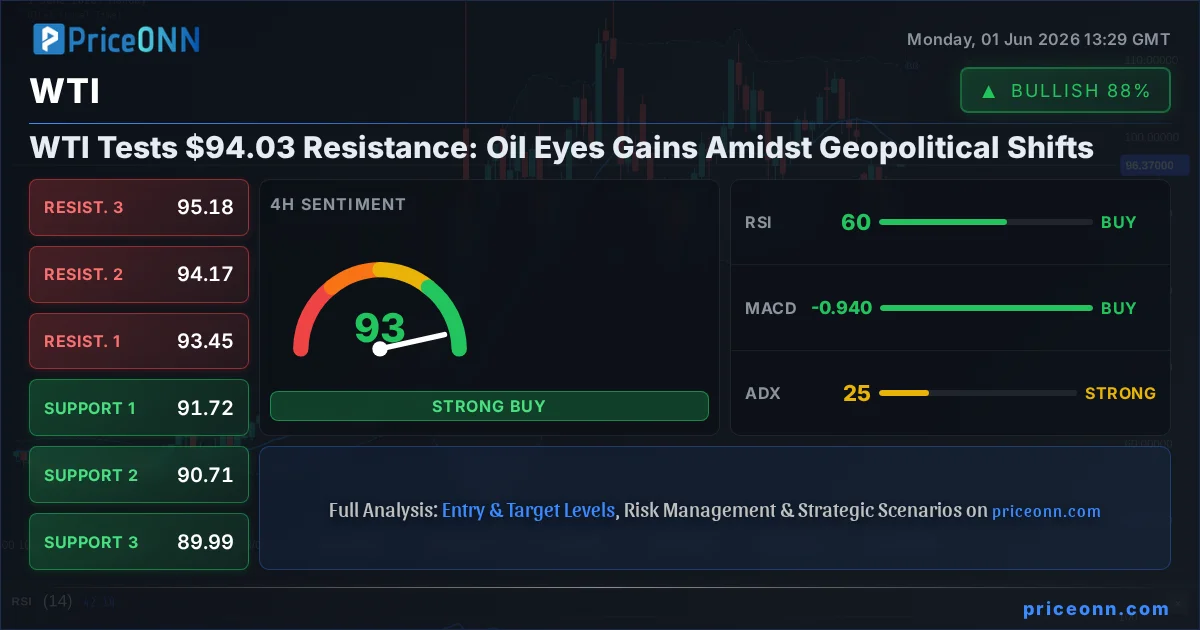
Traders should closely monitor developments in the Gulf War, paying attention to any signs of de-escalation or escalation. Key levels to watch include the recent high of $98.08, which represents a potential resistance level. A break above this level could signal further upside. On the downside, the previous low of $92.04 represents a key support level. A break below this level could lead to a deeper correction.
- Consider hedging strategies to protect against price volatility.
- Monitor news headlines and official statements for clues about the war's trajectory.
- Pay attention to inventory data and production reports to assess the actual supply situation.
Risk factors include a potential escalation of the conflict, which could lead to further supply disruptions and price spikes. Conversely, a breakthrough in negotiations could trigger a sharp sell-off. Traders should also be aware of the potential for further intervention from governments, either through additional reserve releases or diplomatic efforts.
The current market environment is characterized by high uncertainty and volatility. Traders should exercise caution and manage their positions carefully.
Looking ahead, the oil market is likely to remain highly sensitive to geopolitical developments. Upcoming events include further diplomatic talks and potential military actions. Market sentiment is currently leaning towards the expectation of a prolonged conflict, which could keep prices elevated. However, any signs of progress towards a resolution could trigger a significant correction. The market will also be closely watching for any changes in production levels from major oil-producing countries.
Track markets in real-time
Empower your investment decisions with AI-powered analysis, technical indicators and real-time price data.
Join Our Telegram Channel
Get breaking market news, AI analysis and trading signals delivered instantly to your Telegram.
Join Channel PriceONN News
Crude oil prices experienced a significant drop, with WTI futures falling over 1.8% to $87.25, as optimism grew for a U.S.-Iran deal potentially reopening the Strait of Hormuz.
PriceONN News
(RTTNews) - Crude oil prices have tumbled on Friday as expectations of the U.S. and Iran signing a Memorandum of Understanding run high. The MoU would allow for immediate reopening of the Strait of Hormuz and pave the way for the resumption of oil and energy trade.
PriceONN News
Crude oil futures experienced a dramatic intraday reversal on Thursday, soaring overnight on geopolitical fears only to pull back significantly as reports of a potential diplomatic understanding between the U.S. and Iran emerged.
PriceONN News
Global oil prices are treading water after a significant 5% slump, as market sentiment grapples with cautious optimism over Middle East de-escalation efforts versus lingering geopolitical uncertainties. Brent crude hovers near $104.72 and WTI near $98.07.
PriceONN News
Crude oil prices experienced a sharp decline, with WTI futures for July delivery falling 5.66% to $98.26. This drop is largely attributed to renewed diplomatic efforts aimed at de-escalating the U.S.-Iran conflict and easing tensions around the Strait of Hormuz.
PriceONN News
Crude oil prices experienced a significant downturn as market sentiment shifted towards optimism about a potential US-Iran Memorandum of Understanding that could reopen the Strait of Hormuz. WTI futures fell nearly 2% on the news.
PriceONN News
Crude oil futures experienced a dramatic intraday reversal, soaring to $92.52 before pulling back significantly on Thursday. The volatile session was driven by shifting geopolitical narratives and U.S. inventory data.
PriceONN News
Crude oil futures experienced a dramatic reversal, soaring overnight to $92.52 before plummeting nearly 6% to $89 a barrel. This volatility was driven by escalating US-Iran tensions followed by reports of a potential preliminary diplomatic understanding.
PriceONN News
(RTTNews) - Crude oil futures skyrocketed overnight but have shown a significant pullback over the course of the trading day on Thursday.
PriceONN News
(RTTNews) - Extending the losses from yesterday's session, crude oil prices have gone into freefall on Wednesday as investor expectations on a potential U.S.-Iran agreement continue to rise despite the U.S. refusing to ease its demands.
PriceONN News
(RTTNews) - Crude oil prices have tumbled on Tuesday as optimism about a U.S.-Iran peace deal that could lead to reopening of the Strait of Hormuz soon grows despite reports of fresh U.S. strikes on Iran yesterday.
PriceONN News
(RTTNews) - After surging early in the day, crude oil prices have tumbled over the course of the trading session on Thursday. With the downturn, crude oil is extending the losses from the two previous sessions, as investors watch the developments in U.S.-Iran peace talks.